
Now let’s implement streaming. OpenRouter supports Server-Sent Events (SSE) when stream: true, and the current Ruby SDK exposes Chat Completions streaming through stream_raw; its higher-level stream helper is not available in every released SDK version. (OpenRouter)
We’ll keep the implementation practical and compatible with the SDK behavior you’re using.
Step 9 – Stream the AI response
What changes?
Currently:
Browser
  ↓
POST
  ↓
Rails waits for entire LLM response
  ↓
redirect
We want:
Browser
  ↓
POST
  ↓
Rails
  ↓
OpenRouter SSE stream
  ↓
token
token
token
token
  ↓
Browser
SSE is a long-lived HTTP response where the server sends incremental events. OpenRouter explicitly supports this with stream: true.
9.1 First, prove streaming works from Ruby
Before involving Rails, modify Ai::Client temporarily with a method:
def stream_chat(messages:, &on_delta)
  stream = @client.chat.completions.stream_raw(
    model: MODEL,
    messages: messages
  )

  stream.each do |chunk|
    delta = chunk.choices.first&.delta&.content
    on_delta.call(delta) if delta.present?
  end
end
The current SDK’s stream_raw returns an enumerable stream of chat completion chunks. (RubyDoc)
Now from Rails console:
conversation = Conversation.first

messages = Ai::PromptBuilder
  .new(conversation: conversation)
  .build
Then:
Ai::Client.new.stream_chat(messages: messages) do |delta|
  print delta
  $stdout.flush
end
You should see the answer appearing progressively:
Ruby is a programming language...
instead of getting the entire answer at once.
Why $stdout.flush?
Ruby can buffer stdout. Flushing makes each chunk visible immediately in the console.
9.2 Now expose streaming from Rails
Instead of making MessagesController#create wait for the completed response, we’ll create a streaming endpoint.
Open:
config/routes.rb
Add:
resources :conversations, only: [:create, :show] do
  resources :messages, only: [:create]
end

get "/conversations/:conversation_id/messages/stream",
    to: "messages#stream",
    as: :conversation_messages_stream
9.3 Add the streaming controller action
Open:
app/controllers/messages_controller.rb
Add:
include ActionController::Live
and:
def stream
  conversation = Conversation.find(params[:conversation_id])

  response.headers["Content-Type"] = "text/event-stream"
  response.headers["Cache-Control"] = "no-cache"
  response.headers["X-Accel-Buffering"] = "no"

  sse = SSE.new(response.stream)

  messages = Ai::PromptBuilder
    .new(conversation: conversation)
    .build

  content = +""

  begin
    Ai::Client.new.stream_chat(messages: messages) do |delta|
      next if delta.blank?

      content << delta

      sse.write(
        { content: delta },
        event: "message"
      )
    end

    sse.write(
      { done: true },
      event: "done"
    )
  ensure
    sse.close
    response.stream.close
  end
end
But Rails doesn’t provide SSE automatically.
Add:
include ActionController::Live
and use Rails’ ActionController::Live::SSE if available in our Rails 8.1 setup, or otherwise we can use the standard SSE format directly. Rails 8.1’s Live controller infrastructure is the relevant mechanism here.
To avoid another dependency, let’s actually use the raw SSE format ourselves.
Replace the sse.write(...) parts with:
response.stream.write(
  "event: message\n" \
  "data: #{JSON.generate(content: delta)}\n\n"
)
and completion:
response.stream.write(
  "event: done\n" \
  "data: #{JSON.generate(done: true)}\n\n"
)
So the complete action becomes:
include ActionController::Live

def stream
  conversation = Conversation.find(params[:conversation_id])

  response.headers["Content-Type"] = "text/event-stream"
  response.headers["Cache-Control"] = "no-cache"
  response.headers["X-Accel-Buffering"] = "no"

  messages = Ai::PromptBuilder
    .new(conversation: conversation)
    .build

  begin
    Ai::Client.new.stream_chat(messages: messages) do |delta|
      next if delta.blank?

      response.stream.write(
        "event: message\n" \
        "data: #{JSON.generate(content: delta)}\n\n"
      )
    end

    response.stream.write(
      "event: done\n" \
      "data: #{JSON.generate(done: true)}\n\n"
    )
  rescue IOError
    # Browser disconnected.
  ensure
    response.stream.close
  end
end
9.4 What’s happening?
The server sends chunks like:
event: message
data: {"content":"Ruby"}

event: message
data: {"content":" is"}

event: message
data: {"content":" a"}

event: message
data: {"content":" programming"}
That’s SSE.
The browser doesn’t need to wait for the entire LLM response.
9.5 Important limitation
Our current stream action is only streaming the display.
We are not yet persisting the final assistant message.
That’s deliberate.
The next iteration will accumulate:
content << delta
and after the stream finishes:
conversation.messages.create!( role: :assistant, content: content, model: ..., input_tokens: ..., output_tokens: ...)
So we ultimately want:
LLM ↓stream chunks ↓Browser ↓accumulate full response ↓PostgreSQL
9.6 Browser side
We can consume SSE with JavaScript:
const source = new EventSource(
  `/conversations/${conversationId}/messages/stream`
);

let content = "";

source.addEventListener("message", (event) => {
  const data = JSON.parse(event.data);

  content += data.content;

  document.querySelector("#assistant-response").innerHTML =
    content;
});

source.addEventListener("done", () => {
  source.close();
});
For our application, we’ll eventually use a Stimulus controller rather than inline JavaScript.
9.7 Don’t spend time styling this
Our immediate objective is proving:
LLM → SSE → Browser
Once you can see the response arriving incrementally, we’ve achieved the important part.
9.8 Commit
Once Ruby streaming works:
git add app/services/ai/client.rbgit commit -m "feat: stream LLM responses"git push
Then we’ll wire the browser properly.
Int. knowledge from this step
You should now be able to explain:
What is SSE?
A persistent HTTP connection where the server pushes events to the client.
Why use it for AI?
Because LLM output naturally arrives incrementally, and streaming improves perceived latency.
Why not Action Cable?
WebSockets are bidirectional; SSE is simpler when the server primarily needs to push generated output to the browser.
Where does the LLM stream end?
At the Rails server, which consumes the provider’s SSE stream and forwards its own stream to the browser.
OpenRouter documents its AI streaming as SSE, while the Ruby SDK provides streaming chat-completion chunks through stream_raw.
Next step
Since ActionController::Live::SSE exists in Rails 8.1, let’s test the controller before committing.
One important point first: don’t test this through bin/rails server with WEBrick. Rails documents that WEBrick buffers responses, so Live streaming won’t behave correctly. Use our normal Puma server instead. (Ruby on Rails Guides)
1. First verify the route
Run:
bin/rails routes | grep stream
You should see our route, something like:
conversation_messages_streamGET /conversations/:conversation_id/messages/stream
Then get a conversation ID:
bin/rails c
Conversation.last.id
For example:
1
Exit:
exit
2. Test with curl first
This is the easiest way to prove that the Rails endpoint is actually streaming.
Start Rails with Puma:
bin/rails server
Then in another terminal:
curl -N \
  -H "Accept: text/event-stream" \
  http://localhost:3000/conversations/1/messages/stream
Replace 1 with your real conversation ID.
Why -N?
curl -N means:
Don’t buffer the response.
Without it, you may receive everything at once and incorrectly conclude that streaming isn’t working.
3. What you should see
Because we’re using ActionController::Live::SSE, our response should look roughly like:
event: messagedata: {"content":"Ruby"}event: messagedata: {"content":" is"}event: messagedata: {"content":" a"}event: messagedata: {"content":" programming"}event: donedata: {"done":true}
The exact chunks will vary.
The important thing is that the output arrives progressively, not as one giant response at the end.
Rails’ SSE helper formats events and data for the text/event-stream response. (Ruby on Rails API)
4. Very important: our current stream action has a logical problem
Our current endpoint is probably something like:
def stream
  conversation = Conversation.find(params[:conversation_id])

  response.headers["Content-Type"] = "text/event-stream"

  sse = ActionController::Live::SSE.new(response.stream)

  messages = Ai::PromptBuilder
    .new(conversation: conversation)
    .build

  Ai::Client.new.stream_chat(messages: messages) do |delta|
    sse.write({ content: delta }, event: "message")
  end

  sse.write({ done: true }, event: "done")
ensure
  sse.close
end
This can stream the existing conversation, but it doesn’t receive a new user question.
Eventually our endpoint needs something like:
POST /conversations/:id/messages/stream
with:
content=Explain Ruby blocks
Otherwise we’re streaming whatever messages already exist in the conversation.
So for this first test, we’re only proving:
Rails ↓ActionController::Live ↓SSE ↓Browser/curl
We’ll fix the request lifecycle immediately afterward.
5. Test directly from the browser
You can also open the endpoint in Chrome:
http://localhost:3000/conversations/1/messages/stream
But I prefer curl -N for the first test because the browser doesn’t give you a very useful raw view of SSE events.
Rails’ documentation uses essentially this same pattern – writing to response.stream periodically and closing the stream in ensure. (Ruby on Rails Guides)
One architectural correction before we commit
Don’t commit our current streaming implementation yet.
we’ll change the flow to the proper one:
Browser
   │
   │ POST message
   ▼
MessagesController
   │
   ├── save user message
   │
   ▼
LLM streaming
   │
   ├── SSE chunk → Browser
   ├── SSE chunk → Browser
   ├── SSE chunk → Browser
   │
   ▼
Complete response
   │
   ▼
Save assistant message
That is the version worth keeping in our portfolio and discussing in an int. scenario. Rails requires the response headers to be set before the first stream write and requires the stream to be closed when finished. (Ruby on Rails API)
the next step will be to connect the actual user message → streaming endpoint → browser UI rather than having a standalone stream endpoint.
Debug:ActionController::Live::ClientDisconnected – 500 Internal Server Error
Yes – very likely from our rescue behavior, but the deeper issue is that ActionController::Live::ClientDisconnected is not the same exception as IOError in Rails 8.1.
Rails 8.1 explicitly has:
ActionController::Live::ClientDisconnected
as its own exception class. (Ruby on Rails API)
So this:
rescue IOError # Browser disconnected
does not necessarily catch the exception you’re seeing.
Why the 500 appears
Our stream is working, then eventually the client closes the connection – or example:
- browser finishes and closes the SSE connection
EventSource.close()is called- browser navigates/reloads
- user closes the tab
- network connection disappears
Rails detects that the client is gone while processing the Live response and raises:
ActionController::Live::ClientDisconnected
Rails’ Live processing happens in a separate thread, and once the response has been committed Rails handles exceptions differently from a normal controller request. (Ruby on Rails API)
Fix our rescue
add:
rescue ActionController::Live::ClientDisconnected Rails.logger.info("SSE client disconnected")
You can optionally also handle IOError:
rescue ActionController::Live::ClientDisconnected, IOError Rails.logger.info("SSE client disconnected")
And keep:
ensure sse.closeend
So our action should have roughly:
begin # streaming logicrescue IOError Rails.logger.debug(">>>>>>>>>>>>>> Error Occured: IOError")rescue ActionController::Live::ClientDisconnected Rails.logger.debug(">>>>>>>>>>>>>> SSE client disconnected")ensure sse.closeend
But there is an important point
Don’t interpret ClientDisconnected as an application failure.
It’s closer to:
Rails: "I'm streaming."Browser: "I'm no longer listening."Rails: "Okay."
For SSE, that’s a normal lifecycle event.
Why you’re seeing Completed 500
This is the part that initially looks strange.
With ActionController::Live, Rails starts processing the action in a separate thread. When an exception occurs after the response has already been committed/started streaming, Rails can’t behave like a normal controller request with a fresh 500 response. Rails’ Live implementation has special handling for committed responses and closes the stream after logging the exception.
So our log can be misleading:
Completed 500 Internal Server ErrorActionController::Live::ClientDisconnected
even though:
- the user received the streamed answer successfully,
- the connection closed normally afterward.
That’s exactly why I would treat ClientDisconnected separately from genuine application errors.
Fix Streaming issue: After entering the question the page get stuck
Our server logs are as follows:

Started POST "/conversations"
Processing by ConversationsController#create as TURBO_STREAM
Parameters: {"...., "conversation" => {"title" => "Tell me about Node js"}, "commit" => "Start conversation"}

Then goes to
Started GET "/conversations/13"
Processing by ConversationsController#show as TURBO_STREAM
Parameters: {"id" => "13"}
Rendering conversations/show.html.erb
200 OK
Then the page stuck on the Form: form_with in the conversations/show.html.erb.
the div streaming-response is blank and it is not going to messages controller#stream or I think it is not executing the chat_controller.js also.
Yes – the server logs strongly suggest the problem is before MessagesController#stream. The conversation page loads correctly, then the form submission isn’t triggering our Stimulus chat#submit.
The likely culprit is Turbo + Stimulus registration, not SSE.
Let’s debug it quickly in the right order.
1. First confirm Stimulus is actually loading
Open your browser DevTools → Console.
Put this temporarily at the top of:
app/javascript/controllers/chat_controller.js
import { Controller } from "@hotwired/stimulus"

console.log("chat_controller.js loaded")

export default class extends Controller {
  connect() {
    console.log("Chat controller connected")
  }

  submit(event) {
    console.log("Chat submit triggered")
    // existing code...
  }
}
Reload:
http://localhost:3000/conversations/13
You should see:
chat_controller.js loadedChat controller connected
If you don’t see these
Then the problem is Stimulus registration/import, not the form.
2. Check your Stimulus setup
Because you’re using Rails 8.1, check:
app/javascript/controllers/index.js
It should contain something similar to:
import { application } from "controllers/application"import ChatController from "controllers/chat_controller"application.register("chat", ChatController)
Depending on the Rails 8 application template/setup, your index.js may use automatic controller loading instead. The important thing is that chat_controller.js is being registered under:
chat
3. Check application.js
Open:
app/javascript/application.js
You should have the normal Rails setup, typically something along the lines of:
import "@hotwired/turbo-rails"import "controllers"
The important line is:
import "controllers"
Without it, your Stimulus controllers won’t be registered.
4. Check the actual HTML generated by Rails
This is very important.
Inspect the form in Chrome DevTools.
You should see:
<form
  data-controller="chat"
  data-action="submit->chat#submit"
  ...
>
If you don’t see:
data-controller="chat"
then our view isn’t producing the attributes we expect.
Our form should look approximately like:
<%= form_with(
  url: conversation_messages_path(@conversation),
  method: :post,
  data: {
    controller: "chat",
    action: "submit->chat#submit"
  }
) do |form| %>
5. There is another issue in our previous implementation
This is important.
We currently have:
<%= form_with(... method: :post) %>
but the Stimulus controller is trying to create:
GET /conversations/:id/messages/stream
That means the normal Turbo form submission and our SSE request are two different mechanisms.
We don’t actually want Turbo submitting the form at all.
Let Stimulus own the submission.
Change the form to:
<%= form_with(
  url: conversation_messages_path(@conversation),
  method: :post,
  data: {
    controller: "chat",
    action: "submit->chat#submit",
    turbo: false
  }
) do |form| %>

  <%= form.text_area :content,
      rows: 4,
      placeholder: "Ask something..." %>

  <%= form.submit "Send" %>
<% end %>

<div id="streaming-response"></div>
The important addition is:
turbo: false
This prevents Turbo from hijacking the form submission.
6. But there’s a second problem: EventSource
Our previous controller used:
const source = new EventSource(streamUrl)
That means the browser makes:
GET /conversations/13/messages/stream
and that endpoint expects:
params[:content]
So the URL must contain:
?content=Tell+me+about+Node+js
Let’s make the controller simpler and more reliable.
Use:
app/javascripts/controllers/chat_controller.js
import { Controller } from "@hotwired/stimulus"

console.log("chat_controller.js loaded")

export default class extends Controller {
  connect() {
    console.log("Chat controller connected")
  }

  submit(event) {
    console.log("Chat submit triggered")

    event.preventDefault()

    const form = event.currentTarget
    const url = form.action
    const formData = new FormData(form)

    const responseElement = document.querySelector("#streaming-response")
    responseElement.textContent = ""

    const conversationId = url.match(/conversations\/(\d+)\/messages/)[1]
    const streamUrl =
      `/conversations/${conversationId}/messages/stream?${new URLSearchParams(
          formData
        )}`

    const source = new EventSource(streamUrl)
    source.addEventListener("message", (event) => {
      const data = JSON.parse(event.data)

      responseElement.textContent += data.content
    })

    source.addEventListener("done", () => {
      source.close()

      // Reload for now so the persisted assistant message appears.
      window.location.reload()
    })

    source.onerror = () => {
      source.close()
      responseElement.textContent += "\n\n[AI stream disconnected]"
    }
  }
}
7. Verify the route
Run:
bin/rails routes | grep messages
You should have something like:
conversation_messagesconversation_messages_stream
Specifically:
GET /conversations/:conversation_id/messages/stream
If you don’t have that route, the browser will never reach:
MessagesController#stream
8. Test the route independently
Before testing Stimulus, prove the endpoint itself still works:
curl -N \ -H "Accept: text/event-stream" \ "http://localhost:3000/conversations/13/messages/stream?content=Explain%20Node.js"
Since you already confirmed SSE works, this should still stream.
9. Then test the browser
Reload the conversation page and open DevTools → Console.
When the page loads:
Chat controller connected
When you submit:
Chat submit triggered
Then open DevTools → Network.
You should see:
GET /conversations/13/messages/stream?content=...
and its response should remain open while the AI streams.
If you see that request, the pipeline is working:
Form ↓Stimulus ↓EventSource ↓GET /messages/stream ↓MessagesController#stream ↓LLM ↓SSE ↓Browser
10. Why our current log looks the way it does
You currently see:
POST /conversations ↓GET /conversations/13 ↓Rendering conversations/show ↓200 OK
and nothing afterward.
That means:
Rails page rendering ✅Stimulus submit ❌
The fact that we don’t see:
Started GET "/conversations/13/messages/stream"
is the strongest clue.
So don’t debug ActionController::Live or OpenRouter yet.
The problem is almost certainly:
Stimulus controller registration ORTurbo intercepting the form ORdata-controller/data-action not present
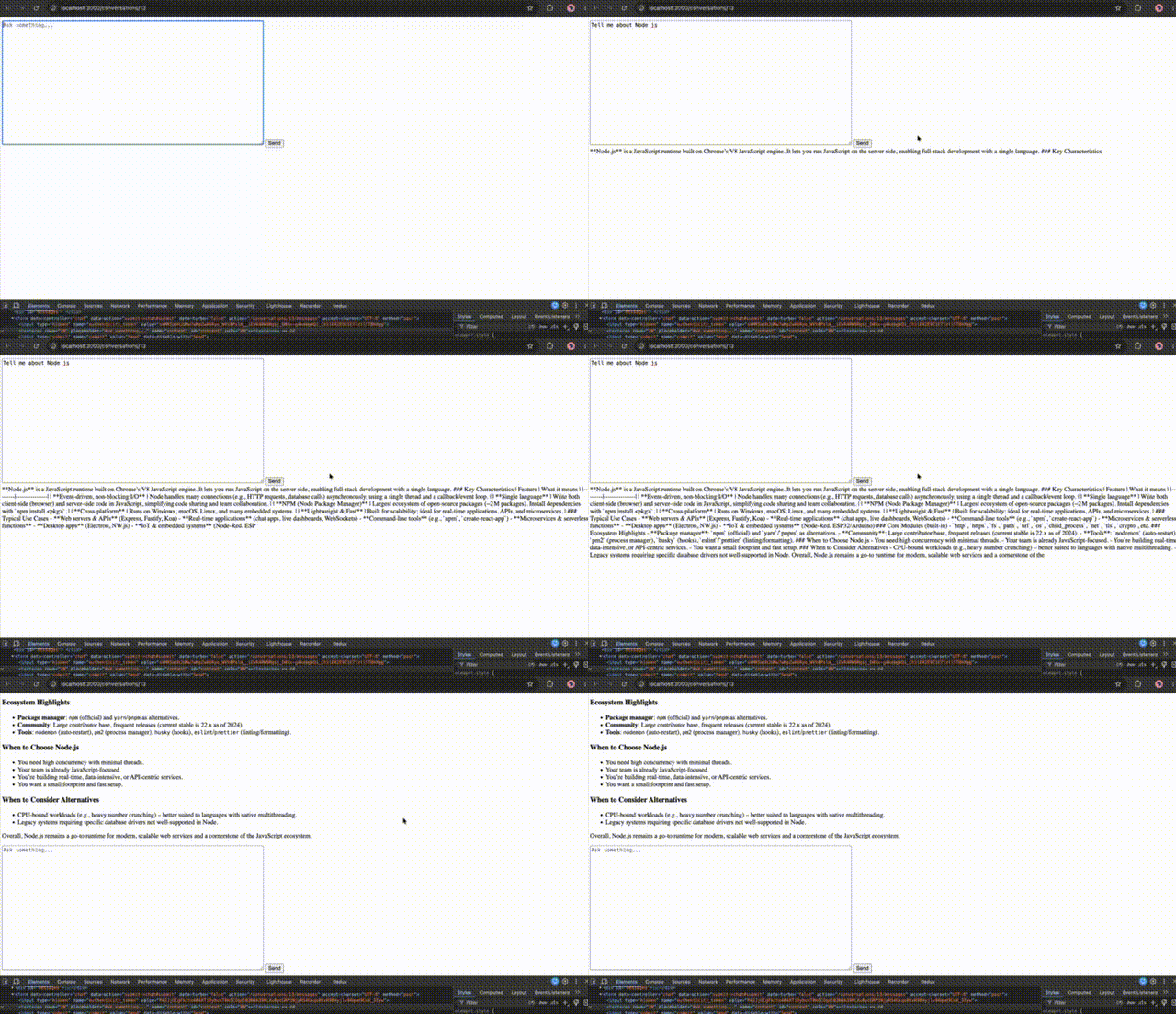
Cheers! We solved it.
Recommended architectural change (Optional)
One option is we can stop using EventSource with a GET query parameter for the actual chat request.
It’s fine for learning SSE, but for a real AI application, sending the user prompt as:
GET /messages/stream?content=...
isn’t ideal.
We’ll eventually use:
POST /conversations/:id/messages
with fetch() and consume the streaming response body:
POST ↓Rails ↓LLM stream ↓ReadableStream ↓Browser
We have to keep the user’s message in the POST body and have a single request lifecycle.
But this make our current app/javascript/controllers/chat_controller.js to re-write completely. So let’s move on to the next step ASAP.
to be continued…


