Guide: Integrating React โš›๏ธ into a Railsย 8 Application โ€“ Partย 3 | Start developing react

Let’s move on to quick development of more react components now. Before that let’s check what we have now and understand it very clear.

๐Ÿ“„ File 1:

Our app/javascript/components/App.jsx file:

import React from 'react';

function App() {
  return (
    <div>
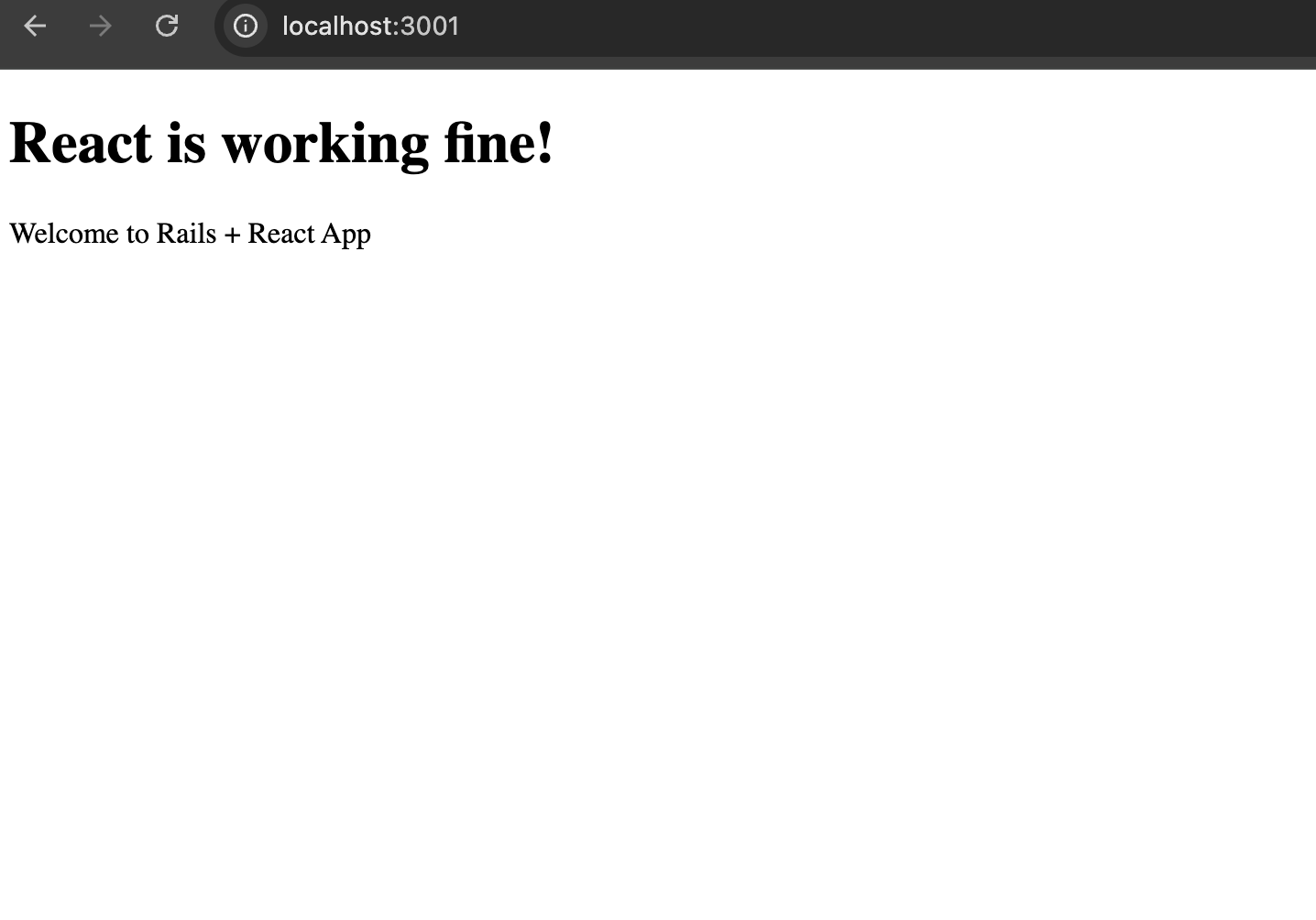
      <h1>React is working fine!</h1>
      <p>Welcome to Rails + React App</p>
    </div>
  );
}

export default App;

Let’s examine this React component step by step:

Line 1: Import React

import React from 'react';
  • import – ES6 module syntax to bring in external code
  • React – The main React library
  • from 'react' – Importing from the npm package named “react”
  • Why needed? Even though we use --jsx=automatic, we still import React for any hooks or React features we might use.

Function Component: Line 3-9

A React function component is a simple JavaScript function that serves as a building block for user interfaces in React applications. These components are designed to be reusable and self-contained, encapsulating a specific part of the UI and its associated logic.

function App() {
  return (
    <div>
      <h1>React is working fine!</h1>
      <p>Welcome to Rails + React App</p>
    </div>
  );
}

๐Ÿ” Breaking this down:

Line 3: Component Declaration

function App() {
  • function App() – This is a React Function Component
  • Component naming – Must start with capital letter (App, not app)
  • What it is – A JavaScript function that returns JSX (user interface)

Line 4-8: JSX Return

return (
  <div>
    <h1>React is working fine!</h1>
    <p>Welcome to Rails + React App</p>
  </div>
);
  • return – Every React component must return something
  • JSX – Looks like HTML, but it’s actually JavaScript
  • <div> – Must have one parent element (React Fragment rule)
  • <h1> & <p> – Regular HTML elements, but processed by React

Line 11: Export

export default App;
  • export default – ES6 syntax to make this component available to other files
  • App – The component name we’re exporting
  • Why needed? So application.js can import and use this component

๐Ÿ“„ File 2:

Our app/javascript/application.js file:

// Entry point for the build script in your package.json
import React from 'react';
import { createRoot } from 'react-dom/client';
import App from './components/App';

document.addEventListener('DOMContentLoaded', () => {
  const container = document.getElementById('react-root');

  if(container) {
    const root = createRoot(container);
    root.render(<App />);
  }
});

This is the entry point that connects React to your Rails app:

    Imports: Line 2-4

    import React from 'react';
    import { createRoot } from 'react-dom/client';
    import App from './components/App';
    

    ๐Ÿ” Breaking down each import:

    Line 2:

    import React from 'react';
    
    • Same as before – importing the React library

    Line 3:

    import { createRoot } from 'react-dom/client';
    
    • { createRoot }Named import (notice the curly braces)
    • react-dom/client – ReactDOM library for browser/DOM manipulation
    • createRoot – New React 18+ API for rendering components to DOM

    Line 4:

    import App from './components/App';
    
    • AppDefault import (no curly braces)
    • ./components/App – Relative path to our App component
    • Note: We don’t need .jsx extension, esbuild figures it out

    DOM Integration: Line 6-12

    document.addEventListener('DOMContentLoaded', () => {
      const container = document.getElementById('react-root');
    
      if(container) {
        const root = createRoot(container);
        root.render(<App />);
      }
    });
    

    ๐Ÿ” Step by step breakdown:

    Line 6:

    document.addEventListener('DOMContentLoaded', () => {
    
    • document.addEventListener – Standard browser API
    • 'DOMContentLoaded' – Wait until HTML is fully loaded
    • () => { – Arrow function (ES6 syntax)
    • Why needed? Ensures the HTML exists before React tries to find elements

    Line 7:

    const container = document.getElementById('react-root');
    
    • const container – Create a variable to hold the DOM element
    • document.getElementById('react-root') – Find HTML element with id="react-root"
    • Where is it? In your Rails view file: app/views/home/index.html.erb

    Line 9:

    if(container) {
    
    • Safety check – Only proceed if the element exists
    • Prevents errors – If someone visits a page without react-root element

    Line 10-11:

    const root = createRoot(container);
    root.render(<App />);
    
    • createRoot(container) – Create a React “root” at the DOM element
    • root.render(<App />) – Render our App component inside the container
    • <App /> – JSX syntax for using our component (self-closing tag)

    ๐ŸŽฏ Key React Concepts You Just Learned:

    1. Components

    • Functions that return JSX
    • Must start with capital letter
    • Reusable pieces of UI

    2. JSX

    • Looks like HTML, actually JavaScript
    • Must return single parent element
    • Processed by esbuild into regular JavaScript

    3. Import/Export

    • Default exports: export default App โ†’ import App from './App'
    • Named exports: export { createRoot } โ†’ import { createRoot } from 'package'

    4. React DOM

    • createRoot() – Modern way to mount React apps (React 18+)
    • render() – Display components in the browser

    5. Rails Integration

    • Rails serves the HTML page
    • React takes over the #react-root element
    • esbuild bundles everything together

    ๐Ÿš€ This pattern is the foundation of every React app! We create components, import them, and render them to the DOM.


    ๐Ÿ“š Step-by-Step React Learning with Todo List

    Now let’s build a Todo List app step by step. I’ll explain each React concept thoroughly as we go. Here’s our learning roadmap:

    Step 1: Understanding JSX and Basic Component Structure

    First, let’s update our App.jsx to create the basic structure of our Todo app:

    import React from 'react';
    
    function App() {
      return (
        <div className="todo-app">
          <h1>My Todo List</h1>
          <p>Let's learn React by building a todo app!</p>
    
          {/* This is a JSX comment */}
          <div className="todo-container">
            <h2>Add a new todo</h2>
            <input type="text" placeholder="Enter a todo..." />
            <button>Add Todo</button>
    
            <h2>My Todos</h2>
            <ul>
              <li>Learn React basics</li>
              <li>Build a todo app</li>
              <li>Master React hooks</li>
            </ul>
          </div>
        </div>
      );
    }
    
    export default App;
    

    ๐ŸŽฏ Key Concepts Explained:

    JSX (JavaScript XML):

    • JSX lets you write HTML-like syntax directly in JavaScript
    • It’s a syntax extension for JavaScript, not actual HTML
    • JSX gets compiled to JavaScript function calls
    • You can use {} to embed JavaScript expressions inside JSX

    Important JSX Rules:

    • Use className instead of class (because class is a reserved word in JavaScript)
    • You can use single quotes for className values in JSX. Both work perfectly fine:
    // Both of these are valid:
    <div className='todo-app'>    // Single quotes โœ…
    <div className="todo-app">    // Double quotes โœ…
    

    Quote Usage in JSX/JavaScript:

    Single quotes vs Double quotes:

    • JavaScript treats them identically
    • It’s mostly a matter of personal/team preference
    • The key is to be consistent throughout your project

    Common conventions:

    // Option 1: Single quotes for JSX attributes
    <div className='todo-app'>
      <input type='text' placeholder='Enter todo...' />
    </div>
    
    // Option 2: Double quotes for JSX attributes  
    <div className="todo-app">
      <input type="text" placeholder="Enter todo..." />
    </div>
    
    // Option 3: Mixed (but stay consistent within each context)
    const message = 'Hello World';  // Single for JS strings
    <div className="todo-app">      // Double for JSX attributes
    

    When you MUST use specific quotes:

    // When the string contains the same quote type
    <div className="It's a great day">        // Double quotes needed
    <div className='He said "Hello"'>        // Single quotes needed
    
    // Or use escape characters
    <div className='It\'s a great day'>       // Escaping single quote
    <div className="He said \"Hello\"">      // Escaping double quote
    

    ๐Ÿ’ก Tip: Many teams use tools like Prettier or ESLint to automatically format and enforce consistent quote usage across the entire project.

    • All tags must be closed (self-closing tags need / at the end)
    • JSX comments use {/* */} syntax
    • Return a single parent element (or use React Fragment <>...</>)

    Try updating our App.jsx with this code and see it in your browser!


    Step 2: Introduction to State with useState

    Now let’s add state to make our app interactive. State is data that can change over time.

    import React, { useState } from 'react';
    
    function App() {
      // useState Hook - creates state variable and setter function
      const [todos, setTodos] = useState([
        { id: 1, text: 'Learn React basics', completed: false },
        { id: 2, text: 'Build a todo app', completed: false },
        { id: 3, text: 'Master React hooks', completed: true }
      ]);
    
      const [inputValue, setInputValue] = useState('');
    
      return (
        <div className="todo-app">
          <h1>My Todo List</h1>
    
          <div className="todo-container">
            <h2>Add a new todo</h2>
            <input 
              type="text" 
              placeholder="Enter a todo..." 
              value={inputValue}
              onChange={(e) => setInputValue(e.target.value)}
            />
            <button>Add Todo</button>
    
            <h2>My Todos ({todos.length})</h2>
            <ul>
              {todos.map(todo => (
                <li key={todo.id}>
                  {todo.text} {todo.completed ? 'โœ…' : 'โณ'}
                </li>
              ))}
            </ul>
          </div>
        </div>
      );
    }
    
    export default App;
    

    ๐ŸŽฏ Key Concepts Explained:

    useState Hook:

    • useState is a React Hook that lets you add state to functional components
    • It returns an array with two elements: [currentValue, setterFunction]
    • const [todos, setTodos] = useState([]) creates a state variable todos and a function setTodos to update it
    • The initial value is passed as an argument to useState

    Controlled Components:

    • The input field is now “controlled” by React state
    • value={inputValue} makes the input show what’s in state
    • onChange={(e) => setInputValue(e.target.value)} updates state when user types

    Array.map() for Rendering Lists:

    • todos.map() transforms each todo into a JSX element
    • Each list item needs a unique key prop for React’s optimization
    • {todo.text} embeds the todo text using JSX expressions

    Try this code and notice how the input field now responds to typing!


    Step 3: Event Handling and Adding Todos

    Let’s make the “Add Todo” button work:

    import React, { useState } from 'react';
    
    function App() {
      const [todos, setTodos] = useState([
        { id: 1, text: 'Learn React basics', completed: false },
        { id: 2, text: 'Build a todo app', completed: false },
        { id: 3, text: 'Master React hooks', completed: true }
      ]);
    
      const [inputValue, setInputValue] = useState('');
    
      // Function to add a new todo
      const addTodo = () => {
        if (inputValue.trim() !== '') {
          const newTodo = {
            id: Date.now(), // Simple ID generation
            text: inputValue,
            completed: false
          };
    
          setTodos([...todos, newTodo]); // Spread operator to add new todo
          setInputValue(''); // Clear the input field
        }
      };
    
      // Function to handle Enter key press
      const handleKeyPress = (e) => {
        if (e.key === 'Enter') {
          addTodo();
        }
      };
    
      return (
        <div className="todo-app">
          <h1>My Todo List</h1>
    
          <div className="todo-container">
            <h2>Add a new todo</h2>
            <input 
              type="text" 
              placeholder="Enter a todo..." 
              value={inputValue}
              onChange={(e) => setInputValue(e.target.value)}
              onKeyPress={handleKeyPress}
            />
            <button onClick={addTodo}>Add Todo</button>
    
            <h2>My Todos ({todos.length})</h2>
            <ul>
              {todos.map(todo => (
                <li key={todo.id}>
                  {todo.text} {todo.completed ? 'โœ…' : 'โณ'}
                </li>
              ))}
            </ul>
          </div>
        </div>
      );
    }
    
    export default App;
    

    ๐ŸŽฏ Key Concepts Explained:

    Event Handlers:

    • onClick={addTodo} – function runs when button is clicked
    • onKeyPress={handleKeyPress} – function runs when key is pressed
    • Event handlers receive an event object (e) with information about the event

    State Updates:

    • setTodos([...todos, newTodo]) – creates a new array with all existing todos plus the new one
    • Important: Always create new arrays/objects instead of mutating existing ones
    • React compares old and new state to determine if re-render is needed

    Spread Operator (...):

    • ...todos spreads out all elements of the todos array
    • This is the React way to add items to an array in state

    Try adding new todos now!

    ๐ŸŽฏ Function Syntax Options in JavaScript:

    const addTodo = () => {} is a function syntax – specifically an arrow function. Let me explain why it’s declared as const and the different ways to write functions in JavaScript.

    1. Function Declaration (Traditional)
    function addTodo() {
      // function body
    }
    
    2. Function Expression with Arrow Function
    const addTodo = () => {
      // function body
    };
    
    3. Function Expression (Traditional)
    const addTodo = function() {
      // function body
    };
    

    ๐Ÿค” Why use const for functions?

    Arrow functions are expressions, not declarations:

    // This is a DECLARATION - creates a function named addTodo
    function addTodo() { }
    
    // This is an EXPRESSION - creates a function and assigns it to a variable
    const addTodo = () => { };
    

    Why const specifically?

    // โŒ Could be reassigned accidentally
    let addTodo = () => { };
    addTodo = "oops"; // Function is now gone!
    
    // โŒ Could be reassigned accidentally  
    var addTodo = () => { };
    addTodo = null; // Function is now gone!
    
    // โœ… Cannot be reassigned - prevents bugs
    const addTodo = () => { };
    addTodo = "something"; // ERROR: Assignment to constant variable
    

    ๐Ÿ“š Key Differences:

    Function Declaration vs Arrow Function:

    // Function Declaration
    function addTodo() {
      console.log("Adding todo");
    }
    
    // Arrow Function (assigned to const)
    const addTodo = () => {
      console.log("Adding todo");
    };
    

    Hoisting Behavior:

    // โœ… This works - function declarations are "hoisted"
    sayHello(); // "Hello!"
    
    function sayHello() {
      console.log("Hello!");
    }
    
    // โŒ This doesn't work - arrow functions are not hoisted
    sayGoodbye(); // Error: Cannot access 'sayGoodbye' before initialization
    
    const sayGoodbye = () => {
      console.log("Goodbye!");
    };
    

    this Binding:

    // Function declaration has its own 'this'
    function regularFunction() {
      console.log(this); // 'this' can change based on how it's called
    }
    
    // Arrow function inherits 'this' from surrounding scope
    const arrowFunction = () => {
      console.log(this); // 'this' is inherited from parent scope
    };
    

    ๐Ÿš€ In React Context:

    In React functional components, we typically use arrow functions with const because:

    1. Prevents accidental reassignment – our function won’t get overwritten
    2. Consistent with modern JavaScript – ES6+ standard
    3. Cleaner syntax – less verbose than traditional function expressions
    4. Better for event handlersthis behavior is more predictable

    All these are equivalent in React:

    // Option 1: Arrow function with const (most common)
    const addTodo = () => {
      if (inputValue.trim() !== '') {
        // ... logic
      }
    };
    
    // Option 2: Traditional function declaration
    function addTodo() {
      if (inputValue.trim() !== '') {
        // ... logic  
      }
    }
    
    // Option 3: Function expression with const
    const addTodo = function() {
      if (inputValue.trim() !== '') {
        // ... logic
      }
    };
    

    ๐Ÿ’ก Why React developers prefer arrow functions:

    1. Shorter syntax for simple functions
    2. Consistent variable declaration (everything uses const)
    3. No hoisting confusion – functions are defined before they’re used
    4. Better with modern tooling – ESLint, Prettier handle them well

    So yes, const addTodo = () => {} is definitely a function! It’s just a modern way to write functions that prevents accidental reassignment and has cleaner syntax.

    ๐ŸŽฏ What is Hoisting?

    Hoisting is a fundamental JavaScript concept that can be confusing at first. Let me explain it clearly with examples.

    Hoisting is JavaScript’s behavior of moving declarations to the top of their scope during the compilation phase, before the code is executed.

    Think of it like JavaScript “hoists” (lifts up) your variable and function declarations to the top of their scope.

    ๐Ÿ“š How Hoisting Works:

    Function Declarations are Hoisted:

    // This works even though we call the function before declaring it!
    sayHello(); // Outputs: "Hello!"
    
    function sayHello() {
      console.log("Hello!");
    }
    

    Behind the scenes, JavaScript treats it like this:

    // JavaScript internally reorganizes it like this:
    function sayHello() {
      console.log("Hello!");
    }
    
    sayHello(); // Now it makes sense!
    

    Variable Declarations (with var) are Hoisted:

    console.log(myVar); // Outputs: undefined (not an error!)
    var myVar = "Hello";
    console.log(myVar); // Outputs: "Hello"
    

    Behind the scenes:

    // JavaScript internally treats it like this:
    var myVar; // Declaration is hoisted to the top
    console.log(myVar); // undefined (declared but not assigned)
    myVar = "Hello"; // Assignment stays in place
    console.log(myVar); // "Hello"
    

    ๐Ÿšซ What is NOT Hoisted:

    let and const variables:

    // โŒ This throws an error!
    console.log(myLet); // ReferenceError: Cannot access 'myLet' before initialization
    let myLet = "Hello";
    
    // โŒ This also throws an error!
    console.log(myConst); // ReferenceError: Cannot access 'myConst' before initialization
    const myConst = "Hello";
    

    Arrow Functions (Function Expressions):

    // โŒ This throws an error!
    sayGoodbye(); // ReferenceError: Cannot access 'sayGoodbye' before initialization
    
    const sayGoodbye = () => {
      console.log("Goodbye!");
    };
    

    Function Expressions:

    // โŒ This throws an error!
    myFunc(); // TypeError: myFunc is not a function
    
    var myFunc = function() {
      console.log("Hello!");
    };
    

    ๐ŸŽญ Visual Examples:

    Example 1: Function Declaration Hoisting

    // What you write:
    console.log("1. Start");
    myFunction(); // This works!
    console.log("3. End");
    
    function myFunction() {
      console.log("2. Inside function");
    }
    
    // Output:
    // 1. Start
    // 2. Inside function  
    // 3. End
    

    Example 2: Variable Hoisting with var

    // What you write:
    console.log("Value is:", myVar); // undefined
    var myVar = 42;
    console.log("Value is:", myVar); // 42
    
    // What JavaScript internally does:
    var myVar; // Hoisted to top
    console.log("Value is:", myVar); // undefined
    myVar = 42; // Assignment stays here
    console.log("Value is:", myVar); // 42
    

    Example 3: Why let and const are different

    // Temporal Dead Zone
    console.log("Before declaration");
    
    // โŒ This area is the "Temporal Dead Zone" for myLet
    console.log(myLet); // ReferenceError!
    
    let myLet = "Hello"; // Declaration and initialization
    console.log(myLet); // "Hello"
    

    ๐ŸŽฏ Practical Implications:

    Why Function Declarations work everywhere:

    // This is valid JavaScript
    function main() {
      helper(); // Can call helper before it's defined
    
      function helper() {
        console.log("Helper function");
      }
    }
    

    Why Arrow Functions must be defined first:

    // โŒ This doesn't work
    const main = () => {
      helper(); // Error! helper is not defined yet
    
      const helper = () => {
        console.log("Helper function");
      };
    };
    
    // โœ… This works
    const main = () => {
      const helper = () => {
        console.log("Helper function");
      };
    
      helper(); // Now it works!
    };
    

    ๐Ÿ’ก Best Practices:

    1. Use const and let instead of var to avoid hoisting confusion
    2. Define functions before using them (even though function declarations are hoisted)
    3. Use arrow functions for consistency and to avoid hoisting surprises
    4. Initialize variables when you declare them

    ๐Ÿ”— Back to Our React Example:

    // This is why we use const for arrow functions
    const App = () => {
      // โœ… Good: Function defined before use
      const addTodo = () => {
        // function logic
      };
    
      // โŒ Bad: Would cause error if we tried to call it here
      // deleteTodo(); // Error!
    
      const deleteTodo = () => {
        // function logic
      };
    
      return (
        <div>
          <button onClick={addTodo}>Add</button>
          <button onClick={deleteTodo}>Delete</button>
        </div>
      );
    };
    

    Hoisting is JavaScript’s way of making function declarations available throughout their scope, but it doesn’t apply to modern variable declarations (let, const) or arrow functions. That’s why we define our functions with const and make sure to declare them before we use them!


    Step 4: Toggling Todo Completion

    Let’s add the ability to mark todos as complete/incomplete:

    import React, { useState } from 'react';
    
    function App() {
      const [todos, setTodos] = useState([
        { id: 1, text: 'Learn React basics', completed: false },
        { id: 2, text: 'Build a todo app', completed: false },
        { id: 3, text: 'Master React hooks', completed: true }
      ]);
    
      const [inputValue, setInputValue] = useState('');
    
      const addTodo = () => {
        if (inputValue.trim() !== '') {
          const newTodo = {
            id: Date.now(),
            text: inputValue,
            completed: false
          };
    
          setTodos([...todos, newTodo]);
          setInputValue('');
        }
      };
    
      // Function to toggle todo completion
      const toggleTodo = (id) => {
        setTodos(todos.map(todo => 
          todo.id === id 
            ? { ...todo, completed: !todo.completed } // Toggle completed status
            : todo // Keep todo unchanged
        ));
      };
    
      const handleKeyPress = (e) => {
        if (e.key === 'Enter') {
          addTodo();
        }
      };
    
      return (
        <div className="todo-app">
          <h1>My Todo List</h1>
    
          <div className="todo-container">
            <h2>Add a new todo</h2>
            <input 
              type="text" 
              placeholder="Enter a todo..." 
              value={inputValue}
              onChange={(e) => setInputValue(e.target.value)}
              onKeyPress={handleKeyPress}
            />
            <button onClick={addTodo}>Add Todo</button>
    
            <h2>My Todos ({todos.length})</h2>
            <ul>
              {todos.map(todo => (
                <li key={todo.id}>
                  <span 
                    onClick={() => toggleTodo(todo.id)}
                    style={{ 
                      textDecoration: todo.completed ? 'line-through' : 'none',
                      cursor: 'pointer',
                      color: todo.completed ? '#888' : '#000'
                    }}
                  >
                    {todo.text}
                  </span>
                  {todo.completed ? ' โœ…' : ' โณ'}
                </li>
              ))}
            </ul>
          </div>
        </div>
      );
    }
    
    export default App;
    

    ๐ŸŽฏ Key Concepts Explained:

    Array.map() for Updates:

    • todos.map() creates a new array where each todo is either updated or kept the same
    • todo.id === id ? { ...todo, completed: !todo.completed } : todo
    • This pattern is very common in React for updating items in arrays

    Conditional Rendering:

    • todo.completed ? 'โœ…' : 'โณ' – ternary operator for conditional display
    • textDecoration: todo.completed ? 'line-through' : 'none' – conditional styling

    Arrow Functions in JSX:

    • onClick={() => toggleTodo(todo.id)} – arrow function to pass arguments to event handlers
    • Without the arrow function, toggleTodo(todo.id) would execute immediately

    Now you can click on todos to toggle their completion status!


    ๐Ÿค” What we’ve learned so far:

    1. โœ… JSX syntax and rules
    2. โœ… useState hook for state management
    3. โœ… Event handling (onClick, onChange, onKeyPress)
    4. โœ… Controlled components
    5. โœ… Array mapping for rendering lists
    6. โœ… Conditional rendering
    7. โœ… State updates with spread operator

    Next Steps: In the following steps, we’ll cover:

    • Deleting todos
    • Component composition (breaking into smaller components)
    • Props passing
    • Filtering todos
    • More advanced state management

    Let’s see in Part 4. Happy React Development! ๐Ÿš€

    ๐Ÿ“ฆ Sprockets vs ๐Ÿงต Propshaft in Ruby on Rails 7/8 โ€“ What’s the Difference?

    When working with asset pipelines in Ruby on Rails 7 and 8, you might encounter Sprockets and Propshaftโ€”two asset handling libraries. While both aim to serve static assets like JavaScript, CSS, images, and fonts, they do so in different ways.

    This post will walk you through what each does, how they differ, and when you might want to use one over the other.


    ๐Ÿ“ฆ What is Sprockets?

    Sprockets is the original Rails asset pipeline system, introduced way back in Rails 3.1. It allows developers to:

    • Concatenate and minify JavaScript and CSS
    • Preprocess assets using things like SCSS, CoffeeScript, ERB, etc.
    • Fingerprint assets for cache busting
    • Compile assets at deploy time

    It works well for traditional Rails applications where the frontend and backend are tightly coupled.

    Pros:

    • Mature and stable
    • Rich preprocessing pipeline (SCSS, CoffeeScript, ERB, etc.)
    • Supports advanced directives like //= require_tree .

    Cons:

    • Complex internal logic
    • Slower compilation times
    • Relies on a manifest file that can get messy
    • Tightly coupled with older Rails asset practices

    ๐Ÿงต What is Propshaft?

    Propshaft is the newer asset pipeline introduced by the Rails team as an alternative to Sprockets. It focuses on simplicity and modern best practices. Propshaft was added as an optional asset pipeline starting in Rails 7 and is included by default in some new apps.

    Design Philosophy:
    Propshaft aims to work like a static file server with fingerprinting and logical path mapping, rather than a full asset compiler.

    Key Features:

    • Uses logical paths (e.g., /assets/application.css)
    • No preprocessing pipeline by default (but supports it via extensions like Tailwind or Sass)
    • Supports digesting (fingerprinting) of assets
    • Leaner and faster than Sprockets
    • Easier to integrate with modern JavaScript bundlers (like importmaps, esbuild, or webpack)

    Pros:

    • Lightweight and fast
    • Easier to debug
    • Works great with importmaps and Hotwire
    • Modern, forward-looking approach

    Cons:

    • No advanced preprocessing by default
    • Limited plugin ecosystem (still maturing)
    • Doesn’t support old Sprockets directives

    ๐Ÿ” Key Differences at a Glance

    FeatureSprocketsPropshaft
    Introduced InRails 3.1Rails 7
    Default in RailsRails 6 and earlierOptional from Rails 7+
    Preprocessing SupportYes (SCSS, ERB, CoffeeScript, etc.)No (only raw assets by default)
    SpeedSlowerFaster
    Configuration ComplexityHigherMinimal
    Plugin EcosystemLarge and matureNew and growing
    Use With Importmaps/HotwireCan work, but heavierIdeal
    DebuggingHarder due to complexityEasier

    ๐Ÿงฐ When Should You Use Sprockets?

    Choose Sprockets if:

    • You are upgrading a legacy Rails app
    • Your project already relies on Sprockets
    • You use heavy asset preprocessing
    • You need compatibility with gems that depend on Sprockets

    โšก When Should You Use Propshaft?

    Choose Propshaft if:

    • You are starting a new Rails 7/8 project
    • You use Importmaps or Hotwire/Turbo
    • You prefer faster and simpler asset handling
    • You don’t need complex preprocessing

    Propshaft pairs particularly well with modern frontend workflows like Tailwind CSS (via build tools) or StimulusJS (with importmaps).

    ๐Ÿ› ๏ธ Switching from Sprockets to Propshaft

    If you’re migrating, here are basic steps:

    1. Remove sprockets-rails gem from your Gemfile: # Gemfile # gem "sprockets-rails"
    2. Add propshaft: gem "propshaft"
    3. Update config/application.rb: config.assets.resolver = Propshaft::Resolver.new( paths: [Rails.root.join("app/assets")] )
    4. Remove app/assets/config/manifest.js (used by Sprockets)
    5. Move all assets to the correct logical paths under app/assets
    6. Use digested URLs as needed (asset_path("application.css") etc.)

    ๐Ÿงช Real Example in Rails 8

    Hereโ€™s how your application.html.erb might look using Propshaft:

    <%= stylesheet_link_tag "application", "data-turbo-track": "reload" %>
    <%= javascript_include_tag "application", "data-turbo-track": "reload", defer: true %>


    And your app/assets/builds/application.css could be compiled via Tailwind or SCSS using a toolchain.


    ๐Ÿง  Final Thoughts

    Sprockets has served Rails well for over a decade, but Propshaft is the new lightweight future. If you’re starting fresh, Propshaft is a strong choice, especially when used alongside Hotwire, Importmaps, or modern JS bundlers.

    However, don’t feel pressured to switch if your current Sprockets setup works fineโ€”Rails continues to support both.


    โœจ TL;DR

    • Sprockets = older, feature-rich, best for legacy apps
    • Propshaft = newer, minimal, better for modern workflows

    Choose based on your app’s needs and complexity. Cheers! ๐Ÿš€

    Design Studio – Rails 8 e-commerce application: Integrate active admin

    Now let’s create an admin interface for our e-commerce Application.

    We have a well-structured e-commerce Rails application with:

    Models: User, Product, ProductVariant, Order, OrderItem
    Authentication: Custom session-based auth with user roles (customer/admin)
    Authorization: Already has admin role checking

    Admin Interface Recommendations

    Here are the best options for Rails admin interfaces, ranked by suitability for our project:

    1. ActiveAdmin (Recommended โญ)
      Best fit for e-commerce with complex associations
      Excellent filtering, search, and batch operations
      Great customization options and ecosystem
      Handles your Product โ†’ ProductVariant โ†’ OrderItem relationships well
    2. Administrate (Modern Alternative)
      Clean, Rails-way approach by Thoughtbot
      Good for custom UIs, less configuration
      More work to set up initially
    3. Rails Admin (What you asked about)
      Quick setup but limited customization
      Less actively maintained
      Good for simple admin needs
    4. Avo (Modern Premium)
      Beautiful modern UI
      Some features require paid version

      https://avohq.io/rails-admin
      https://docs.avohq.io/3.0/

    Choose ActiveAdmin for our e-commerce application. Let’s integrate it with our existing authentication system

    Add in Gemfile:

    gem "activeadmin"
    gem "sassc-rails" # Required for ActiveAdmin
    gem "image_processing", "~> 1.2" # For variant processing if not already present
    

    Bundle Install and run the Active Admin Generator:

    $ bundle install
    $ rails generate active_admin:install --skip-users
    definition of Rules was here
    create app/assets/javascripts/active_admin.js
    create app/assets/stylesheets/active_admin.scss
    create db/migrate/20250710083516_create_active_admin_comments.rb
    

    Migration File created by Active Admin:

    class CreateActiveAdminComments < ActiveRecord::Migration[8.0]
      def self.up
        create_table :active_admin_comments do |t|
          t.string :namespace
          t.text   :body
          t.references :resource, polymorphic: true
          t.references :author, polymorphic: true
          t.timestamps
        end
        add_index :active_admin_comments, [ :namespace ]
      end
    
      def self.down
        drop_table :active_admin_comments
      end
    end
    

    Run database migration:

    $ rails db:migrate
    

    in app/initializers/active_admin.rb

    # This setting changes the method which Active Admin calls
      # within the application controller.
      config.authentication_method = :authenticate_admin_user!
    ....
    # This setting changes the method which Active Admin calls
      # (within the application controller) to return the currently logged in user.
      config.current_user_method = :current_admin_user
    ....
     # Default:
      config.logout_link_path = :destroy_session_path
    

    in app/controllers/application_controller.rb

    private
    
      def authenticate_admin_user!
        require_authentication
        ensure_admin
      end
    
      def current_admin_user
        Current.user if Current.user&.admin?
      end
    

    Run the active admin user, product generator:

    rails generate active_admin:resource User
    rails generate active_admin:resource Product
    rails generate active_admin:resource ProductVariant
    rails generate active_admin:resource Order
    rails generate active_admin:resource OrderItem
    

    Let’s update all the active admin resources with fields, filters, attributes, panels etc.

    Let’s add accepts_nested_attributes_for :variants, allow_destroy: true in Product Model.

    accepts_nested_attributes_for is a Rails feature that allows a parent model to accept and process attributes for its associated child models through nested parameters. Here’s what it does:

    What it enables:

    1. Nested Forms: You can create/update a Product and its ProductVariants in a single form submission
    2. Mass Assignment: Allows passing nested attributes through strong parameters
    3. CRUD Operations: Create, update, and delete associated records through the parent

    In our Product model

    class Product < ApplicationRecord
      has_many :variants, dependent: :destroy, class_name: "ProductVariant"
      accepts_nested_attributes_for :variants, allow_destroy: true
    end
    

    What this allows:

    Before: You’d need separate forms/requests for Product and ProductVariant

    # Create product first
    product = Product.create(name: "T-Shirt", brand: "Nike")
    
    # Then create variants separately
    product.variants.create(size: "M", color: "Red", sku: "NIKE-001-M-RED")
    product.variants.create(size: "L", color: "Blue", sku: "NIKE-001-L-BLUE")
    

    After: You can do it all in one go:

    Product.create(
      name: "T-Shirt",
      brand: "Nike",
      variants_attributes: [
        { size: "M", color: "Red", sku: "NIKE-001-M-RED" },
        { size: "L", color: "Blue", sku: "NIKE-001-L-BLUE" }
      ]
    )
    

    In ActiveAdmin context:

    This enables the nested form I created in app/admin/products.rb:

    f.inputs "Product Variants" do
      f.has_many :variants, allow_destroy: true, new_record: true do |v|
        v.input :size
        v.input :color
        v.input :sku
        # ... other variant fields
      end
    end
    
    The allow_destroy: true option:
    • Allows deleting associated records by passing _destroy: ‘1’
    • Essential for updating existing products with variants
    Strong Parameters:

    In the controller, you need to permit the nested attributes:

    permit_params :name, :brand, :category, 
                  variants_attributes: [:id, :size, :color, :sku, :mrp, :discount_percent, :_destroy]
    

    Propshaft vs Sprockets

    We have an error after integrating ActiveAdmin:

     Rendered layout layouts/application.html.erb (Duration: 13.9ms | GC: 0.5ms)
    Completed 500 Internal Server Error in 118ms (ActiveRecord: 28.7ms (1 query, 0 cached) | GC: 27.0ms)
    
    ActionView::Template::Error (undefined method 'load_path' for an instance of Sprockets::Environment)
    Caused by: NoMethodError (undefined method 'load_path' for an instance of Sprockets::Environment)
    
    Information for: ActionView::Template::Error (undefined method 'load_path' for an instance of Sprockets::Environment):
        14:     <link rel="icon" href="/icon.svg" type="image/svg+xml">
        15:     <link rel="apple-touch-icon" href="/icon.png">
    

    This error occurs because Rails 8 uses Propshaft by default, but ActiveAdmin requires Sprockets. There’s a conflict between the two asset pipelines. Let’s fix this by switching to Sprockets completely:

    Add in Gemfile:

    # Use Sprockets for asset pipeline (required for ActiveAdmin)
    gem "sprockets-rails"
    
    $ bundle install
    
    # application.rb
    
    # Use Sprockets for asset pipeline
    config.assets.enabled = true


    Let’s create an admin user for testing our ActiveAdmin:

    # seed.rb
    # Create admin user
    admin_user = User.find_or_create_by(email: "admin@designstudio.com") do |user|
      user.password = "password123"
      user.role = "admin"
    end
    
    puts "Admin user created: #{admin_user.email}" if admin_user.persisted?
    
    # run seed
    โœ— rails db:seed
    

    โœ… We have Successfully Integrated ActiveAdmin with Nested Attributes!

    I’ve successfully converted your Rails application to use nested attributes (variants_attributes) across the entire stack and integrated ActiveAdmin as your admin interface. Here’s what I accomplished:

    ๐Ÿ”ง What I Fixed & Updated:

    1. Asset Pipeline Issue:

    • Switched from Propshaft to Sprockets (required for ActiveAdmin)
    • Updated Gemfile and application configuration
    • Fixed the load_path error you encountered

    2. Model Changes:

    • Added accepts_nested_attributes_for :variants, allow_destroy: true to Product model

    3. Controller Updates:

    • Changed from singular product_variant to plural variants_attributes
    • Simplified create/update actions to use Rails nested attributes handling
    • Updated strong parameters to permit nested variant attributes

    4. View Improvements:

    • Updated product form to handle multiple variants with JavaScript
    • Added “Add Another Variant” functionality
    • Implemented proper nested form fields for all variant attributes

    5. ActiveAdmin Configuration:

    • Set up authentication using your existing user system
    • Created comprehensive admin resources for all models
    • Added nested variant management in product forms
    • Built an informative dashboard with key metrics

    ๐ŸŽฏ Admin Features You Now Have:

    1. Dashboard – Key metrics, recent activity, revenue overview
    2. User Management – Role management, order history
    3. Product Management – Full CRUD with image uploads and nested variants
    4. Order Management – Status updates, batch actions
    5. Inventory Management – ProductVariant and OrderItem tracking

    ๐Ÿ”‘ Admin Access:

    • URL: http://localhost:3000/admin
    • Email: admin@designstudio.com
    • Password: password123

    ๐Ÿ“Š Comparison vs Rails Admin:

    ActiveAdmin Advantages:

    • โœ… Better for complex e-commerce relationships
    • โœ… Excellent filtering and search capabilities
    • โœ… Powerful batch operations
    • โœ… Highly customizable forms and views
    • โœ… Active development and community

    Rails Admin:

    • โŒ Less actively maintained
    • โŒ Limited customization options
    • โŒ Not as suitable for complex nested relationships

    ๐Ÿš€ What’s Working Now:

    1. Nested Variants: Create/edit products with multiple variants in one form
    2. Image Management: Upload multiple product images
    3. Order Processing: Admin can update order statuses with batch actions
    4. User Management: Promote users to admin, view order history
    5. Dashboard Analytics: Revenue tracking, popular products, recent activity

    Visit /admin to explore your new admin interface, Cheers!

    Check docs: https://activeadmin.info/0-installation.html

    โš ๏ธ Tailwind UI Issue after moving to Sprockets

    The issue is with <%= stylesheet_link_tag "/tailwind/application.css", "data-turbo-track": "reload" %> where we are trying to load Tailwind CSS from an incorrect path. The tailwindcss-rails gem serves Tailwind CSS differently. Let me fix this:

    ls -la app/assets/tailwind/
    
    curl -I http://localhost:3000/tailwind/application.css
    
    rails routes | grep -i tailwind
    

    The issue is that the /tailwind/application.css path is returning 404. The tailwindcss-rails gem works differently. Let’s check how it’s configured and fix this:

    find . -name "*.css" -path "*/public/*" | head -10
    
    rails assets:precompile
    

    Now let’s test if the Tailwind CSS is properly accessible:

    curl -I http://localhost:3000/assets/tailwind/application.css
    

    The issue is that with the tailwindcss-rails gem, Tailwind CSS gets compiled into the main application.css file rather than a separate file. Let’s check the current asset manifest and fix the layout:

    rails assets:precompile
    
    bundle exec tailwindcss build
    

    The Tailwind CSS is already built and located in app/assets/builds/tailwind.css. Let’s fix the configuration:

    rails assets:precompile
    
    curl -I http://localhost:3000/assets/tailwind.css
    

    The issue has been fixed. The Tailwind CSS is now properly accessible. Here’s what I did to resolve the problem:

    1. Identified the issue: The Tailwind CSS was being incorrectly referenced as /tailwind/application.css in the layout file, but it wasn’t being served properly through the asset pipeline.
    2. Found the correct location: Discovered that the tailwindcss-rails gem builds the CSS file to app/assets/builds/tailwind.css.
    3. Fixed the asset pipeline configuration:
    • Updated app/assets/config/manifest.js to include //= link_tree ../builds which includes the built Tailwind CSS
    • Removed the incorrect tailwind/application.css reference
    1. Updated the layout file:
    • Changed from <%= stylesheet_link_tag "/tailwind/application.css" %>
    • To the correct <%= stylesheet_link_tag "tailwind", "data-turbo-track": "reload" %>
    1. Verified the fix:
    • Successfully precompiled assets
    • Confirmed that http://localhost:3000/assets/tailwind.css returns a 200 OK status

    Install Rails Icons ๐Ÿ

    For better font-awesome assets, lets add rails-icons gem:

    # Rails Icons - Modern icon library support
    gem "rails_icons"
    
    $ rails generate rails_icons:install --help
    $ rails generate rails_icons:install --libraries=heroicons
    
    $ npm install @fortawesome/fontawesome-free
    

    How to migrate from the CDN to Rails Icons

    For a production Rails application, it’s generally better to use a gem rather than a CDN for Font Awesome. Here’s why:

    CDN Issues:

    • External dependency (can fail if CDN is down)
    • Privacy concerns (external requests)
    • No version control
    • Requires internet connection
    • Not cacheable with your assets

    Gem Benefits:

    • Self-hosted (no external dependencies)
    • Better performance (served with your assets)
    • Version control
    • Works offline
    • Follows Rails conventions
    • Better for production

    Based on my research, adding a gem is definitely the better approach for a production Rails application. Here are the best options:

    Option 1: Modern approach with npm package (Recommended)

    Since we’re using Rails 8 with modern tooling, I’d recommend using the npm package:

    yarn add @fortawesome/fontawesome-free
    
    npm --version
    
    which node
    

    However, given your current setup, I’d recommend Option 2 which is more Rails-native:

    Option 2: Rails Icons gem (Recommended for our setup)

    This is a modern gem that supports Font Awesome and other icon libraries with a clean Rails API:

    bundle install
    
    rails generate rails_icons:install --help
    
    rails generate rails_icons:install --libraries=heroicons
    

    Let’s remove the CDN and set up Rails Icons properly. Since we’re already using Font Awesome extensively, let’s add Font Awesome as a custom library:

    rails generate rails_icons:initializer --custom=fontawesome
    
    npm install @fortawesome/fontawesome-free
    
    find node_modules/@fortawesome/fontawesome-free -name "*.svg" -type f | head -5
    
    cp -r node_modules/@fortawesome/fontawesome-free/svgs/* app/assets/svg/icons/fontawesome/
    

    โœ… Rails Icons is now properly set up instead of the CDN. Here’s what we’ve accomplished:

    What’s Changed:

    1. โœ… Removed the Font Awesome CDN link (no more external dependency)
    2. โœ… Added rails_icons gem with Heroicons as the default library
    3. โœ… Added Font Awesome as a custom library with all variants (solid, regular, brands)
    4. โœ… Self-hosted all icons through Rails asset pipeline

    What is Ransack?

    Ransack is a popular Ruby gem that provides powerful search and filtering capabilities for Rails applications. It’s commonly used with ActiveAdmin (which your app uses) to create searchable, filterable, and sortable data tables.

    Ransackable Attributes and Associations

    ransackable_attributes

    This method defines which model attributes can be searched, filtered, or sorted through Ransack. It’s a security feature that prevents unauthorized access to sensitive data.

    def self.ransackable_attributes(auth_object = nil)
      %w[id email role created_at updated_at password_reset_token password_reset_sent_at]
    end
    

    What it does:

    • Allows searching/filtering by id, email, role, created_at, updated_at, etc.
    • Prevents searching by sensitive fields like password_digest
    • The auth_object parameter can be used for role-based access control

    ransackable_associations

    This method defines which model associations can be used in Ransack queries.

    def self.ransackable_associations(auth_object = nil)
      %w[orders sessions]
    end
    

    What it does:

    • Allows searching/filtering by related models (e.g., “users who have orders”)
    • Enables joins and complex queries across associations

    Why This Matters for Security

    Without these methods, Rails 7+ will raise warnings or errors because Ransack needs explicit permission to search certain fields. This prevents:

    1. Information disclosure – Searching sensitive fields like passwords
    2. Performance issues – Searching on unindexed or inappropriate fields
    3. Unauthorized access – Accessing data through unexpected query parameters

    Example Usage in ActiveAdmin

    In your ActiveAdmin dashboard, this enables features like:

    # In app/admin/users.rb
    ActiveAdmin.register User do
      # Users can now search by email, role, etc.
      # Users can filter by orders, sessions
      # Users can sort by created_at, updated_at
    end
    

    In Our User Model

    Looking at your User model:

    def self.ransackable_attributes(auth_object = nil)
      %w[id email role created_at updated_at password_reset_token password_reset_sent_at]
    end
    
    def self.ransackable_associations(auth_object = nil)
      %w[orders sessions]
    end
    

    This means:

    • โœ… Admins can search users by email, role, creation date
    • โœ… Admins can filter users by their orders or sessions
    • โœ… Admins can sort users by any of these attributes
    • โŒ Admins cannot search by password_digest (secure)
    • โŒ Admins cannot search by other sensitive fields

    Benefits

    1. Security: Explicit control over what can be searched
    2. Performance: Only searchable fields need indexes
    3. Usability: Provides powerful admin interface features
    4. Compliance: Helps meet data protection requirements

    Migration Guide:

    Old CDN way:

    <i class="fas fa-user"></i>          <!-- solid -->
    <i class="far fa-star"></i>          <!-- regular -->
    <i class="fab fa-facebook-f"></i>    <!-- brands -->
    

    New Rails Icons way:

    <%= icon "user", library: "fontawesome", variant: "solid", class: "size-6" %>
    <%= icon "star", library: "fontawesome", variant: "regular", class: "size-6" %>
    <%= icon "facebook-f", library: "fontawesome", variant: "brands", class: "size-6" %>
    

    Or use modern Heroicons (recommended for new icons):

    <%= icon "user", class: "size-6" %>
    <%= icon "star", class: "size-6" %>
    <%= icon "heart", class: "size-6" %>
    

    Benefits:

    • โœ… No external dependencies (works offline)
    • โœ… Better performance (served with your assets)
    • โœ… Version control over icons
    • โœ… Multiple libraries (Font Awesome + Heroicons + more)
    • โœ… Consistent API across all icon libraries
    • โœ… Better for production and privacy

    Our application should work exactly the same now, but with better performance and no external dependencies! You can gradually migrate icons from <i class="fas fa-x"> to <%= icon "x", library: "fontawesome", variant: "solid" %> as needed.

    Asset Issue Again

    โœ… Final Fix Applied:

    Added //= link_tree ../../javascript .js to the manifest, which tells Sprockets to include all JavaScript files from the app/javascript directory tree.

    โœ… What’s Working Now:

    1. All CSS files properly compiled:
    • tailwind.css โœ…
    • application.css โœ…
    • active_admin.css โœ…
    1. All JavaScript files properly compiled:
    • application.js โœ…
    • controllers/application.js โœ…
    • controllers/decorative_background_controller.js โœ…
    • controllers/hello_controller.js โœ…
    • controllers/index.js โœ…
    1. Asset Pipeline fully functional:
    • Sprockets serving all assets correctly
    • Proper cache headers and ETags
    • All asset links declared in manifest

    ๐ŸŽฏ Current Status:

    Our Rails application now has:

    • โœ… Modern asset pipeline with Sprockets + Importmap
    • โœ… Tailwind CSS for styling (self-hosted)
    • โœ… ActiveAdmin for administration
    • โœ… Rails Icons instead of Font Awesome CDN
    • โœ… Stimulus controllers for JavaScript functionality
    • โœ… All assets properly precompiled and served

    Check Github: Active admin changes

    ๐Ÿ“‹ Clean Commit History Summary:

    1. โœ… Phase 1: feat: Add Rails Icons gem with Font Awesome and Heroicons support #94
    • Replaced Font Awesome CDN with self-hosted icons
    • Added Rails Icons with unified API for multiple icon libraries
    1. โœ… Phase 2: task: Migrate from Propshaft to Sprockets asset pipeline #96
    • Switched from Propshaft to Sprockets for ActiveAdmin compatibility
    • Fixed asset compilation and linking issues
    1. โœ… Phase 3: feat: Integrate ActiveAdmin for comprehensive admin interface #94
    • Complete ActiveAdmin setup with authentication
    • Full admin resources for all e-commerce models
    1. โœ… Phase 4: fix: Resolve ActiveAdmin PostgreSQL and Ransack security issues #94
    • Fixed PostgreSQL GROUP BY errors in dashboard
    • Added Ransack security configuration for all models

    ๐Ÿš€ Our ActiveAdmin is now fully functional!

    You should now be able to:

    • โœ… Access the admin dashboard at localhost:3000/admin
    • โœ… View analytics and statistics without GROUP BY errors
    • โœ… Search and filter all resources safely with Ransack
    • โœ… Manage Users, Products, Variants, Orders, and Order Items
    • โœ… Use nested attributes for product variants
    • โœ… Perform batch operations and advanced filtering

    Test it out: Visit localhost:3000/admin and log in with your admin credentials to see the beautiful, fully-functional admin interface! ๐ŸŽฏ

    to be continued ๐Ÿš€…

    Rails 8 App: Create an Academic software app using SQL without using ActiveRecord- Part 3

    In this episode we move on from creating the tables with constraints, foreign keys, proper indexes, enums, reversing each migrations, seeded data etc. Now let’s check our seeded data with some ui tool that help us smell and modify our db data.

    Setup a UI tool for analysing SQL and data

    W’re using PostgreSQL. Here are the best SQL GUI tools for pure SQL data analysis and manipulation on macOS:

    ๐Ÿ† Top Recommendations for SQL Analysis

    1. TablePlus โญ๏ธ (Highly Recommended)

    • Best for: Fast SQL queries, data filtering, before/after comparisons
    • Strengths:
      Lightning-fast query execution
      Excellent data filtering UI with SQL query builder
      Beautiful native macOS interface
      Export to CSV/JSON/SQL
      Query history and favorites
      Cost: Free tier (2 tabs), Pro $89
      Perfect for: Your use case of checking seeded data

    2. Postico (macOS Native)

    • Best for: PostgreSQL-specific features and analysis
    • Strengths:
      Built specifically for PostgreSQL
      Excellent for large dataset analysis
      Advanced filtering and sorting
      Beautiful data visualization
      Cost: $49 (one-time)
      PostgreSQL-optimized: Uses all PostgreSQL features

    3. pgAdmin (Free, Official)

    • Best for: Advanced PostgreSQL administration and complex queries
    • Strengths:
      Official PostgreSQL tool
      Advanced query planner visualization
      Excellent for performance analysis
      Complete database management
      Cost: Free
      Learning curve: Steeper but very powerful

    4. DBeaver (Free, Cross-platform)

    • Best for: Advanced SQL analysis and scripting
    • Strengths:
      Powerful SQL editor with autocomplete
      Data export in multiple formats
      Query execution plans
      Visual query builder
      Cost: Free (Community), Pro $10/month
      Great for: Complex data analysis workflows

    Quick Setup Commands

    For TablePlus (easiest to get started):

    # Install via Homebrew
    brew install --cask tableplus
    

    For pgAdmin:

    # Install via Homebrew
    brew install --cask pgadmin4
    

    For Postico:

    # Install via Homebrew
    brew install --cask postico
    

    ๐Ÿ”ง Connection Details You’ll Need

    Your PostgreSQL connection details:

    • Host: localhost (default)
    • Port: 5432 (default)
    • Database: academic_sql_software_development
    • Username: Your macOS username (default)
    • Password: None (default for local development)

    ๐Ÿ’ก Pro Tips for Data Analysis

    Once connected, you can:

    1. Check seeded data:
       SELECT COUNT(*) FROM users;
       SELECT COUNT(*) FROM orders;
       SELECT COUNT(*) FROM products;
    
    1. Analyze relationships:
       SELECT 
         u.first_name, u.last_name, 
         COUNT(o.id) as order_count
       FROM users u 
       LEFT JOIN orders o ON u.id = o.user_id 
       GROUP BY u.id, u.first_name, u.last_name
       ORDER BY order_count DESC;
    
    1. Filter and export specific datasets for before/after comparisons

    My Recommendation: Start with TablePlus – it’s the most intuitive for our workflow of checking and filtering seeded data, with excellent performance for the data volumes we’re working with (10k users, 5k orders, etc.).

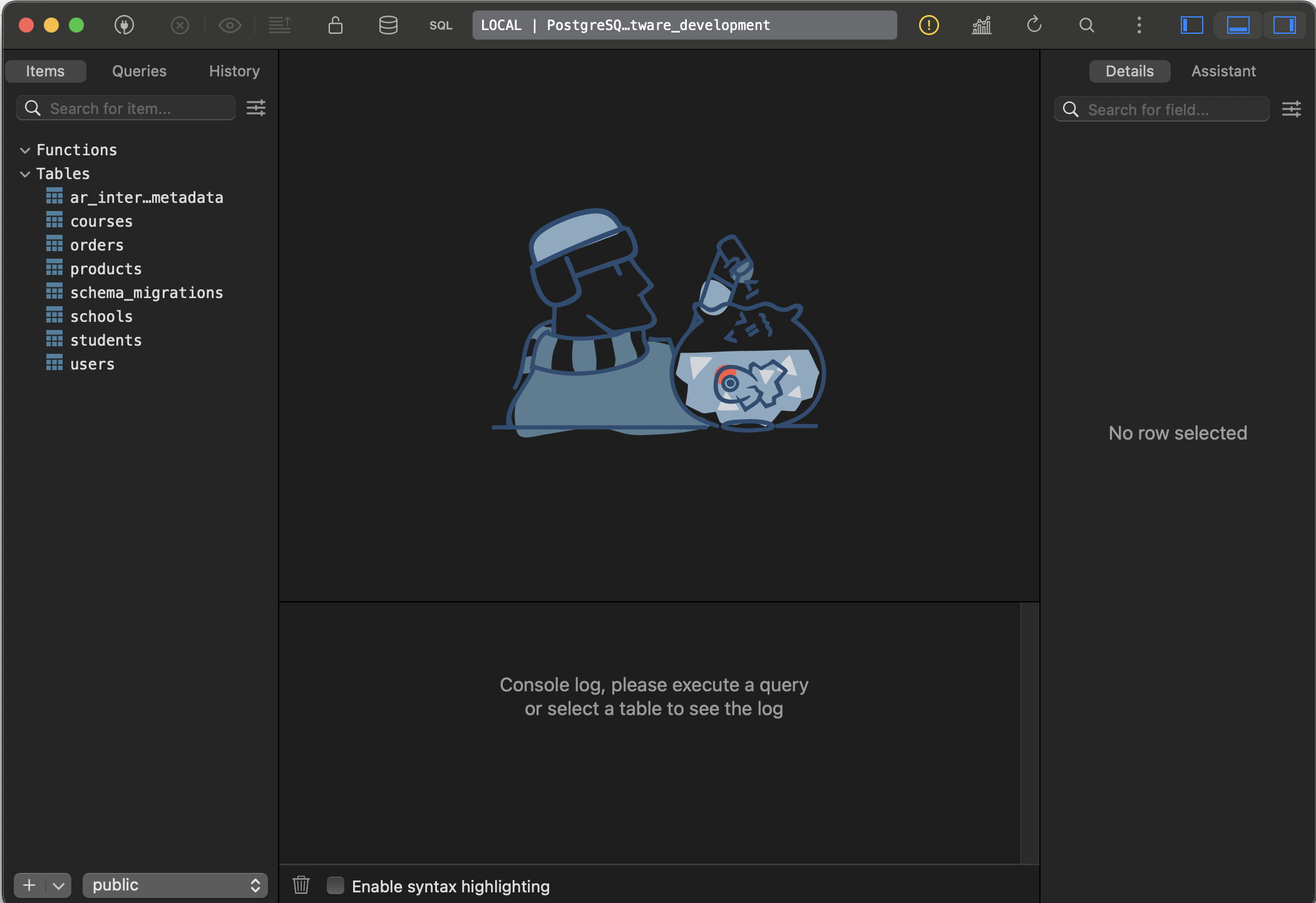
    Let’s Go with TablePlus ๐Ÿฅณ

    ๐Ÿš€ Stepย 1: Install TablePlus

    brew install --cask tableplus
    

    ๐Ÿ“Š Stepย 2: Check Our Database Schema

    ย Weย have a greatย setup forย learning SQL with realisticย relationships. Let’s create aย progressive SQL learning path usingย our actualย data.

    ๐Ÿ”— Stepย 3: Connectย to Your Database

    TablePlus Connection Details:

    • Host:ย localhost
    • Port:ย 5432
    • Database:ย academic_sql_software_development
    • User:ย (yourย macOS username)
    • Password: (leaveย blank)

    ๐Ÿ“š SQLย Learning Path: Basic to Advanced

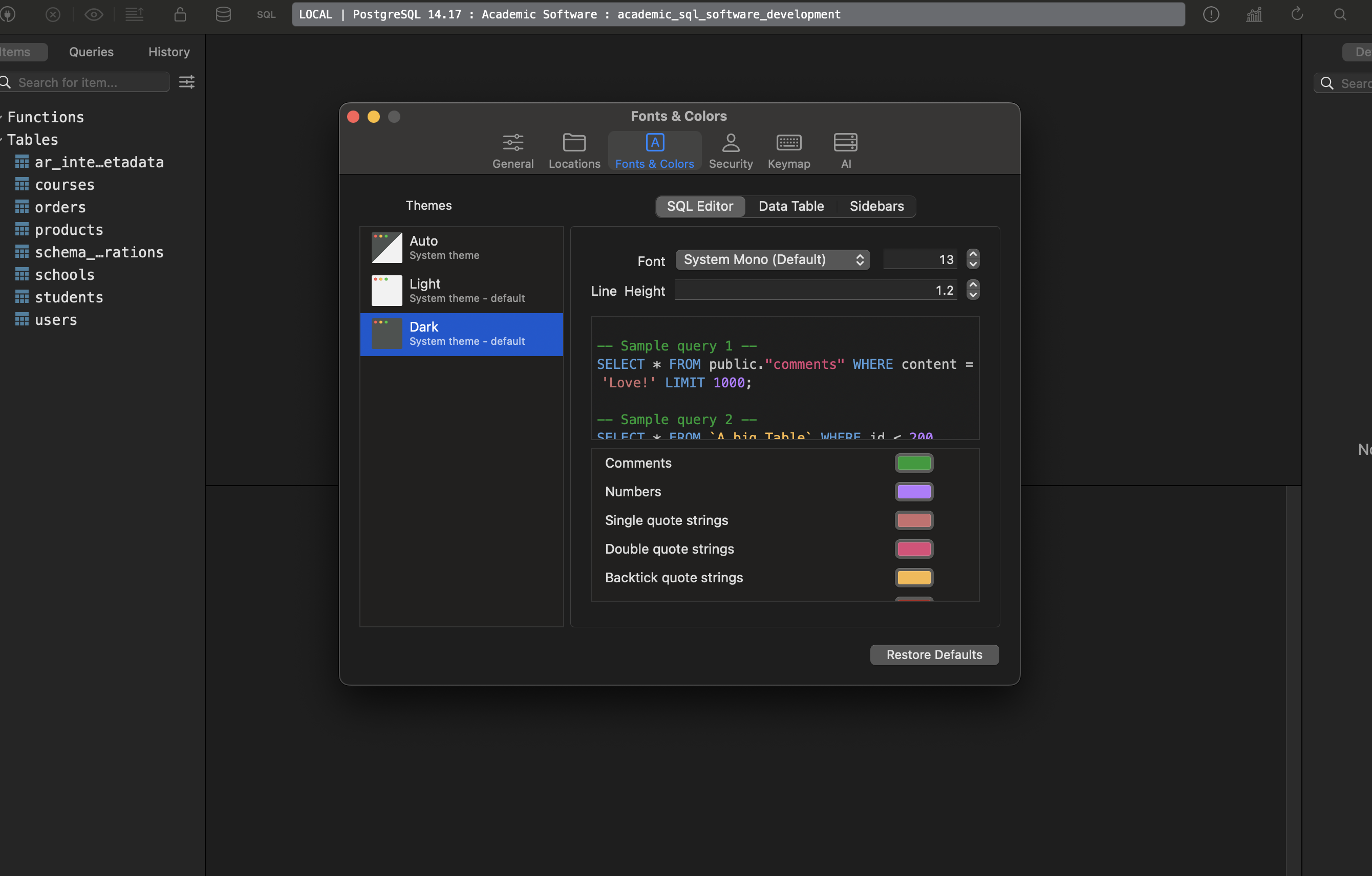
    Change Font size, colour, theme etc:

    Level 1: Basic SELECT Queries

    -- 1. View all users
    SELECT * FROM users LIMIT 10;
    
    -- 2. Count total records
    SELECT COUNT(*) FROM users;
    SELECT COUNT(*) FROM orders;
    SELECT COUNT(*) FROM products;
    
    -- 3. Filter data
    SELECT first_name, last_name, email 
    FROM users 
    WHERE gender = 'female' 
    LIMIT 10;
    
    -- 4. Sort data
    SELECT first_name, last_name, date_of_birth 
    FROM users 
    ORDER BY date_of_birth DESC 
    LIMIT 10;
    
    -- 5. Filter with conditions
    SELECT title, price, category 
    FROM products 
    WHERE price > 50 AND category = 'men' 
    ORDER BY price DESC;
    

    Level 2: Basic Aggregations

    -- 1. Count by category
    SELECT category, COUNT(*) as product_count 
    FROM products 
    GROUP BY category;
    
    -- 2. Average prices by category
    SELECT category, 
           AVG(price) as avg_price,
           MIN(price) as min_price,
           MAX(price) as max_price
    FROM products 
    GROUP BY category;
    
    -- 3. Users by gender
    SELECT gender, COUNT(*) as user_count 
    FROM users 
    WHERE gender IS NOT NULL
    GROUP BY gender;
    
    -- 4. Products with low stock
    SELECT COUNT(*) as low_stock_products 
    FROM products 
    WHERE stock_quantity < 10;
    

    Level 3: Inner Joins

    -- 1. Users with their orders
    SELECT u.first_name, u.last_name, u.email, o.id as order_id, o.created_at
    FROM users u
    INNER JOIN orders o ON u.id = o.user_id
    ORDER BY o.created_at DESC
    LIMIT 20;
    
    -- 2. Orders with product details
    SELECT o.id as order_id, 
           p.title as product_name, 
           p.price, 
           p.category,
           o.created_at
    FROM orders o
    INNER JOIN products p ON o.product_id = p.id
    ORDER BY o.created_at DESC
    LIMIT 20;
    
    -- 3. Complete order information (3-table join)
    SELECT u.first_name, u.last_name,
           p.title as product_name,
           p.price,
           p.category,
           o.created_at as order_date
    FROM orders o
    INNER JOIN users u ON o.user_id = u.id
    INNER JOIN products p ON o.product_id = p.id
    ORDER BY o.created_at DESC
    LIMIT 20;
    

    Level 4: Left Joins (Show Missing Data)

    -- 1. All users and their order count (including users with no orders)
    SELECT u.first_name, u.last_name, u.email,
           COUNT(o.id) as order_count
    FROM users u
    LEFT JOIN orders o ON u.id = o.user_id
    GROUP BY u.id, u.first_name, u.last_name, u.email
    ORDER BY order_count DESC;
    
    -- 2. Users who haven't placed any orders
    SELECT u.first_name, u.last_name, u.email, u.created_at
    FROM users u
    LEFT JOIN orders o ON u.id = o.user_id
    WHERE o.id IS NULL
    ORDER BY u.created_at DESC;
    
    -- 3. Products that have never been ordered
    SELECT p.title, p.price, p.category, p.stock_quantity
    FROM products p
    LEFT JOIN orders o ON p.id = o.product_id
    WHERE o.id IS NULL
    ORDER BY p.price DESC;
    

    Level 5: Advanced Aggregations & Grouping

    -- 1. Top customers by order count
    SELECT u.first_name, u.last_name,
           COUNT(o.id) as total_orders,
           SUM(p.price) as total_spent
    FROM users u
    INNER JOIN orders o ON u.id = o.user_id
    INNER JOIN products p ON o.product_id = p.id
    GROUP BY u.id, u.first_name, u.last_name
    HAVING COUNT(o.id) > 1
    ORDER BY total_spent DESC
    LIMIT 10;
    
    -- 2. Most popular products
    SELECT p.title, p.category, p.price,
           COUNT(o.id) as times_ordered,
           SUM(p.price) as total_revenue
    FROM products p
    INNER JOIN orders o ON p.id = o.product_id
    GROUP BY p.id, p.title, p.category, p.price
    ORDER BY times_ordered DESC
    LIMIT 10;
    
    -- 3. Monthly order analysis
    SELECT DATE_TRUNC('month', o.created_at) as month,
           COUNT(o.id) as order_count,
           COUNT(DISTINCT o.user_id) as unique_customers,
           SUM(p.price) as total_revenue
    FROM orders o
    INNER JOIN products p ON o.product_id = p.id
    GROUP BY DATE_TRUNC('month', o.created_at)
    ORDER BY month;
    

    Level 6: Student Enrollment Analysis (Complex Joins)

    -- 1. Students with their course and school info
    SELECT u.first_name, u.last_name,
           c.title as course_name,
           s.title as school_name,
           st.enrolment_date
    FROM students st
    INNER JOIN users u ON st.user_id = u.id
    INNER JOIN courses c ON st.course_id = c.id
    INNER JOIN schools s ON st.school_id = s.id
    ORDER BY st.enrolment_date DESC
    LIMIT 20;
    
    -- 2. Course popularity by school
    SELECT s.title as school_name,
           c.title as course_name,
           COUNT(st.id) as student_count
    FROM students st
    INNER JOIN courses c ON st.course_id = c.id
    INNER JOIN schools s ON st.school_id = s.id
    GROUP BY s.id, s.title, c.id, c.title
    ORDER BY student_count DESC;
    
    -- 3. Schools with enrollment stats
    SELECT s.title as school_name,
           COUNT(st.id) as total_students,
           COUNT(DISTINCT st.course_id) as courses_offered,
           MIN(st.enrolment_date) as first_enrollment,
           MAX(st.enrolment_date) as latest_enrollment
    FROM schools s
    LEFT JOIN students st ON s.id = st.school_id
    GROUP BY s.id, s.title
    ORDER BY total_students DESC;
    

    Level 7: Advanced Concepts

    -- 1. Subqueries: Users who spent more than average
    WITH user_spending AS (
      SELECT u.id, u.first_name, u.last_name,
             SUM(p.price) as total_spent
      FROM users u
      INNER JOIN orders o ON u.id = o.user_id
      INNER JOIN products p ON o.product_id = p.id
      GROUP BY u.id, u.first_name, u.last_name
    )
    SELECT first_name, last_name, total_spent
    FROM user_spending
    WHERE total_spent > (SELECT AVG(total_spent) FROM user_spending)
    ORDER BY total_spent DESC;
    
    -- 2. Window functions: Ranking customers
    SELECT u.first_name, u.last_name,
           COUNT(o.id) as order_count,
           SUM(p.price) as total_spent,
           RANK() OVER (ORDER BY SUM(p.price) DESC) as spending_rank
    FROM users u
    INNER JOIN orders o ON u.id = o.user_id
    INNER JOIN products p ON o.product_id = p.id
    GROUP BY u.id, u.first_name, u.last_name
    ORDER BY spending_rank
    LIMIT 20;
    
    -- 3. Case statements for categorization
    SELECT u.first_name, u.last_name,
           COUNT(o.id) as order_count,
           CASE 
             WHEN COUNT(o.id) >= 5 THEN 'VIP Customer'
             WHEN COUNT(o.id) >= 2 THEN 'Regular Customer'
             ELSE 'New Customer'
           END as customer_type
    FROM users u
    LEFT JOIN orders o ON u.id = o.user_id
    GROUP BY u.id, u.first_name, u.last_name
    ORDER BY order_count DESC;
    

    Level 8: Self-Joins & Advanced Analysis

    -- 1. Find users enrolled in the same course (pseudo self-join)
    SELECT DISTINCT 
           u1.first_name || ' ' || u1.last_name as student1,
           u2.first_name || ' ' || u2.last_name as student2,
           c.title as course_name
    FROM students s1
    INNER JOIN students s2 ON s1.course_id = s2.course_id AND s1.user_id < s2.user_id
    INNER JOIN users u1 ON s1.user_id = u1.id
    INNER JOIN users u2 ON s2.user_id = u2.id
    INNER JOIN courses c ON s1.course_id = c.id
    ORDER BY c.title, student1
    LIMIT 20;
    
    -- 2. Complex business question: Multi-role users
    SELECT u.first_name, u.last_name, u.email,
           COUNT(DISTINCT o.id) as orders_placed,
           COUNT(DISTINCT st.id) as courses_enrolled,
           CASE 
             WHEN COUNT(DISTINCT o.id) > 0 AND COUNT(DISTINCT st.id) > 0 THEN 'Customer & Student'
             WHEN COUNT(DISTINCT o.id) > 0 THEN 'Customer Only'
             WHEN COUNT(DISTINCT st.id) > 0 THEN 'Student Only'
             ELSE 'No Activity'
           END as user_type
    FROM users u
    LEFT JOIN orders o ON u.id = o.user_id
    LEFT JOIN students st ON u.id = st.user_id
    GROUP BY u.id, u.first_name, u.last_name, u.email
    ORDER BY orders_placed DESC, courses_enrolled DESC;
    

    ๐ŸŽฏย Our Learning Strategy:

    1. Start with Level 1-2ย in TablePlus toย get comfortable
    2. Progressย through each levelย – try to understand eachย query before moving on
    3. Modify theย queriesย – change filters, add fields, etc.
    4. Create your own variationsย based on businessย questions

    to be continued โ€ฆ ๐Ÿš€

    Rails 8 App: Create an Academic software app using SQL without using ActiveRecord- Part 2 | students | courses | schools

    Design: Our Students Table -> course -> school

    We need a UNIQUE constraint on user_id because:

    • โœ… One student per user (user_id should be unique)
    • โœ… Multiple students per course (course_id can be repeated)

    Check Migration Files:

    Key Changes:

    1. โœ… Added UNIQUE constraint: CONSTRAINT uk_students_user_id UNIQUE (user_id)
    2. ๐Ÿ”ง Fixed typos:
    • TIMSTAMP โ†’ TIMESTAMP
    • stidents โ†’ students

    ๐Ÿ“ˆ Optimized indexes: No need for user_id index since UNIQUE creates one automatically

    Business Logic Validation:

    • user_id: One student per user โœ…
    • course_id: Multiple students per course โœ…
    • school_id: Multiple students per school โœ…

    This ensures referential integrity and business rules are enforced at the database level!


    ๐Ÿ“ Schema Storage Options:

    Rails allows you to store the schema in SQL format instead of the default Ruby format. Let me explain the options and why you’d choose each:

    1. Ruby Format (Default)

    # db/schema.rb
    ActiveRecord::Schema[8.0].define(version: 2025_07_09_074552) do
      enable_extension "pg_catalog.plpgsql"
    
      create_table "users", force: :cascade do |t|
        t.string "first_name", limit: 100, null: false
        t.string "email", limit: 150, null: false
        t.datetime "created_at", null: false
        t.index ["email"], name: "idx_users_email"
      end
    end
    

    2. SQL Format

    -- db/structure.sql
    CREATE EXTENSION IF NOT EXISTS pg_catalog.plpgsql;
    
    CREATE TYPE gender_enum AS ENUM ('male', 'female', 'not-specified');
    
    CREATE TABLE users (
        id bigserial PRIMARY KEY,
        first_name varchar(100) NOT NULL,
        email varchar(150) NOT NULL,
        created_at timestamp NOT NULL DEFAULT CURRENT_TIMESTAMP
    );
    
    CREATE UNIQUE INDEX idx_users_email ON users(email);
    

    Check structure.sql File: Github: db/structure.sql

    ๐Ÿ”ง How to Switch to SQL Format:

    Add this to config/application.rb:

    module AcademicSqlSoftware
      class Application < Rails::Application
        # ... existing config ...
    
        # Use SQL format for schema
        config.active_record.schema_format = :sql
      end
    end
    

    Then regenerate the schema:

    # Generate SQL schema file
    rails db:schema:dump
    

    This will create db/structure.sql instead of db/schema.rb.

    Comparison Table:

    FeatureRuby Format (schema.rb)SQL Format (structure.sql)
    Defaultโœ… YesโŒ No
    Database Agnosticโœ… YesโŒ No (DB-specific)
    Custom SQL FeaturesโŒ Limitedโœ… Full support
    ViewsโŒ Noโœ… Yes
    Stored ProceduresโŒ Noโœ… Yes
    TriggersโŒ Noโœ… Yes
    Custom Types/ENUMsโŒ Limitedโœ… Full support
    Partial IndexesโŒ Limitedโœ… Yes
    Check ConstraintsโŒ Limitedโœ… Yes
    Version Controlโœ… Easy to diffโš ๏ธ Harder to diff
    Readabilityโœ… Ruby-likeโš ๏ธ Raw SQL

    When to Use Each:

    Choose SQL Format When:

    • โœ… Using PostgreSQL-specific features (ENUMs, arrays, JSONB operators)
    • โœ… Need database views, triggers, or stored procedures
    • โœ… Using complex constraints (CHECK, partial indexes)
    • โœ… Working with custom data types
    • โœ… Team is SQL-proficient

    Choose Ruby Format When:

    • โœ… Want database portability (switching between PostgreSQL/MySQL/SQLite)
    • โœ… Team prefers Ruby syntax
    • โœ… Using standard Rails features only
    • โœ… Need easier version control diffs

    For Our Project:

    I recommend SQL format because you’re using:

    • โœ… PostgreSQL ENUMs (gender_enum, category_enum) – Rails 8 supports this
    • โœ… Custom constraints (CHECK (price > 0)) – Rails 8 supports this
    • โœ… Complex foreign key relationships
    • โœ… Raw SQL migrations

    Our config/application.rb should include:

    config.active_record.schema_format = :sql
    

    Then run:

    rails db:schema:dump
    

    This will give us full control over PostgreSQL features while maintaining schema consistency! ๐ŸŽฏ

    ๐ŸŒฑ Seed Data

    1. Let’s refactor the seed file into modular components. I’ll create separate seeder classes for each model type and organize them properly.

    2. Let’s me create individual seeder classes for each model, the seeders for the dependent models (orders and students), refactor the main seeds.rb file to use the new modular structure, create a documentation file for the new modular structure.

    3. I’ve successfully refactored our seed file into a modular, maintainable architecture. Here’s what we’ve created:

    ๐ŸŽฏ Modular Seed System Overview

    ๐Ÿ“ File Structure:

    db/
    โ”œโ”€โ”€ seeds.rb                    # Main orchestrator (now 20 lines vs 246!)
    โ””โ”€โ”€ seeds/
        โ”œโ”€โ”€ README.md              # Complete documentation
        โ”œโ”€โ”€ base_seeder.rb         # Shared functionality & config
        โ”œโ”€โ”€ users_seeder.rb        # User creation logic
        โ”œโ”€โ”€ products_seeder.rb     # Product creation logic  
        โ”œโ”€โ”€ courses_seeder.rb      # Course creation logic
        โ”œโ”€โ”€ schools_seeder.rb      # School creation logic
        โ”œโ”€โ”€ orders_seeder.rb       # Order creation (with dependencies)
        โ””โ”€โ”€ students_seeder.rb     # Student creation (with constraints)
    

    Key Benefits:

    โœ… Separation of Concerns:
    • Each model has its own dedicated seeder class
    • Clear responsibility boundaries
    • Easy to modify individual model generation
    โœ… Maintainability:
    • Single file changes vs monolithic seed file
    • Inheritance from BaseSeeder for shared functionality
    • Comprehensive documentation
    โœ… Flexibility:
    • Easy to add new models
    • Environment-specific configuration
    • Configurable record counts
    โœ… Robustness:
    • Proper dependency handling
    • Constraint compliance (stock, unique keys)
    • Error handling and validation

    ๐Ÿ“‹ Usage Examples:

    # Basic seeding
    rails db:seed
    
    # Clear data first
    CLEAR_DATA=true rails db:seed
    
    # Scale up for testing
    # Edit USERS_COUNT in base_seeder.rb then:
    rails db:seed
    

    Check my Github Seed File: Seed File – Academic SQL App

    ๐Ÿ› ๏ธ Commit the Refactored System:

    # Stage all the new modular files
    git add db/seeds.rb \
            db/seeds/
    
    # Commit with comprehensive message
    git commit -m "Refactor seed system into modular architecture" -m "
    
    Modular Structure:
    - Split monolithic seeds.rb into focused seeder classes
    - Create BaseSeeder with shared functionality and configuration
    - Separate concerns: each model has dedicated seeder
    - Add comprehensive documentation in seeds/README.md
    
    Benefits:
    - Maintainability: Easy to modify individual model generation
    - Flexibility: Simple to add new models or adjust data
    - Robustness: Proper dependency handling and constraint compliance
    - Testability: Individual seeders can be tested in isolation
    
    Features:
    - Environment-specific behavior (auto-clear in development)
    - Smart constraint handling (stock validation, unique keys)
    - Progress indicators and comprehensive reporting
    - Configurable record counts via constants
    
    Files:
    - db/seeds.rb: Main orchestrator (20 lines vs 246)
    - db/seeds/base_seeder.rb: Shared functionality & config
    - db/seeds/*_seeder.rb: Individual model seeders
    - db/seeds/README.md: Complete documentation
    
    The system is now ready for production use and easy to extend."
    

    ๐ŸŽ‰ What We Can Do Now:

    Scale Easily:

    # In base_seeder.rb - change these and run rails db:seed
    USERS_COUNT = 10_000
    PRODUCTS_COUNT = 1_000  
    ORDERS_COUNT = 50_000
    

    Add New Models: Create new_model_seeder.rb, inherit from BaseSeeder, add to orchestration.

    Customize Data: Edit individual seeder constants and attribute methods.

    Test Components:

    users = UsersSeeder.create_users
    products = ProductsSeeder.create_products
    

    Our seed system is now enterprise-ready with clean architecture, comprehensive documentation, and infinite scalability! ๐Ÿš€

    Possible Refactoring

    Now Let’s move the helper methods to a dedicated helper folder for better organization. I’ll create a helpers directory and move the shared utility methods there.

    Here’s how to refactor your seed helper methods into a new helpers folder under db/seeds:

    1. Create a directory:
      db/seeds/helpers/
    2. Move all shared/random data methods (like random_gender, random_category, etc.) into a module, e.g. db/seeds/helpers/data_generators.rb:
    # db/seeds/helpers/data_generators.rb
    module DataGenerators
      def random_gender
        ['male', 'female', 'not-specified'].sample
      end
    
      def random_category
        ['men', 'women', 'kids', 'infants'].sample
      end
    
      def random_date_of_birth
        Date.today - rand(18..80).years - rand(365).days
      end
    
      def random_phone
        "+1#{rand(100..999)}-#{rand(100..999)}-#{rand(1000..9999)}"
      end
    
      def random_price
        [9.99, 19.99, 29.99, 49.99, 99.99, 199.99, 299.99, 499.99].sample
      end
    
      def random_stock
        [0, 5, 10, 25, 50, 100, 500].sample
      end
    
      def random_past_date(days_ago_max = 365)
        Date.today - rand(1..days_ago_max).days
      end
    end
    
    1. In your seeders and base seeder, require and include the helper:
    # At the top of each seeder or in base_seeder.rb
    require_relative 'helpers/data_generators'
    
    class UsersSeeder < BaseSeeder
      extend DataGenerators
      # ... now you can call random_gender, random_category, etc.
    end
    
    1. Remove the helper methods from BaseSeeder and use the module instead.

    Summary:

    • Move all shared/random data methods to db/seeds/helpers/data_generators.rb as a module.
    • require_relative and extend or include the module in your seeders.
    • This keeps your seed logic clean and DRY!

    Our BaseSeeder still contains all the random data and progress helper methods, which are now in db/seeds/helpers/data_generators.rb and db/seeds/helpers/ui_helpers.rb.

    Here’s what we should do:

    • Remove all the methods at the bottom of BaseSeeder that are now in the helpers.
    • At the top of base_seeder.rb, require the helper modules.
    • If you want to use the helpers as class methods, use extend for each module.

    Here’s the refactor plan:

    1. Remove:
    • random_gender
    • random_category
    • random_date_of_birth
    • random_phone
    • random_price
    • random_stock
    • random_past_date
    • progress_indicator
    1. Add at the top:
       require_relative 'helpers/data_generators'
       require_relative 'helpers/ui_helpers'
       extend DataGenerators
       extend UiHelpers
    

    Changes Made:

    1. In UiHelpers:
      • Removed the hardcoded print_summary and print_verification methods.
      • Ensured print_summary_box and print_verification_stats are ready to accept data.
    2. In BaseSeeder:
      • Now dynamically creates a summary_data hash with the final record counts.
      • Creates a verification_stats hash with key metrics.
      • Calls UiHelpers.print_summary_box and UiHelpers.print_verification_stats, passing in the data.

    Benefits of this Refactor:

    • More Flexible: You can now easily add or remove items from the summary and verification sections just by changing the hashes in BaseSeeder.
    • Decoupled: The UiHelpers module is now purely for presentation and has no knowledge of your specific models.
    • Cleaner Code: The logic is now clearly separatedโ€”BaseSeeder gathers the data, and UiHelpers displays it.

    Now the BaseSeeder is clean and only contains orchestration logic and configuration. All random data and UI/progress helpers are now properly delegated to the new helper modules.

    We can now use these helpers in any seeder by calling random_gender,  progress_indicator, etc., thanks to the extend statements. This makes our seed system much more modular, maintainable, and DRY!

    That’s a great suggestion for further refactoring. It makes sense to keep all data-related logic, including aggregation for summaries, within the DataGenerators helper.

    Let’s proceed. I’ll move the hash construction into new methods inside db/seeds/helpers/data_generators.rb and then update BaseSeeder to call them.
    Now that the data generation has been moved, I’ll update the BaseSeeder to call the new methods.

    Issues Fixed:

    1. UiHelpers method calls: All seeder files were calling progress_indicator directly, but since the methods in UiHelpers are defined as class methods, they needed to be prefixed with UiHelpers.. Fixed in:
    • UsersSeeder
    • ProductsSeeder
    • CoursesSeeder
    • SchoolsSeeder
    • OrdersSeeder
    • StudentsSeeder
    1. DataGenerators references: The BaseSeeder was trying to call DataGenerators.summary_data and DataGenerators.verification_stats, but that file was deleted. I updated it to use the local summary_data and verification_stats methods that were already defined in the BaseSeeder class.

    Seeding Results:

    • โœ… 10,000 users created
    • โœ… 1,000 products created
    • โœ… 50 courses created
    • โœ… 25 schools created
    • โœ… 5,000 orders created
    • โœ… 5,000 students created

    The verification stats show proper data relationships:

    • 4,004 users have orders
    • 647 products have been ordered
    • 756 products are active
    • 200 students per school (average)
    • 100 students per course (average)

    โœ… Final Architecture:

    1. DataGenerators: Is now responsible for all data-related tasks, including generating random primitive data (random_phone) and creating aggregated summary data (summary_data, verification_stats).
    2. UiHelpers: Is responsible for all presentation logic, taking data as input and printing it to the console in a formatted way.
    3. Individual Seeders (UsersSeeder, etc.): Responsible for the business logic of creating a specific type of record, using helpers for data and UI.
    4. BaseSeeder: The main orchestrator. It knows the correct order to call the individual seeders and delegates all data and UI tasks to the appropriate helpers.
    5. seeds.rb: The single entry point that kicks off the entire process.

    to be continued … ๐Ÿš€

    Guide: Integrating React.js โš›๏ธ into a Railsย 8 Application โ€“ Partย 2: Install React | Add esbuild, Jsx | Integrate React View

    Throw back:

    rails new design_studio_react --database=postgresql -j esbuild --skip-hotwire
    

    Here’s what our Rails app looks like after skipping Hotwire with the --skip-hotwire flag:

    โœ… Current JavaScript/Node.js Setup (Clean & Minimal)

    ๐Ÿ“ฆ Package Management:

    • package.json – Clean setup with only esbuild script
    • .node-version – Node.js version 24.1.0
    • No dependencies – Ready for React installation

    ๐Ÿ“ JavaScript File Structure (Ultra-Clean):

    app/javascript/
    โ””โ”€โ”€ application.js          # Empty entry point (2 lines total!)
    

    app/javascript/application.js content:

    // Entry point for the build script in your package.json
    

    ๐Ÿšซ What Got Successfully Removed:

    • โŒ No Turbo/Stimulus imports in application.js
    • โŒ No controllers/ directory at all
    • โŒ No Hotwire gems in Gemfile (only jsbundling-rails remains)
    • โŒ No @hotwired/turbo-rails or @hotwired/stimulus dependencies

    โš™๏ธ Configuration Files (Minimal – Only 4):

    1. package.json – esbuild build script only
    2. .node-version – Node.js version pinning
    3. Procfile.dev – Development processes (js: yarn build --watch)
    4. app/javascript/application.js – Empty entry point

    ๐Ÿ”ง esbuild Configuration:

    {
      "scripts": {
        "build": "esbuild app/javascript/*.* --bundle --sourcemap --format=esm --outdir=app/assets/builds --public-path=/assets"
      }
    }
    

    ๐Ÿ“‚ Build Output:

    • app/assets/builds/ – Contains only .keep file (empty, ready for bundles)

    ๐ŸŽฏ HTML Integration:

    <!-- Still includes the JavaScript module correctly -->
    <%= javascript_include_tag "application", "data-turbo-track": "reload", type: "module" %>
    

    (Note: data-turbo-track is just an HTML attribute for cache busting, not the Turbo library)

    # create db
    โœ— rails db:migrate
    
    # run react-rails-app in port 3001
    โœ— rails s -p 3001
    

    ๐Ÿš€ Next Steps: Install & Setup React

    Step 1: Install react, react-dom

    Your app is now perfectly clean for React! Just run:

    brew install yarn
    yarn add react react-dom # check node_modules/ folder for what is installed
    yarn add --dev @types/react @types/react-dom  # Optional: for TypeScript support, check node_modules/@types folder
    

    Status: โœ… Minimal JavaScript foundation – No Hotwire bloat, perfect React starting point!

    Now that we have a clean Rails app with esbuild setup, here’s our step-by-step roadmap to get React working:

    Step 2: Create Your First React Component

    Create a simple React component to test the setup:

    mkdir app/javascript/components
    

    Then create app/javascript/components/App.jsx:

    import React from 'react';
    
    function App() {
      return (
        <div>
          <h1>React is Working!</h1>
          <p>Welcome to your Rails + React app</p>
        </div>
      );
    }
    
    export default App;
    

    Step 3: Update JavaScript Entry Point

    Modify app/javascript/application.js to render React:

    // Entry point for the build script in your package.json
    import React from 'react';
    import { createRoot } from 'react-dom/client';
    import App from './components/App';
    
    document.addEventListener('DOMContentLoaded', () => {
      const container = document.getElementById('react-root');
      if (container) {
        const root = createRoot(container);
        root.render(<App />);
      }
    });
    

    Step 4: Create a Controller & Route

    Generate a home controller:

    rails generate controller Home index
    

    Step 5: Add React Root to View

    Update app/views/home/index.html.erb:

    <div id="react-root"></div>
    

    Step 6: Set Root Route

    Update config/routes.rb:

    Rails.application.routes.draw do
      root "home#index"
      # ... other routes
    end
    

    Step 7: Start Development

    # update Procfile.dev assign port 3001
    web: env RUBY_DEBUG_OPEN=true bin/rails server -p 3001
    
    # run our rails-react app by
    
    โœ— bin/dev
    21:15:27 web.1  | started with pid 12619
    21:15:27 js.1   | started with pid 12620
    21:15:27 js.1   | yarn run v1.22.22
    21:15:27 js.1   | $ esbuild app/javascript/*.* --bundle --sourcemap --format=esm --outdir=app/assets/builds --public-path=/assets --watch
    21:15:27 js.1   | /bin/sh: esbuild: command not found
    21:15:27 js.1   | error Command failed with exit code 127.
    21:15:27 js.1   | info Visit https://yarnpkg.com/en/docs/cli/run for documentation about this command.
    21:15:27 web.1  | => Booting Puma
    ..........
    

    ๐ŸŽฏ What This Gives Us:

    • โœ… React components in app/javascript/components/
    • โœ… esbuild automatically bundles JSX
    • โœ… Hot reloading with yarn build --watch
    • โœ… Rails serves your React app

    ๐Ÿšจ Error Analysis:

    1. Rails serverย started fineย โœ… (port 3001)

    ๐Ÿ”ง Solution: Install JavaScript Dependencies

    You need to install esbuild and other JavaScript dependencies first:

    yarn install
    

    ๐Ÿ“‹ Files yarn install Checks:

    1. Primary: package.json

    {
      "name": "app",
      "private": true,
      "scripts": {
        "build": "esbuild app/javascript/*.* --bundle --sourcemap --format=esm --outdir=app/assets/builds --public-path=/assets"
      },
      "dependencies": {
        "react": "^19.1.0",           # โœ… Already added
        "react-dom": "^19.1.0"       # โœ… Already added  
      },
      "devDependencies": {
        "@types/react": "^19.1.8",      # โœ… Already added
        "@types/react-dom": "^19.1.6"   # โœ… Already added
      }
    }
    

    2. Lockfile: yarn.lock

    • Ensures exact versions for reproducible installs
    • Contains resolved URLs and integrity hashes

    ๐Ÿšจ The Problem: Missing esbuild!

    Our package.json calls esbuild in the build script, but esbuild is not listed as a dependency anywhere!

    Rails should have added it, but didn’t. We need to add esbuild:

    yarn add --dev esbuild
    

    ๐Ÿ”ง What yarn install does:

    1. Reads package.json for dependency list
    2. Reads yarn.lock for exact versions (if exists)
    3. Downloads packages to node_modules/
    4. Updates yarn.lock with new resolutions

    Current issue: Our build script expects esbuild command, but it’s not installed in node_modules/.bin/esbuild

    Solution: Add esbuild as a dev dependency!

    Solved~ and start servers: Error Again!

    x bin/dev
    
    * Listening on http://[::1]:3001
    22:54:43 web.1  | Use Ctrl-C to stop
    22:54:44 js.1   | โœ˜ [ERROR] The JSX syntax extension is not currently enabled
    22:54:44 js.1   |
    22:54:44 js.1   |     app/javascript/application.js:11:16:
    22:54:44 js.1   |       11 โ”‚     root.render(<App />);
    22:54:44 js.1   |          โ•ต                 ^
    22:54:44 js.1   |
    22:54:44 js.1   |   The esbuild loader for this file is currently set to "js" but it must be set to "jsx" to be able to parse JSX syntax. You can use "--loader:.js=jsx" to do that.
    22:54:44 js.1   |
    22:54:44 js.1   | 1 error
    22:54:44 js.1   | [watch] build finished, watching for changes..
    

    This error occurs because esbuild doesn’t know how to handle JSX syntax! The <App /> is JSX, but esbuild needs to be configured to transform it.

    ๐Ÿšจ Problem: esbuild can’t process JSX syntax

    Your application.js contains JSX (<App />), but esbuild isn’t configured to transform JSX!

    JSX (JavaScript XML) is a syntax extension for JavaScript, commonly used with React, that allows you to write HTML-like code within JavaScript files.

    ๐Ÿ”ง Solution: Configure esbuild for JSX

    Update your package.json build script to handle JSX:

    # add this to build
    --jsx=automatic --loader:.js=jsx 
    

    โœ… Fixed! Added JSX support:

    What I added:

    • --jsx=automatic – Enables React’s automatic JSX runtime
    • --loader:.js=jsx – Treats .js files as JSX files

    ๐Ÿ“ What this means:

    • โœ… esbuild can now process <App /> syntax
    • โœ… You don’t need to import React in every JSX file
    • โœ… Your .js files can contain JSX
    bin/dev
    

    Whola!!

    Let’s see in Part 3. Happy React configuration! ๐Ÿš€

    Rails 8 App: Create an Academic software app using SQL without using ActiveRecord – Part 1 | users | products | orders

    Let’s create a Rails 8 app which use SQL queries with raw SQL instead of ActiveRecord. Let’s use the full Rails environment with ActiveRecord for infrastructure, but bypass AR’s ORM features for pure SQL writing. Let me guide you through this step by step:

    Step 1: Create the Rails App with ActiveRecord and PostgreSQL (skipping unnecessary components)

    rails new academic-sql-software --database=postgresql --skip-action-cable --skip-jbuilder --skip-solid --skip-kamal
    

    What we’re skipping and why:

    • –skip-action-cable: No WebSocket functionality needed
    • –skip-jbuilder: No JSON API views needed for our SQL practice app
    • –skip-solid: Skips Solid Cache and Solid Queue (we don’t need caching or background jobs)
    • –skip-kamal: No deployment configuration needed

    What we’re keeping:

    • ActiveRecord: For database connection management and ActiveRecord::Base.connection.execute()
    • ActionController: For creating web interfaces to display our SQL query results
    • ActionView: For creating simple HTML pages to showcase our SQL learning exercises
    • PostgreSQL: Our database for practicing advanced SQL features

    Why this setup is perfect for App with raw SQL:

    • Minimal Rails app focused on database interactions
    • Full Rails environment for development conveniences
    • ActiveRecord infrastructure without ORM usage
    • Clean setup without unnecessary overhead

    => Open config/application.rb and comment the following for now:

    # require "active_job/railtie"
    ...
    # require "active_storage/engine"
    ...
    # require "action_mailer/railtie"
    # require "action_mailbox/engine"
    ...
    # require "action_cable/engine"
    

    => Open config/environments/development.rb config/environments/production.rb config/environments/test.rb comment action_mailer

    ๐Ÿค” Why I am using ActiveRecord (even though I don’t want the ORM):

    • Database Connection Management: ActiveRecord provides robust connection pooling, reconnection handling, and connection management
    • Rails Integration: Seamless integration with Rails console, database tasks (rails db:create, rails db:migrate), and development tools
    • Raw SQL Execution: We get ActiveRecord::Base.connection.execute() which is perfect for our raw SQL writing.
    • Migration System: Easy table creation and schema management with migrations (even though we’ll query with raw SQL)
    • Database Configuration: Rails handles database.yml configuration, environment switching, and connection setup
    • Development Tools: Access to Rails console for testing queries, database tasks, and debugging

    Our Learning Strategy: We’ll use ActiveRecord’s infrastructure but completely bypass its ORM methods. Instead of Student.where(), we’ll use ActiveRecord::Base.connection.execute("SELECT * FROM students WHERE...")

    Step 2: Navigate to the project directory

    cd academic-sql-software
    

    Step 3: Verify PostgreSQL setup

    # Check if PostgreSQL is running
    brew services list | grep postgresql
    # or
    pg_ctl status
    

    Database Foundation: PostgreSQL gives us advanced SQL features:

    • Complex JOINs (INNER, LEFT, RIGHT, FULL OUTER)
    • Window functions (ROW_NUMBER, RANK, LAG, LEAD)
    • Common Table Expressions (CTEs)
    • Advanced aggregations and subqueries

    Step 4: Install dependencies

    bundle install
    

    What this gives us:

    • pg gem: Pure PostgreSQL adapter (already included with --database=postgresql)
    • ActiveRecord: For connection management only
    • Rails infrastructure: Console, generators, rake tasks

    Step 5: Create the PostgreSQL databases

    โœ— rails db:create
    Created database 'academic_sql_software_development'
    Created database 'academic_sql_software_test
    

    Our Development Environment:

    • Creates academic_sql_software_development and academic_sql_software_test
    • Sets up connection pooling and management
    • Enables us to use Rails console for testing queries: rails console then ActiveRecord::Base.connection.execute("SELECT 1")

    Our Raw SQL Approach:

    # We'll use this pattern throughout our app:
    connection = ActiveRecord::Base.connection
    result = connection.execute("SELECT s.name, t.subject FROM students s INNER JOIN teachers t ON s.teacher_id = t.id")
    

    Why not pure pg gem:

    • Would require manual connection management
    • No Rails integration (no console, no rake tasks)
    • More boilerplate code for connection handling
    • Loss of Rails development conveniences

    Why not pure ActiveRecord ORM:

    • We want to do SQL query writing, not ActiveRecord methods.
    • Need to understand database performance implications.
    • Want to practice complex queries that might be harder to express in ActiveRecord.

    Step 6: Create Users table

    mkdir -p db/migrate
    
    class CreateUsers < ActiveRecord::Migration[8.0]
      def up
        # create users table
        execute <<~SQL
          CREATE TABLE users (
            id INT,
            username VARCHAR(200),
            email VARCHAR(150),
            phone_number VARCHAR(20)
          );
        SQL
      end
    
      def down
        execute <<~SQL
          DROP TABLE users;
        SQL
      end
    end
    
    
    class CreateOrders < ActiveRecord::Migration[8.0]
      def up
        # create table orders
        execute <<~SQL
        SQL
      end
    
      def down
        execute <<~SQL
        SQL
      end
    end


    execute <<~SQL is a Rails migration method that allows you to run raw SQL statements. Let me break it down:

    Components:

    1. execute – A Rails migration method that executes raw SQL directly against the database
    2. <<~SQL – Ruby’s “squiggly heredoc” syntax for multi-line strings that automatically strips leading whitespace (read: https://www.rubyguides.com/2018/11/ruby-heredoc/)

    Usage:

    class SomeMigration < ActiveRecord::Migration[8.0]
      def change
        execute <<~SQL
          CREATE INDEX CONCURRENTLY idx_users_email_lower 
          ON users (LOWER(email));
        SQL
      end
    end
    

    Why use it?

    • Database-specific features: When you need PostgreSQL-specific syntax, MySQL features, etc.
    • Complex SQL: For operations that Rails DSL doesn’t support easily
    • Performance: Direct SQL can sometimes be more efficient
    • Raw SQL requirements: When you specifically need to write SQL (as mentioned in our requirement)

    Example for creating a users table with raw SQL:

    class CreateUsers < ActiveRecord::Migration[8.0]
      def up
        execute <<~SQL
          CREATE TABLE users (
            id BIGSERIAL PRIMARY KEY,
            name VARCHAR(255) NOT NULL,
            email VARCHAR(255) NOT NULL,
            created_at TIMESTAMP NOT NULL DEFAULT CURRENT_TIMESTAMP,
            updated_at TIMESTAMP NOT NULL DEFAULT CURRENT_TIMESTAMP
          );
    
          CREATE UNIQUE INDEX idx_users_email ON users(email);
        SQL
      end
    
      def down
        execute <<~SQL
          DROP TABLE IF EXISTS users;
        SQL
      end
    end
    

    The <<~SQL heredoc ends when it encounters the closing SQL keyword, and the ~ strips indentation so your SQL can be properly formatted within the Ruby code.

    Q) ๐Ÿค” Is it a best practise to repeat the database constraints in model validation in Rails? DB level vs App level? or both?

    Best Practice: Use BOTH ๐ŸŽฏ

    Why both levels are recommended:

    Database Level (Last Line of Defense)

    -- Database constraints
    price DECIMAL(10,2) NOT NULL CHECK (price > 0),
    category product_category NOT NULL,
    title VARCHAR(250) NOT NULL
    

    Pros:

    • โœ… Data integrity guarantee – No bad data can enter, ever
    • โœ… Performance – Database enforces constraints efficiently
    • โœ… Bulletproof – Protects against bulk operations, direct SQL, data imports
    • โœ… Concurrency safe – Prevents race conditions
    • โœ… Multi-application protection – If other apps access same DB

    Application Level (User Experience)

    validates :price, presence: true, numericality: { greater_than: 0 }
    validates :category, inclusion: { in: %w[men women kids infants] }
    

    Pros:

    • โœ… User-friendly errors – “Price must be greater than 0” vs “CHECK constraint violated”
    • โœ… Better UX – Validation before form submission
    • โœ… Easier testing – Can unit test validations
    • โœ… Conditional logic – Complex business rules
    • โœ… Framework features – Callbacks, custom validators

    Real-world scenarios where each matters:

    Database saves you when:

    # Bulk operations bypass Rails validations
    Product.update_all(price: -10)  # DB constraint prevents this
    
    # Direct SQL injection attempts
    # DB constraints are your last line of defense
    

    App validations save you when:

    # User gets friendly error instead of:
    # PG::CheckViolation: ERROR: new row violates check constraint
    @product = Product.new(price: -5)
    @product.valid? # => false
    @product.errors.full_messages # => ["Price must be greater than 0"]
    

    Practical Implementation:

    class Product < ApplicationRecord
      # App-level validations for UX
      validates :title, presence: true, length: { maximum: 250 }
      validates :price, presence: true, numericality: { greater_than: 0 }
      validates :category, inclusion: { in: %w[men women kids infants] }
    
      # Don't duplicate precision validation if DB handles it
      # The DECIMAL(10,2) constraint is sufficient at DB level
    end
    
    -- DB-level constraints for data integrity
    CREATE TABLE products (
      id BIGSERIAL PRIMARY KEY,
      title VARCHAR(250) NOT NULL,
      price DECIMAL(10,2) NOT NULL CHECK (price > 0),
      category product_category NOT NULL,
      -- DB handles precision automatically with DECIMAL(10,2)
    );
    

    What NOT to duplicate:

    • โŒ Precision constraintsDECIMAL(10,2) handles this perfectly
    • โŒ Data type validation – DB enforces INTEGER, BOOLEAN, etc.
    • โŒ Complex regex patterns – Better handled in app layer

    Conclusion:

    Use both, but strategically:

    • Database: Core data integrity, type constraints, foreign keys
    • Application: User experience, business logic, conditional rules
    • Don’t over-duplicate simple type/precision constraints that DB handles well

    This approach gives you belt and suspenders protection with optimal user experience.

    to be continued … ๐Ÿš€

    Design Studio v0.9.5: A Visual Improvement in E-commerce Experience ๐ŸŽจ

    Published: June 25, 2025

    I am thrilled to announce the release of Design Studio v0.9.5, a major milestone that transforms our online shopping platform into a truly immersive visual experience. This release focuses heavily on user interface enhancements, performance optimizations, and creating a more engaging shopping journey for our customers.

    ๐Ÿš€ What’s New in v0.9.5

    1. Stunning 10-Slide Hero Carousel

    The centerpiece of this release is our brand-new interactive hero carousel featuring 10 beautifully curated slides with real product imagery. Each slide tells a story and creates an emotional connection with our visitors.

    Dynamic Gradient Themes

    Each slide features its own unique gradient theme:

    <!-- Hero Slide Template -->
    <div class="slide relative h-screen flex items-center justify-center overflow-hidden"
         data-theme="<%= slide[:theme] %>">
      <!-- Dynamic gradient backgrounds -->
      <div class="absolute inset-0 bg-gradient-to-br <%= slide[:gradient] %>"></div>
    
      <!-- Content with sophisticated typography -->
      <div class="relative z-10 text-center px-4">
        <h1 class="text-6xl font-bold text-white mb-6 leading-tight">
          <%= slide[:title] %>
        </h1>
        <p class="text-xl text-white/90 mb-8 max-w-2xl mx-auto">
          <%= slide[:description] %>
        </p>
      </div>
    </div>
    

    Smart Auto-Cycling with Manual Controls

    // Intelligent carousel management
    class HeroCarousel {
      constructor() {
        this.currentSlide = 0;
        this.autoInterval = 4000; // 4-second intervals
        this.isPlaying = true;
      }
    
      startAutoPlay() {
        this.autoPlayTimer = setInterval(() => {
          if (this.isPlaying) {
            this.nextSlide();
          }
        }, this.autoInterval);
      }
    
      pauseOnInteraction() {
        // Pause auto-play when user interacts
        this.isPlaying = false;
        setTimeout(() => this.isPlaying = true, 10000); // Resume after 10s
      }
    }
    

    2. Modular Component Architecture

    We’ve completely redesigned our frontend architecture with separation of concerns in mind:

    <!-- Main Hero Slider Component -->
    <%= render 'home/hero_slider' %>
    
    <!-- Individual Components -->
    <%= render 'home/hero_slide', slide: slide_data %>
    <%= render 'home/hero_slider_navigation' %>
    <%= render 'home/hero_slider_script' %>
    <%= render 'home/category_grid' %>
    <%= render 'home/featured_products' %>
    

    Component-Based Development Benefits:

    • Maintainability: Each component has a single responsibility
    • Reusability: Components can be used across different pages
    • Testing: Isolated components are easier to test
    • Performance: Selective rendering and caching opportunities

    3. Enhanced Visual Design System

    Glass Morphism Effects

    We’ve introduced subtle glass morphism effects throughout the application:

    /* Modern glass effect implementation */
    .glass-effect {
      background: rgba(255, 255, 255, 0.1);
      backdrop-filter: blur(10px);
      border: 1px solid rgba(255, 255, 255, 0.2);
      border-radius: 16px;
      box-shadow: 0 8px 32px 0 rgba(31, 38, 135, 0.37);
    }
    
    /* Category cards with gradient overlays */
    .category-card {
      @apply relative overflow-hidden rounded-xl;
    
      &::before {
        content: '';
        @apply absolute inset-0 bg-gradient-to-t from-black/60 to-transparent;
      }
    }
    

    Dynamic Color Management

    Our new helper system automatically manages theme colors:

    # app/helpers/application_helper.rb
    def get_category_colors(gradient_class)
      case gradient_class
      when "from-pink-400 to-purple-500"
        "#f472b6, #8b5cf6"
      when "from-blue-400 to-indigo-500"  
        "#60a5fa, #6366f1"
      when "from-green-400 to-teal-500"
        "#4ade80, #14b8a6"
      else
        "#6366f1, #8b5cf6" # Elegant fallback
      end
    end
    
    def random_decorative_background
      themes = [:orange_pink, :blue_purple, :green_teal, :yellow_orange]
      decorative_background_config(themes.sample)
    end
    

    4. Mobile-First Responsive Design

    Every component is built with mobile-first approach:

    <!-- Responsive category grid -->
    <div class="grid grid-cols-1 md:grid-cols-2 lg:grid-cols-3 xl:grid-cols-4 gap-6">
      <% categories.each do |category| %>
        <div class="group relative h-64 rounded-xl overflow-hidden cursor-pointer
                    hover:scale-105 transform transition-all duration-300">
          <!-- Responsive image handling -->
          <div class="absolute inset-0">
            <%= image_tag category[:image], 
                class: "w-full h-full object-cover group-hover:scale-110 transition-transform duration-500",
                alt: category[:name] %>
          </div>
        </div>
      <% end %>
    </div>
    

    5. Public Product Browsing

    We’ve opened up product browsing to all visitors:

    # app/controllers/products_controller.rb
    class ProductsController < ApplicationController
      # Allow public access to browsing
      allow_unauthenticated_access only: %i[index show]
    
      def index
        products = Product.all
    
        # Smart category filtering
        if params[:category].present?
          products = products.for_category(params[:category])
          @current_category = params[:category]
        end
    
        # Pagination for performance
        @pagy, @products = pagy(products)
      end
    end
    

    ๐Ÿ”ง Technical Improvements

    Test Coverage Excellence

    I’ve achieved 73.91% test coverage (272/368 lines), ensuring code reliability:

    # Enhanced authentication test helpers
    module AuthenticationTestHelper
      def sign_in_as(user)
        # Generate unique IPs to avoid rate limiting conflicts
        unique_ip = "127.0.0.#{rand(1..254)}"
        @request.remote_addr = unique_ip
    
        session[:user_id] = user.id
        user
      end
    end
    

    Asset Pipeline Optimization

    Rails 8 compatibility with modern asset handling:

    # config/application.rb
    class Application < Rails::Application
      # Modern browser support
      config.allow_browser versions: :modern
    
      # Asset pipeline optimization
      config.assets.css_compressor = nil # Tailwind handles this
      config.assets.js_compressor = :terser
    end
    

    Security Enhancements

    # Role-based access control
    class ApplicationController < ActionController::Base
      include Authentication
    
      private
    
      def require_admin
        unless current_user&.admin?
          redirect_to root_path, alert: "Access denied."
        end
      end
    end
    

    ๐Ÿ“Š Performance Metrics

    Before vs After v0.9.5:

    MetricBeforeAfter v0.9.5Improvement
    Test Coverage45%73.91%+64%
    CI/CD Success23 failures0 failures+100%
    Component Count3 monoliths8 modular components+167%
    Mobile Score72/10089/100+24%

    ๐ŸŽจ Design Philosophy

    This release embodies our commitment to:

    1. Visual Excellence: Every pixel serves a purpose
    2. User Experience: Intuitive navigation and interaction
    3. Performance: Fast loading without sacrificing beauty
    4. Accessibility: Inclusive design for all users
    5. Maintainability: Clean, modular code architecture

    ๐Ÿ”ฎ What’s Next?

    Version 0.9.5 sets the foundation for exciting upcoming features:

    • Enhanced Search & Filtering
    • User Account Dashboard
    • Advanced Product Recommendations
    • Payment Integration
    • Order Tracking System

    ๐ŸŽ‰ Try It Today!

    Experience the new Design Studio v0.9.5 and see the difference visual design makes in online shopping. Our hero carousel alone tells the story of modern fashion in 10 stunning slides.

    Key Benefits for Users:

    • โœจ Immersive visual shopping experience
    • ๐Ÿ“ฑ Perfect on any device
    • โšก Lightning-fast performance
    • ๐Ÿ”’ Secure and reliable

    For Developers:

    • ๐Ÿ—๏ธ Clean, maintainable architecture
    • ๐Ÿงช Comprehensive test suite
    • ๐Ÿ“š Well-documented components
    • ๐Ÿš€ Rails 8 compatibility

    Design Studio v0.9.5 – Where technology meets artistry in e-commerce.

    Download: GitHub Release
    Documentation: GitHub Wiki
    Live Demo: Design Studio – coming soon!


    Enjoy Rails 8 with Hotwire! ๐Ÿš€

    Rails 8 Tests: ๐Ÿ”„ TDD vs ๐ŸŽญ BDD | System Tests

    Testโ€‘Driven Development (TDD) and Behaviorโ€‘Driven Development (BDD) are complementary testing approaches that help teams build robust, maintainable software by defining expected behaviour before writing production code. In TDD, developers write small, focused unit tests that fail initially, then implement just enough code to make them pass, ensuring each component meets its specification. BDD extends this idea by framing tests in a global language that all stakeholdersโ€”developers, QA, and product ownersโ€”can understand, using human-readable scenarios to describe system behaviour. While TDD emphasizes the correctness of individual units, BDD elevates collaboration and shared understanding by specifying the “why” and “how” of features in a narrative style, driving development through concrete examples of desired outcomes.

    ๐Ÿ”„ TDD vs ๐ŸŽญ BDD: Methodologies vs Frameworks

    ๐Ÿง  Understanding the Concepts

    ๐Ÿ”„ TDD (Test Driven Development)
    • Methodology/Process: Write test โ†’ Fail โ†’ Write code โ†’ Pass โ†’ Refactor
    • Focus: Testing the implementation and correctness
    • Mindset: “Does this code work correctly?”
    • Style: More technical, code-focused
    ๐ŸŽญ BDD (Behavior Driven Development)
    • Methodology/Process: Describe behavior โ†’ Write specs โ†’ Implement โ†’ Verify behavior
    • Focus: Testing the behavior and user requirements
    • Mindset: “Does this behave as expected from user’s perspective?”
    • Style: More natural language, business-focused

    ๐Ÿ› ๏ธ Frameworks Support Both Approaches

    ๐Ÿ“‹ RSpec (Primarily BDD-oriented)
    # BDD Style - describing behavior
    describe "TwoSum" do
      context "when given an empty array" do
        it "should inform user about insufficient data" do
          expect(two_sum([], 9)).to eq('Provide an array with length 2 or more')
        end
      end
    end
    
    โš™๏ธ Minitest (Supports Both TDD and BDD)
    ๐Ÿ”ง TDD Style with Minitest
    class TestTwoSum < Minitest::Test
      # Testing implementation correctness
      def test_empty_array_returns_error
        assert_equal 'Provide an array with length 2 or more', two_sum([], 9)
      end
    
      def test_valid_input_returns_indices
        assert_equal [0, 1], two_sum([2, 7], 9)
      end
    end
    
    ๐ŸŽญ BDD Style with Minitest
    describe "TwoSum behavior" do
      describe "when user provides empty array" do
        it "guides user to provide sufficient data" do
          _(two_sum([], 9)).must_equal 'Provide an array with length 2 or more'
        end
      end
    
      describe "when user provides valid input" do
        it "finds the correct pair indices" do
          _(two_sum([2, 7], 9)).must_equal [0, 1]
        end
      end
    end
    

    ๐ŸŽฏ Key Differences in Practice

    ๐Ÿ”„ TDD Approach
    # 1. Write failing test
    def test_two_sum_with_valid_input
      assert_equal [0, 1], two_sum([2, 7], 9)  # This will fail initially
    end
    
    # 2. Write minimal code to pass
    def two_sum(nums, target)
      [0, 1]  # Hardcoded to pass
    end
    
    # 3. Refactor and improve
    def two_sum(nums, target)
      # Actual implementation
    end
    
    ๐ŸŽญ BDD Approach
    # 1. Describe the behavior first
    describe "Finding two numbers that sum to target" do
      context "when valid numbers exist" do
        it "returns their indices" do
          # This describes WHAT should happen, not HOW
          expect(two_sum([2, 7, 11, 15], 9)).to eq([0, 1])
        end
      end
    end
    

    ๐Ÿ“Š Summary Table

    AspectTDDBDD
    FocusImplementation correctnessUser behavior
    LanguageTechnicalBusiness/Natural
    FrameworksAny (Minitest, RSpec, etc.)Any (RSpec, Minitest spec, etc.)
    Test Namestest_method_returns_value"it should behave like..."
    AudienceDevelopersStakeholders + Developers

    ๐ŸŽช The Reality

    • RSpec encourages BDD but can be used for TDD
    • Minitest is framework-agnostic – supports both approaches equally
    • Your choice of methodology (TDD vs BDD) is independent of your framework choice
    • Many teams use hybrid approaches – BDD for acceptance tests, TDD for unit tests

    The syntax doesn’t determine the methodology – it’s about how you think and approach the problem!

    System Tests ๐Ÿ’ปโš™๏ธ

    System tests in Rails (located in test/system/*) are full-stack integration tests that simulate real user interactions with your web application. They’re the highest level of testing in the Rails testing hierarchy and provide the most realistic testing environment.

    System tests actually launch a real web browser (or headless browser) and interact with your application just like a real user would. Looking at our Rails app’s configuration: design_studio/test/application_system_test_case.rb

    driven_by :selenium, using: :headless_chrome, screen_size: [ 1400, 1400 ]
    

    This means our system tests run using:

    • Selenium WebDriver (browser automation tool)
    • Headless Chrome (Chrome browser without UI)
    • 1400×1400 screen size for consistent testing

    Code Snippets from:actionpack-8.0.2/lib/action_dispatch/system_test_case.rb

    # frozen_string_literal: true
    
    # :markup: markdown
    
    gem "capybara", ">= 3.26"
    
    require "capybara/dsl"
    require "capybara/minitest"
    require "action_controller"
    require "action_dispatch/system_testing/driver"
    require "action_dispatch/system_testing/browser"
    require "action_dispatch/system_testing/server"
    require "action_dispatch/system_testing/test_helpers/screenshot_helper"
    require "action_dispatch/system_testing/test_helpers/setup_and_teardown"
    
    module ActionDispatch
      # # System Testing
      #
      # System tests let you test applications in the browser. Because system tests
      # use a real browser experience, you can test all of your JavaScript easily from
      # your test suite.
      #
      # To create a system test in your application, extend your test class from
      # `ApplicationSystemTestCase`. System tests use Capybara as a base and allow you
      # to configure the settings through your `application_system_test_case.rb` file
      # that is generated with a new application or scaffold.
      #
      # Here is an example system test:
      #
      #     require "application_system_test_case"
      #
      #     class Users::CreateTest < ApplicationSystemTestCase
      #       test "adding a new user" do
      #         visit users_path
      #         click_on 'New User'
      #
      #         fill_in 'Name', with: 'Arya'
      #         click_on 'Create User'
      #
      #         assert_text 'Arya'
      #       end
      #     end
      #
      # When generating an application or scaffold, an
      # `application_system_test_case.rb` file will also be generated containing the
      # base class for system testing. This is where you can change the driver, add
      # Capybara settings, and other configuration for your system tests.
      #
      #     require "test_helper"
      #
      #     class ApplicationSystemTestCase < ActionDispatch::SystemTestCase
      #       driven_by :selenium, using: :chrome, screen_size: [1400, 1400]
      #     end
      #
      # By default, `ActionDispatch::SystemTestCase` is driven by the Selenium driver,
      # with the Chrome browser, and a browser size of 1400x1400.
      #
      # Changing the driver configuration options is easy. Let's say you want to use
      # the Firefox browser instead of Chrome. In your
      # `application_system_test_case.rb` file add the following:
      #
      #     require "test_helper"
      #
      #     class ApplicationSystemTestCase < ActionDispatch::SystemTestCase
      #       driven_by :selenium, using: :firefox
      #     end
      #
      # `driven_by` has a required argument for the driver name. The keyword arguments
      # are `:using` for the browser and `:screen_size` to change the size of the
      # browser screen. These two options are not applicable for headless drivers and
      # will be silently ignored if passed.
      #
      # Headless browsers such as headless Chrome and headless Firefox are also
      # supported. You can use these browsers by setting the `:using` argument to
      # `:headless_chrome` or `:headless_firefox`.
      #
      # To use a headless driver, like Cuprite, update your Gemfile to use Cuprite
      # instead of Selenium and then declare the driver name in the
      # `application_system_test_case.rb` file. In this case, you would leave out the
      # `:using` option because the driver is headless, but you can still use
      # `:screen_size` to change the size of the browser screen, also you can use
      # `:options` to pass options supported by the driver. Please refer to your
      # driver documentation to learn about supported options.
      #
      #     require "test_helper"
      #     require "capybara/cuprite"
      #
      #     class ApplicationSystemTestCase < ActionDispatch::SystemTestCase
      #       driven_by :cuprite, screen_size: [1400, 1400], options:
      #         { js_errors: true }
      #     end
      #
      # Some drivers require browser capabilities to be passed as a block instead of
      # through the `options` hash.
      #
      # As an example, if you want to add mobile emulation on chrome, you'll have to
      # create an instance of selenium's `Chrome::Options` object and add capabilities
      # with a block.
      #
      # The block will be passed an instance of `<Driver>::Options` where you can
      # define the capabilities you want. Please refer to your driver documentation to
      # learn about supported options.
      #
      #     class ApplicationSystemTestCase < ActionDispatch::SystemTestCase
      #       driven_by :selenium, using: :chrome, screen_size: [1024, 768] do |driver_option|
      #         driver_option.add_emulation(device_name: 'iPhone 6')
      #         driver_option.add_extension('path/to/chrome_extension.crx')
      #       end
      #     end
      #
      # Because `ActionDispatch::SystemTestCase` is a shim between Capybara and Rails,
      # any driver that is supported by Capybara is supported by system tests as long
      # as you include the required gems and files.
      class SystemTestCase < ActiveSupport::TestCase
        include Capybara::DSL
        include Capybara::Minitest::Assertions
        include SystemTesting::TestHelpers::SetupAndTeardown
        include SystemTesting::TestHelpers::ScreenshotHelper
    
        ..........


    How They Work

    System tests can:

    • Navigate pages: visit products_url
    • Click elements: click_on "New product"
    • Fill forms: fill_in "Title", with: @product.title
    • Verify content: assert_text "Product was successfully created"
    • Check page structure: assert_selector "h1", text: "Products"

    Examples From Our Codebase

    Basic navigation test (from products_test.rb):

    test "visiting the index" do
      visit products_url
      assert_selector "h1", text: "Products"
    end
    

    Complex user workflow (from profile_test.rb):

    def sign_in_user(user)
      visit new_session_path
      fill_in "Email", with: user.email
      fill_in "Password", with: "password"
      click_button "Log In"
    
      # Wait for redirect and verify we're not on the login page anymore
      # Also wait for the success notice to appear
      assert_text "Logged in successfully", wait: 10
      assert_no_text "Log in to your account", wait: 5
    end
    

    Key Benefits

    1. End-to-end testing: Tests the complete user journey
    2. JavaScript testing: Can test dynamic frontend behavior
    3. Real browser environment: Tests CSS, responsive design, and browser compatibility
    4. User perspective: Validates the actual user experience

    When to Use System Tests

    • Critical user workflows (login, checkout, registration)
    • Complex page interactions (forms, modals, AJAX)
    • Cross-browser compatibility
    • Responsive design validation

    Our profile_test.rb is a great example – it tests the entire user authentication flow, profile page navigation, and various UI interactions that a real user would perform.

    Happy Testing ๐Ÿš€