
Setup 🛠 Rails 8 App – Part 10: PostgreSQL Into The Action

For a Ruby on Rails 8 application, the choice of database depends on your specific needs, but here’s a breakdown of the best options and when to use each:

PostgreSQL (Highly Recommended)

Best overall choice for most Rails apps.

Why:

  • First-class support in Rails.
  • Advanced features like full-text search, JSONB support, CTEs, window functions.
  • Strong consistency and reliability.
  • Scales well vertically and horizontally (with tools like Citus).
  • Used by: GitHub, Discourse, Basecamp, Shopify.

Use if:

  • You’re building a standard Rails web app or API.
  • You need advanced query features or are handling complex data types (e.g., JSON).

SQLite (For development/testing only)

  • Lightweight, file-based.
  • Fast and easy to set up.
  • But not recommended for production.

Use if:

  • You’re building a quick prototype or local dev/testing app.
  • NOT for multi-user production environments.

MySQL / MariaDB

  • Also supported by Rails.
  • Can work fine for simpler applications.
  • Lacks some advanced features (like robust JSON support or full Postgres-style indexing).
  • Not the default in many modern Rails setups.

Use if:

  • Your team already has MySQL infrastructure or legacy systems.
  • You need horizontal scaling with Galera Cluster or similar setups.

Others (NoSQL like MongoDB, Redis, etc.)

  • Use Redis for caching and background job data (not as primary DB).
  • Use MongoDB or other NoSQL only if your data model really demands it (e.g., unstructured documents, event sourcing).

Recommendation Summary:

Use CaseRecommended DB
Production web/API appPostgreSQL
Dev/prototyping/local testingSQLite
Legacy systems/MySQL infrastructureMySQL/MariaDB
Background jobs/cachingRedis
Special needs (e.g., documents)MongoDB (with caution)

If you’re starting fresh or building something scalable and modern with Rails 8, go with PostgreSQL.

Let’s break that down:

💬 What does “robust JSON support” mean?

PostgreSQL supports a special column type: json and jsonb, which lets you store structured JSON data directly in your database — like hashes or objects.

Why it matters:

  • You can store dynamic data without needing to change your schema.
  • You can query inside the JSON using SQL (->, ->>, @>, etc.).
  • You can index parts of the JSON — for speed.

🔧 Example:

You have a products table with a specs column that holds tech specs in JSON:

specs = {
  "color": "black",
  "brand": "Libas",
  "dimensions": {"chest": "34", "waist": "30", "shoulder": "13.5"}
}

You can query like:

SELECT * FROM products WHERE specs->>'color' = 'black';

Or check if the JSON contains a value:

SELECT * FROM products WHERE specs @> '{"brand": "Libas"}';

You can even index specs->>'color' to make these queries fast.


💬 What does “full Postgres-style indexing” mean?

PostgreSQL supports a wide variety of powerful indexing options, which improve query performance and flexibility.

⚙️ Types of Indexes PostgreSQL supports:

Index TypeUse Case
B-TreeDefault; used for most equality and range searches
GIN (Generalized Inverted Index)Fast indexing for JSON, arrays, full-text search
Partial IndexesIndex only part of the data (e.g., WHERE active = true)
Expression IndexesIndex a function or expression (e.g., LOWER(email))
Covering Indexes (INCLUDE)Fetch data directly from the index, avoiding table reads
  • B-Tree Indexes: B-tree indexes are more suitable for single-value columns.
  • When to Use GIN Indexes: When you frequently search for specific elements within arrays, JSON documents, or other composite data types.
  • Example for GIN Indexes: Imagine you have a table with a JSONB column containing document metadata. A GIN index on this column would allow you to quickly find all documents that have a specific author or belong to a particular category. 

Why does this matter for our shopping app?

  • We can store and filter products with dynamic specs (e.g., kurtas, shorts, pants) without new columns.
  • Full-text search on product names/descriptions.
  • Fast filters: color = 'red' AND brand = 'Libas' even if those are stored in JSON.
  • Index custom expressions like LOWER(email) for case-insensitive login.

💬 What are Common Table Expressions (CTEs)?

CTEs are temporary result sets you can reference within a SQL query — like defining a mini subquery that makes complex SQL easier to read and write.

WITH recent_orders AS (
  SELECT * FROM orders WHERE created_at > NOW() - INTERVAL '7 days'
)
SELECT * FROM recent_orders WHERE total > 100;

  • Breaking complex queries into readable parts.
  • Re-using result sets without repeating subqueries.
In Rails (via with from gems like scenic or with_cte):
Order
  .with(recent_orders: Order.where('created_at > ?', 7.days.ago))
  .from('recent_orders')
  .where('total > ?', 100)

💬 What are Window Functions?

Window functions perform calculations across rows related to the current row — unlike aggregate functions, they don’t group results into one row.

🔧 Example: Rank users by their score within each team:
SELECT
  user_id,
  team_id,
  score,
  RANK() OVER (PARTITION BY team_id ORDER BY score DESC) AS rank
FROM users;
Use cases:
  • Ranking rows (like leaderboards).
  • Running totals or moving averages.
  • Calculating differences between rows (e.g. “How much did this order increase from the last?”).
🛤 In Rails:

Window functions are available through raw SQL or Arel. Here’s a basic example:

User
  .select("user_id, team_id, score, RANK() OVER (PARTITION BY team_id ORDER BY score DESC) AS rank")

CTEs and Window functions are fully supported in PostgreSQL, making it the go-to DB for any Rails 8 app that needs advanced querying.

JSONB Support

JSONB stands for “JSON Binary” and is a binary representation of JSON data that allows for efficient storage and retrieval of complex data structures.

This can be useful when you have data that doesn’t fit neatly into traditional relational database tables, such as nested or variable-length data structures.

Absolutely — storing JSON in a relational database (like PostgreSQL) can be super powerful when used wisely. It gives you schema flexibility without abandoning the structure and power of SQL. Here are real-world use cases for using JSON columns in relational databases:

Here are real-world use cases for using JSON columns in relational databases:

🔧 1. Flexible Metadata / Extra Attributes

Let users store arbitrary attributes that don’t require schema changes every time.

Use case: Product variants, custom fields

t.jsonb :metadata

{
  "color": "red",
  "size": "XL",
  "material": "cotton"
}

=> Good when:

  • You can’t predict all the attributes users will need.
  • You don’t want to create dozens of nullable columns.

🎛️ 2. Storing Settings or Preferences

User or app settings that vary a lot.

Use case: Notification preferences, UI layout, feature toggles

{
  "email": true,
  "sms": false,
  "theme": "dark"
}

=> Easy to store and retrieve as a blob without complex joins.

🌐 3. API Response Caching

Store external API responses for caching or auditing.

Use case: Storing Stripe, GitHub, or weather API responses.

t.jsonb :api_response

=> Avoids having to map every response field into a column.

📦 4. Storing Logs or Events

Use case: Audit trails, system logs, user events

{
  "action": "login",
  "timestamp": "2025-04-18T10:15:00Z",
  "ip": "123.45.67.89"
}

=> Great for capturing varied data over time without a rigid schema.

📊 6. Embedded Mini-Structures

Use case: A form builder app storing user-created forms and fields.

{
  "fields": [
    { "type": "text", "label": "Name", "required": true },
    { "type": "email", "label": "Email", "required": false }
  ]
}

=> When each row can have nested, structured data — almost like a mini-document.

🕹️ 7. Device or Browser Info (User Agents)

Use case: Analytics, device fingerprinting

{
  "browser": "Safari",
  "os": "macOS",
  "version": "17.3"
}

=> You don’t need to normalize or query this often — perfect for JSON.


JSON vs JSONB in PostgreSQL

Use jsonb over json unless you need to preserve order or whitespace.

  • jsonb is binary format → faster and indexable
  • You can do fancy stuff like:
SELECT * FROM users WHERE preferences ->> 'theme' = 'dark';

Or in Rails:

User.where("preferences ->> 'theme' = ?", 'dark')

store and store_accessor

They let you treat JSON or text-based hash columns like structured data, so you can access fields as if they were real database columns.

🔹 store

  • Used to declare a serialized store (usually a jsonb, json, or text column) on your model.
  • Works best with key/value stores.

👉 Example:

Let’s say your users table has a settings column of type jsonb:

# migration
add_column :users, :settings, :jsonb, default: {}

Now in your model:

class User < ApplicationRecord
  store :settings, accessors: [:theme, :notifications], coder: JSON
end

You can now do this:

user.theme = "dark"
user.notifications = true
user.save

user.settings
# => { "theme" => "dark", "notifications" => true }

🔹 store_accessor

A lightweight version that only declares attribute accessors for keys inside a JSON column. Doesn’t include serialization logic — so you usually use it with a json/jsonb/text column that already works as a Hash.

👉 Example:

class User < ApplicationRecord
  store_accessor :settings, :theme, :notifications
end

This gives you:

  • user.theme, user.theme=
  • user.notifications, user.notifications=
🤔 When to Use Each?
FeatureWhen to Use
storeWhen you need both serialization and accessors
store_accessorWhen your column is already serialized (jsonb, etc.)

If you’re using PostgreSQL with jsonb columns — it’s more common to just use store_accessor.

Querying JSON Fields
User.where("settings ->> 'theme' = ?", "dark")

Or if you’re using store_accessor:

User.where(theme: "dark")

💡 But remember: you’ll only be able to query these fields efficiently if you’re using jsonb + proper indexes.


🔥 Conclusion:

  • PostgreSQL can store, search, and index inside JSON fields natively.
  • This lets you keep your schema flexible and your queries fast.
  • Combined with its advanced indexing, it’s ideal for a modern e-commerce app with dynamic product attributes, filtering, and searching.

To install and set up PostgreSQL on macOS, you have a few options. The most common and cleanest method is using Homebrew. Here’s a step-by-step guide:

Setup 🛠 Rails 8 App – Part 7: Mastering Debugbar 👾 for Rails Performance Optimization

As Rails developers, we’ve all been there – your application starts slowing down as data grows, pages take longer to load, and memory usage spikes. Before you blame Rails itself or consider rewriting your entire application, you should profile your app to understand what’s really happening behind the scenes.

Most of the time, the issue lies in how the app is written: unnecessary SQL queries, excessive object allocations, or inefficient code patterns. Before you think about rewriting your app or switching frameworks, profile it.

That’s where Rails Debugbar shines— It helps you identify bottlenecks like slow database queries, excessive object allocations, and memory leaks – all from a convenient toolbar at the bottom of your development environment.


🤔 What is Rails Debugbar?

Rails Debugbar is a browser-integrated dev tool that adds a neat, powerful panel at the bottom of your app in development. It helps you answer questions like:

  • How long is a request taking?
  • How many SQL queries are being executed?
  • How many Ruby objects are being allocated?
  • Which parts of my code are slow?

It’s like a surgeon’s X-ray for your app—giving you visibility into internals without needing to dig into logs or guess. Get a better understanding of your application performance and behavior (SQL queries, jobs, cache, routes, logs, etc)


⚙️ Installation & Setup (Rails 8)

Prerequisites

  • Ruby on Rails 5.2+ (works perfectly with Rails 8)
  • A Ruby version supported by your Rails version

1. Add it to your Gemfile:

group :development do
  gem 'debugbar'
end

Then run:

bundle install

2. Add the Debugbar layout helpers in your application layout:

In app/views/layouts/application.html.erb, just before the closing </head> and </body> tags:

<%= debugbar_head if defined?(Debugbar) %>
...
<%= debugbar_body if defined?(Debugbar) %>

That’s it! When you restart your server, you’ll see a sleek Debugbar docked at the bottom of the screen.

You can see ActionCable interacting with debugbar_channel in logs:

[ActionCable] Broadcasting to debugbar_channel: [{id: "xxxx-xxxx-xxxx-xxxx", meta: {controller: "ProductsController", action: "show", params: {"controller" => "products", "action" => "show", "id" => "3"}, format: :html, method: "GET", path: "/products/3", status: 200, view_runtime: 10.606000004219823, db_runtime: 0.44599999819...

23:47:17 web.1  | Debugbar::DebugbarChannel transmitting [{"id" => "xxxx-xxxx-xxxx-xxxx", "meta" => {"controller" => "ProductsController", "action" => "show", "params" => {"controller" => "products", "action" => "show", "id" => "3"}, "format" => "html", "method" => "GET", "path" => "/products/3", "status" => 200, "view_runtime" => 10.6... (via streamed from debugbar_channel)

23:47:17 web.1  | Debugbar::DebugbarChannel#receive({"ids" => ["xxxx-xxxx-xxxx-xxxx"]})
23:47:17 web.1  | [ActionCable] Broadcasting to debugbar_channel: []

23:47:17 web.1  | Debugbar::DebugbarChannel transmitting [] (via streamed from debugbar_channel)

📚 Official links for reference:


🔍 Exploring the Debugbar Tabs

Rails Debugbar includes several tabs. Let’s go through the most useful ones—with real-world examples of how to interpret and improve performance using the data.

1. Queries Tab

This tab shows all SQL queries executed during the request, including their duration in milliseconds.

Example:

You see this in the Queries tab:

SELECT * FROM users WHERE email = 'test@example.com'  (15ms)
SELECT * FROM products WHERE user_id = 1                 (20ms)
SELECT * FROM comments WHERE product_id IN (...)         (150ms)

You realize:

  • The third query is taking 10x more time.
  • You’re not using eager loading, and it’s triggering N+1 queries.

How to Fix:

Update your controller:

@products = Product.includes(:comments).where(user_id: 1)

This loads the comments in a single query, reducing load time and object allocation.


2. Timeline Tab

Gives you a timeline breakdown of how long each part of the request takes—view rendering, database, middleware, etc.

Example:

You notice that rendering a partial takes 120ms, way more than expected.

<%= render 'shared/sidebar' %>

How to Fix:

Check the partial for:

  • Heavy loops or database calls
  • Uncached helper methods

Move the partial to use a fragment cache:

<% cache('sidebar') do %>
  <%= render 'shared/sidebar' %>
<% end %>

Another Example Problem:
If you notice view rendering takes 800ms for a simple page.

Solution:
Investigate partials being rendered. You might be:

  • Rendering unnecessary partials
  • Using complex helpers in views
  • Need to implement caching
# Before
<%= render @products %> # Renders _product.html.erb for each

# After (with caching)
<% @products.each do |product| %>
  <% cache product do %>
    <%= render product %>
  <% end %>
<% end %>

3. Memory Tab

Tracks memory usage and object allocations per request.

Example:

You load a dashboard page and see 25,000+ objects allocated. Yikes.

Dig into the view and see:

<% User.all.each do |user| %>
  ...
<% end %>

That’s loading all users into memory.

How to Fix:

Use pagination or lazy loading:

@users = User.page(params[:page]).per(20)

Now the object count drops dramatically.


4. Environment & Request Info

See request parameters, environment variables, session data, and headers.

Example:

You’re debugging an API endpoint and want to confirm the incoming headers or params—Debugbar shows them neatly in this tab.

It can help identify:

  • Wrong content-type headers
  • CSRF issues
  • Auth headers or missing cookies

💡 Debugbar Best Practices

  • Use it early: Don’t wait until your app is slow—profile as you build.
  • Watch out for hidden N+1 in associations, partials, or background jobs.
  • Keep an eye on object counts to reduce memory pressure in production.
  • Use fragment and Russian doll caching where needed, based on render timelines.
  • Regularly review slow pages with Debugbar open—it’s a development-time lifesaver.

💭 Final Thoughts

Rails Debugbar offers an easy, visual way to profile and optimize your Rails 8 app. Whether you’re debugging a slow page, inspecting a query storm, or chasing down memory leaks, this tool gives you insight without friction.

So before you overhaul your architecture or blame Rails, fire up Debugbar—and fix the real issues.

to be modified..  🚀

Setup 🛠 Rails 8 App – Part 1: Setup All Necessary Configurations | Ruby | Rails setup | Kamal | Rails Generations

Ruby on Rails 8 introduces several improvements that make development easier, more secure, and more maintainable. In this guide, we’ll walk through setting up a new Rails 8 application while noting the significant configurations and features that come out of the box.

1. Check Your Ruby and Rails Versions

If not installed Ruby 3.4 and Rails 8.0 please check: https://railsdrop.com/2025/02/11/installing-and-setup-ruby-3-rails-8-vscode-ide-on-macos-in-2025/

Before starting, ensure that you have the correct versions of Ruby and Rails installed:

$ ruby -v
ruby 3.4.1

$ rails -v
Rails 8.0.1

If you don’t have these versions installed, update them using your package manager or version manager (like rbenv or RVM).

2. Create a New Rails 8 Application

Run the following command to create a new Rails app:

$ rails new design_studio

Noteworthy Files and Directories Created

Here are some interesting files and directories that are generated with a new Rails 8 app:

 create  .ruby-version
 create  bin/brakeman
 create  bin/rubocop
 create  bin/docker-entrypoint
 create  .rubocop.yml
 create  .github/workflows
 create  .github/workflows/ci.yml
 create  config/cable.yml
 create  config/storage.yml
 create  config/initializers/content_security_policy.rb
 create  config/initializers/filter_parameter_logging.rb
 create  config/initializers/new_framework_defaults_8_0.rb

Key Takeaways:

  • Security & Code Quality Tools: Brakeman (security scanner) and RuboCop (code style linter) are included by default.
  • Docker Support: The presence of bin/docker-entrypoint suggests better built-in support for containerized deployment.
  • GitHub Actions Workflow: The .github/workflows/ci.yml file provides default CI configurations.
  • Enhanced Security: The content_security_policy.rb initializer helps enforce a strict security policy.
  • New Rails Defaults: The new_framework_defaults_8_0.rb initializer helps manage breaking changes in Rails 8.

Rails automatically creates the following during the creation of the rails new app.

a. Configuring Import Maps and Installing Turbo & Stimulus

Rails 8 still defaults to Import Maps for JavaScript package management, avoiding the need for Node.js and Webpack:

$ rails turbo:install stimulus:install

This creates the following files:

create    config/importmap.rb
create    app/javascript/controllers
create    app/javascript/controllers/index.js
create    app/javascript/controllers/hello_controller.js
append    config/importmap.rb

Key Takeaways:

  • Import Maps: Defined in config/importmap.rb, allowing dependency management without npm.
  • Hotwired Support: Turbo and Stimulus are automatically configured for modern front-end development.
  • Generated Controllers: Stimulus controllers are pre-configured inside app/javascript/controllers/.

b. Deploying with Kamal

Kamal simplifies deployment with Docker and Kubernetes. Rails 8 includes built-in support:

$ bundle binstubs kamal
$ bundle exec kamal init

This results in:

Created .kamal/secrets file
Created sample hooks in .kamal/hooks

Key Takeaways:

  • Automated Deployment Setup: Kamal provides easy-to-use deployment scripts.
  • Secret Management: The .kamal/secrets file ensures secure handling of credentials.
  • Deployment Hooks: Custom hooks allow pre- and post-deployment scripts for automation.

c. Setting Up Caching and Queues with Solid Cache, Queue, and Cable

NOTE: Rails automatically creates this for you while creating the rails app.

Rails 8 includes Solid Cache, Solid Queue, and Solid Cable for enhanced performance and scalability:

$ rails solid_cache:install solid_queue:install solid_cable:install

This creates:

create  config/cache.yml
create  db/cache_schema.rb
create  config/queue.yml

Key Takeaways:

  • Caching Support: config/cache.yml manages application-wide caching.
  • Database-Powered Queue System: Solid Queue simplifies background job management without requiring external dependencies like Sidekiq.
  • Real-Time WebSockets: Solid Cable offers Action Cable improvements for real-time features.

3. Rails 8 Migration Enhancements

Rails 8 provides new shortcuts and syntax improvements for database migrations:

NOT NULL Constraints with ! Shortcut

You can impose NOT NULL constraints directly from the command line using !:

# Example for not null constraints: 
➜ rails generate model User name:string!

Type Modifiers in Migrations

Rails 8 allows passing commonly used type modifiers directly via the command line. These modifiers are enclosed in curly braces {} after the field type.

# Example for model generation: 
➜ rails generate model Product name:string description:text
# Example for passing modifiers: 
➜ rails generate migration AddDetailsToProducts 'price:decimal{5,2}' supplier:references{polymorphic}

Generating a Scaffold for the Product Model

Let’s generate a complete scaffold for our Product model:

✗ rails generate scaffold product title:string! description:text category:string color:string 'size:string{10}' 'mrp:decimal{7,2}' 'discount:decimal{7,2}' 'rating:decimal{1,1}'
➜  design_studio git:(main) ✗ rails -v
Rails 8.0.1
➜  design_studio git:(main) ✗ ruby -v
ruby 3.4.1 (2024-12-25 revision 48d4efcb85) +PRISM [arm64-darwin24]
➜  design_studio git:(main) ✗ rails generate scaffold product title:string! description:text category:string color:string 'size:string{10}' 'mrp:decimal{7,2}' 'discount:decimal{7,2}' 'rating:decimal{1,1}'

Using the Rails Resource Generator

The rails g resource command is a powerful way to generate models, controllers, migrations, and routes all in one go. This is particularly useful when setting up RESTful resources in a Rails application.

Basic Syntax

➜ rails g resource product

This command creates the necessary files for a new resource, including:

  • A model (app/models/product.rb)
  • A migration file (db/migrate/)
  • A controller (app/controllers/product_controller.rb)
  • Routes in config/routes.rb
  • A test file (test/controllers/product_controller_test.rb or spec/)

Example Usage

To generate a Post resource with attributes:

➜ rails g resource Product title:string! description:text brand:references

This will:

  1. Create a Product model with title and description attributes.
  2. Add a brand_id foreign key as a reference.
  3. Apply a NOT NULL constraint on title (! shortcut).
  4. Generate a corresponding migration file.
  5. Set up routes automatically (resources :products).

Running the Migration

After generating a resource, apply the migration to update the database:

➜ rails db:migrate


Difference Between resource and scaffold

Rails provides both rails g resource and rails g scaffold, but they serve different purposes:

Featurerails g resourcerails g scaffold
Generates a Model
Generates a Migration
Generates a Controller✅ (empty actions)✅ (full CRUD actions)
Generates Views (HTML/ERB)✅ (index, show, new, edit, etc.)
Generates Routes
Generates Helper Files
Generates Tests
  • rails g resource is minimal—it generates only essential files without view templates. It’s useful when you want more control over how your views and controller actions are built.
  • rails g scaffold is more opinionated and generates full CRUD functionality with prebuilt forms and views, making it ideal for rapid prototyping.

If you need full CRUD functionality quickly, use scaffold. If you prefer a leaner setup with manual control over implementation, use resource.

Conclusion

Rails 8 significantly enhances the development experience with built-in security tools, CI/CD workflows, streamlined deployment via Kamal, and modern front-end support with Turbo & Stimulus. It also improves caching, background jobs, and real-time features with Solid tools.

These improvements make Rails 8 a robust framework for modern web applications, reducing the need for additional dependencies while keeping development efficient and secure.

Enjoy Rails! 🚀

Installing ⚙️ and Setting Up 🔧 Ruby 3.4, Rails 8.0 and IDE on macOS in 2025

Ruby on Rails is a powerful framework for building web applications. If you’re setting up your development environment on macOS in 2025, this guide will walk you through installing Ruby 3.4, Rails 8, and a best IDE for development.

1. Installing Ruby and Rails

“While macOS comes with Ruby pre-installed, it’s often outdated and can’t be upgraded easily. Using a version manager like Mise allows you to install the latest Ruby version, switch between versions, and upgrade as needed.” – Rails guides

Install Dependencies

Run the following command to install essential dependencies (takes time):

brew install openssl@3 libyaml gmp rust

…..
==> Installing rust dependency: libssh2, readline, sqlite, python@3.13, pkgconf
==> Installing rust

zsh completions have been installed to:
/opt/homebrew/share/zsh/site-functions
==> Summary
🍺 /opt/homebrew/Cellar/rust/1.84.1: 3,566 files, 321.3MB
==> Running brew cleanup rust
==> openssl@3
A CA file has been bootstrapped using certificates from the system
keychain. To add additional certificates, place .pem files in
/opt/homebrew/etc/openssl@3/certs

and run
/opt/homebrew/opt/openssl@3/bin/c_rehash
==> rust
zsh completions have been installed to:
/opt/homebrew/share/zsh/site-functions

Install Mise Version Manager

curl https://mise.run | sh
echo 'eval "$(~/.local/bin/mise activate zsh)"' >> ~/.zshrc
source ~/.zshrc

Install Ruby and Rails

mise use -g ruby@3
mise ruby@3.4.1 ✓ installed
mise ~/.config/mise/config.toml tools: ruby@3.4.1

ruby --version   # output Ruby 3.4.1

gem install rails

# reload terminal and check
rails --version  # output Rails 8.0.1

For additional guidance, refer to these resources:


2. Installing an IDE for Ruby on Rails Development

Choosing the right Integrated Development Environment (IDE) is crucial for productivity. Here are some popular options:

RubyMine

  • Feature-rich and specifically designed for Ruby on Rails.
  • Includes debugging tools, database integration, and smart code assistance.
  • Paid software that can be resource-intensive.

Sublime Text

  • Lightweight and highly customizable.
  • Requires plugins for additional functionality.

Visual Studio Code (VS Code) (Recommended)

  • Free and open-source.
  • Excellent plugin support.

Install VS Code

Follow the official installation guide.

Enable GitHub Copilot for AI-assisted coding:

  1. Open VS Code.
  2. Sign in with your GitHub account.
  3. Enable Copilot from the extensions panel.

To use VS Code from the terminal, ensure code is added to your $PATH:

  1. Open Command Palette (Cmd+Shift+P).
  2. Search for Shell Command: Install 'code' command in PATH.
  3. Restart your terminal and try: code .

3. Your 15 Essential VS Code Extensions for Ruby on Rails

To enhance your development workflow, install the following VS Code extensions:

  1. GitHub Copilot – AI-assisted coding (already installed).
  2. vscode-icons – Better file and folder icons.
  3. Tabnine AI – AI autocompletion for JavaScript and other languages.
  4. Ruby & Ruby LSP – Language support and linting.
  5. ERB Formatter/Beautify – Formats .erb files (requires htmlbeautifier gem): gem install htmlbeautifier
  6. ERB Helper Tags – Autocomplete for ERB tags.
  7. GitLens – Advanced Git integration.
  8. Ruby Solargraph – Provides code completion and inline documentation (requires solargraph gem): gem install solargraph
  9. Rails DB Schema – Auto-completion for Rails database schema.
  10. ruby-rubocop – Ruby linting and auto-formatting (requires rubocop gem): gem install rubocop
  11. endwise – Auto-adds end keyword in Ruby.
  12. Output Colorizer – Enhances syntax highlighting in log files.
  13. Auto Rename Tag – Automatically renames paired HTML/Ruby tags.
  14. Highlight Matching Tag – Highlights matching tags for better visibility.
  15. Bracket Pair Colorizer 2 – Improved bracket highlighting.

Conclusion

By following this guide, you’ve successfully set up a robust Ruby on Rails development environment on macOS. With Mise for version management, Rails installed, and VS Code configured with essential extensions, you’re ready to start building Ruby on Rails applications.

Part 2: https://railsdrop.com/2025/03/22/setup-rails-8-app-rubocop-actiontext-image-processing-part-2

Happy Rails setup! 🚀

Setting Up Terminal 🖥️ for Development on MacOS (Updated 2025)

If you’re setting up your MacBook for development, having a well-configured terminal is essential. This guide will walk you through installing and configuring a powerful terminal setup using Homebrew, iTerm2, and Oh My Zsh, along with useful plugins.

1. Install Homebrew

Homebrew is a package manager that simplifies installing software on macOS.

Open the Terminal and run:

/bin/bash -c "$(curl -fsSL https://raw.githubusercontent.com/Homebrew/install/HEAD/install.sh)"

After installation, add Homebrew to your PATH by running the following commands:

echo >> ~/.zprofile
echo 'eval "$(/opt/homebrew/bin/brew shellenv)"' >> ~/.zprofile
eval "$(/opt/homebrew/bin/brew shellenv)"

Verify installation:

brew --version

Check here.

2. Install iTerm2

The default macOS Terminal is functional but lacks advanced features. iTerm2 is a powerful alternative.

Install it using Homebrew:

brew install --cask iterm2

Open iTerm2 from your Applications folder after installation.

Check and Install Git

Ensure Git is installed:

git --version

If not installed, install it using Homebrew:

brew install git

3. Install Oh My Zsh

Oh My Zsh enhances the Zsh shell with themes and plugins. Install it with:

sh -c "$(curl -fsSL https://raw.githubusercontent.com/ohmyzsh/ohmyzsh/master/tools/install.sh)"

Check here.

Configure .zshrc

Edit your .zshrc file:

vim ~/.zshrc

Add useful plugins:

plugins=(git rails ruby)

The default theme is robbyrussell. You can explore other themes here.

Customize iTerm2 Color Scheme

Find and import themes from iTerm2 Color Schemes.

4. Add Zsh Plugins

Enhance your terminal experience with useful plugins.

a. Install zsh-autosuggestions

This plugin provides command suggestions as you type.

Install via Oh My Zsh:

git clone https://github.com/zsh-users/zsh-autosuggestions ${ZSH_CUSTOM:-~/.oh-my-zsh/custom}/plugins/zsh-autosuggestions

Or install via Homebrew:

brew install zsh-autosuggestions

Add to ~/.zshrc:

plugins=(git rails ruby zsh-autosuggestions)

If installed via Homebrew, add:

source /opt/homebrew/share/zsh-autosuggestions/zsh-autosuggestions.zsh

to the bottom of ~/.zshrc.

Restart iTerm2:

exec zsh

b. Install zsh-syntax-highlighting

This plugin highlights commands to distinguish valid syntax from errors.

Install via Oh My Zsh:

git clone https://github.com/zsh-users/zsh-syntax-highlighting.git ${ZSH_CUSTOM:-~/.oh-my-zsh/custom}/plugins/zsh-syntax-highlighting

Add to .zshrc:

plugins=(git rails ruby zsh-autosuggestions zsh-syntax-highlighting)

Restart iTerm2:

exec zsh

Wrapping Up

Your terminal is now set up for an optimized development experience! With Homebrew, iTerm2, Oh My Zsh, and useful plugins, your workflow will be faster and more efficient.

to be continued …

Setup Ruby, ruby-build, rbenv-gemset | Conclusion – Moving micro-services into AWS EC2 instance – Part 3

In this post let’s setup Ruby and ruby gemsets for each project, so that your package versions are maintained.

Install ruby-build # ruby-build is a command-line utility for rbenv

git clone https://github.com/rbenv/ruby-build.git ~/.rbenv/plugins/ruby-build

# Add ruby build path

echo 'export PATH="$HOME/.rbenv/plugins/ruby-build/bin:$PATH"' >> ~/.bashrc # OR
echo 'export PATH="$HOME/.rbenv/plugins/ruby-build/bin:$PATH"' >> ~/.zshrc

# load it

source ~/.bashrc # OR
source ~/.zshrc


For Mac users – iOS users


# verify rbenv
curl -fsSL https://github.com/rbenv/rbenv-installer/raw/main/bin/rbenv-doctor | bash

If you are using zsh add the following to `~/.zshrc`

# rbenv configuration
eval "$(rbenv init -)"
export RUBY_CONFIGURE_OPTS="--with-openssl-dir=$(brew --prefix openssl@1.1)"

Install Ruby 2.5.1 using rbenv

rbenv install 2.5.1

rbenv global 2.5.1 # to make this version as default

ruby -v # must display 2.5.1 if installed correctly

which ruby # must show the fully qualified path of the executable

echo "gem: --no-document" > ~/.gemrc # to skip documentation while installing gem

rbenv rehash # latest version of rbenv apparently don't need this. Nevertheless, lets use it to avoid surprises.

gem env home # See related details

# If a new version of ruby was installed, ensure RubyGems is up to date.
gem update --system --no-document


Install rbenv gemset – https://github.com/jf/rbenv-gemset

git clone git://github.com/jf/rbenv-gemset.git ~/.rbenv/plugins/rbenv-gemset

If you are getting following issue:

fatal: remote error:
  The unauthenticated git protocol on port 9418 is no longer supported.
# Fix
 git clone https://github.com/jf/rbenv-gemset.git ~/.rbenv/plugins/rbenv-gemset

Now clone your project and go inside the project folder -Micro-service folder (say my-project) which has Gemfile in it and do the following commands.

cd my-project

my-project $ rbenv gemset init # NOTE: this will create the gemset under the current ruby version.

my-project $ rbenv gemset list # list all gemsets

my-project $ rbenv gemset active # check this in project folder

my-project $ gem install bundler -v '1.6.0'

my-project $ rbenv rehash

my-project $ bundle install  # install all the gems for the project inside the gemset.

my-project $ rails s -e production # start rails server
my-project $ puma -e production -p 3002 -C config/puma.rb # OR start puma server
# OR start the server you have configured with rails. 

Do this for all the services and see how this is running. The above will install all the gems inside the project gemset that acts like a namespace.

So our aim is to setup all the ruby micro-services in the same machine.

  • I started 10 services together in AWS EC2 (type: t3.small).
  • Database is running in t2.small instance with 2 volumes (EBS) attached.
  • For Background job DB (redis) is running in t2.micro instance.

So for 3 ec2 instance + 2 EBS volumes –$26 + elastic IP addresses ( aws charges some amount – $7.4) 1 month duration, it costs me around $77.8, almost 6k rupees. That means we reduced the aws-cloud cost to half of the previous cost.

Setup Zsh, NVM, Rbenv | Moving micro-services into AWS EC2 instance – Part 2

In this post let’s continue to install the other packages.

Install Oh my zsh.

sh -c "$(curl -fsSL https://raw.github.com/ohmyzsh/ohmyzsh/master/tools/install.sh)"
sudo reboot

Make sure that ~/.zshrc contains the following lines.

# Path to your oh-my-zsh installation.
export ZSH="$HOME/.oh-my-zsh"

# See https://github.com/ohmyzsh/ohmyzsh/wiki/Themes
ZSH_THEME="robbyrussell"

# Example format: plugins=(rails git textmate ruby lighthouse)
# Add wisely, as too many plugins slow down shell startup.
plugins=(git)

source $ZSH/oh-my-zsh.sh

# Rbenv Loader
export PATH="$HOME/.rbenv/bin:$PATH"
eval "$(rbenv init -)"
export PATH="$HOME/.rbenv/plugins/ruby-build/bin:$PATH"

# NVM loader
export NVM_DIR="$HOME/.nvm"
[ -s "$NVM_DIR/nvm.sh" ] && \. "$NVM_DIR/nvm.sh"  # This loads nvm
[ -s "$NVM_DIR/bash_completion" ] && \. "$NVM_DIR/bash_completion"  # This loads nvm bash_completion

Install NVM

sudo apt-get update -y
curl -o- https://raw.githubusercontent.com/nvm-sh/nvm/v0.34.0/install.sh | bash
source ~/.bashrc or source ~/.zshrc

Install Rbenv

git clone https://github.com/rbenv/rbenv.git ~/.rbenv

echo 'export PATH="$HOME/.rbenv/bin:$PATH"' >> ~/.bashrc # OR
echo 'export PATH="$HOME/.rbenv/bin:$PATH"' >> ~/.zshrc

echo 'eval "$(rbenv init -)"' >> ~/.bashrc # OR
echo 'eval "$(rbenv init -)"' >> ~/.zshrc

source ~/.bashrc # OR
source ~/.zshrc

type rbenv # to see if rbenv is installed correctly

In this tutorial, we installed nvm to manage Node versions, rbenv to manage Ruby versions and gemsets, and Oh My Zsh for a better terminal interface with more information. As a result, we use the .zshrc file instead of the .bashrc file on this machine.

To load all the necessary configurations into the terminal, add the above lines of code for nvm and rbenv to the zshrc file.

Basic Software installation| Moving micro-services into AWS EC2 instance – Part 1

As I mentioned in the previous post, I have decided to move away from micro-services. To achieve this, I am taking an AWS EC2 instance and configuring each micro-service on this instance. For this setup, I am using an Ubuntu 16.04 machine because my application setup is a bit old. However, if you have newer versions of Rails, Ruby, etc., you may want to choose Ubuntu 20.04.

Our setup includes Ruby on Rails (5.2.1) micro-services (5-10 in number), a NodeJS application, a Sinatra Application, and an Angular 9.1 Front-End Application.

To begin, go to the AWS EC2 home page and select an Ubuntu 16.04 machine with default configurations and SSH enabled.

https://ap-south-1.console.aws.amazon.com/ec2/v2/home

Now login to this new instance and install all the packages we needed for our setup.

Software Installation

Update the package list.

sudo apt-get update

Install Ruby dependencies.

sudo apt-get install ruby-dev
sudo apt-get install libxml2-dev
sudo apt-get install libxslt-dev
sudo apt-get install graphviz

Install NodeJS

curl -sL https://deb.nodesource.com/setup_10.x | sudo -E bash -
sudo apt-get install -y nodejs
node -v

Install yarn and other dependencies.

curl -sS https://dl.yarnpkg.com/debian/pubkey.gpg | sudo apt-key add -
echo "deb https://dl.yarnpkg.com/debian/ stable main" | sudo tee /etc/apt/sources.list.d/yarn.list
sudo apt-get update
sudo apt-get install git-core zlib1g-dev build-essential libssl-dev libreadline-dev libyaml-dev libsqlite3-dev sqlite3 libxml2-dev libxslt1-dev libcurl4-openssl-dev software-properties-common libffi-dev nodejs yarn

Install Mysql 5.7 (Remember this is for Ubuntu 16.04, 18.04 versions)

sudo apt-get install mysql-server-5.7 mysql-client-core-5.7 libmysqlclient-dev
sudo service mysql status # or
systemctl status mysql
username: <your-username>, password: <your-password>

You can also try
mysql_secure_installation, if you use other mysql version.

Note that if you are setting up Ubuntu 20.04, there is a significant change in MySQL, as the version of MySQL is now 8.0 instead of 5.7. If you have applications running in MySQL 5.7, it is recommended that you set up and use Ubuntu 16.04 or 18.04.

We will continue the installation process in our next post.

LifeRay: What is Liferay? How to install it?

What is liferay?

With liferay we can create any number of custom sites. We can easily create sections like web content, blog content etc and share between those
sites. We can drag and drop sections to create website parts. So it is easy to use for admin users to add sections and drag to create pages.

“Liferay Portal is an open source enterprise web platform for building business solutions that deliver immediate results and long-term value. Liferay Portal started out as a personal development project in 2000 and was open sourced in 2001.”

Insallation:

Download liferay from: https://www.liferay.com/it/downloads-community

Or by command line:

wget https://releases.liferay.com/portal/7.3.1-ga2/liferay-ce-portal-tomcat-7.3.1-ga2-20200327090859603.tar.gz

Here we are going to install liferay version 7.3

Links:

https://portal.liferay.dev/docs/7-2/deploy/-/knowledge_base/d/installing-product

OR

check the readme file in (after downloading liferay portal)

~/Downloads/liferay-ce-portal-tomcat-7.3.1-ga2-20191111141448326/liferay-ce-portal-7.3.0-ga1/ folder

After that Download and install Java (JDK) 8 (if necessary) in your local environment.

OpenJDK 8

Java 8 is the current Long Term Support version and is still widely supported, though public maintenance ends in January 2019. To install OpenJDK 8, execute the following command:


sudo apt install openjdk-8-jdk
➜ java -version
openjdk version "1.8.0_232"
OpenJDK Runtime Environment (build 1.8.0_232-8u232-b09-0ubuntu1~18.04.1-b09)
OpenJDK 64-Bit Server VM (build 25.232-b09, mixed mode)

Extract the liferay portal .zip file. Copy the folder liferay-ce-portal-7.3.0-ga1 to your home path. And go inside the folder path as shown below:

cd ~/liferay-ce-portal-7.3.0-ga1/tomcat-9.0.17/bin

and do:

Start Tomcat server:

sh startup.sh

Using CATALINA_BASE:   /home/abhi/liferay-ce-portal-7.3.0-ga1/tomcat-9.0.17
Using CATALINA_HOME:   /home/abhi/liferay-ce-portal-7.3.0-ga1/tomcat-9.0.17
Using CATALINA_TMPDIR: /home/abhi/liferay-ce-portal-7.3.0-ga1/tomcat-9.0.17/temp
Using JRE_HOME:        /usr/lib/jvm/java-8-openjdk-amd64
Using CLASSPATH:       /home/abhi/liferay-ce-portal-7.3.0-ga1/tomcat-9.0.17/bin/bootstrap.jar:/home/abhi/liferay-ce-portal-7.3.0-ga1/tomcat-9.0.17/bin/tomcat-juli.jar
Tomcat started.

Restart command for Tomcat server:

sh shutdown.sh && sh startup.sh

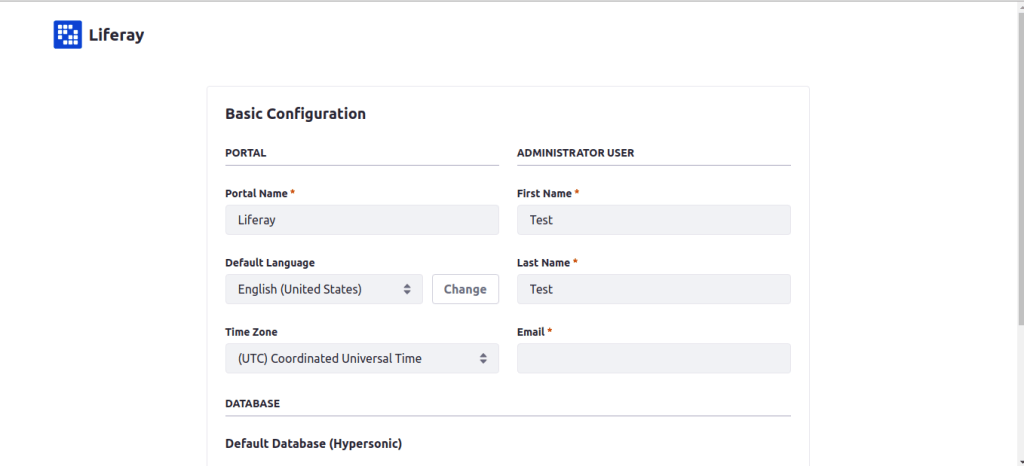
Goto http://localhost:8080/

Go with default hypersonic DB if you are in testing environment.


Restart the Tomcat server

sh shutdown.sh && sh startup.sh

and goto http://localhost:8080

If the server is not started properly, you can check the logs here:

cd ~/liferay-ce-portal-7.3.0-ga1/tomcat-9.0.17/logs/ && tail -f catalina.out

I faced the following issue in new 7.3 version with mysql db which I didn’t face with 7.2 version with Hypersonic DB. My mysql db schema is not proper to version 7.3.

  __    ____________________  _____  __
   / /   /  _/ ____/ ____/ __ \/   \ \/ /
  / /    / // /_  / __/ / /_/ / /| |\  /
 / /____/ // __/ / /___/ _, _/ ___ |/ /
/_____/___/_/   /_____/_/ |_/_/  |_/_/

Starting Liferay Community Edition Portal 7.3.0 CE GA1 (Athanasius / Build 7300 / January 20, 2020)

2020-03-23 12:22:13.798 INFO  [main][StartupHelperUtil:99] There are no patches installed
You must first upgrade the portal to the required schema version 8.1.0
2020-03-23 12:22:13.860 ERROR [main][MainServlet:300] java.lang.RuntimeException: You must first upgrade the portal to the required schema version 8.1.0
java.lang.RuntimeException: You must first upgrade the portal to the required schema version 8.1.0
	at com.liferay.portal.events.StartupHelperUtil.verifyRequiredSchemaVersion(StartupHelperUtil.java:220)
	at com.liferay.portal.events.StartupAction.doRun(StartupAction.java:136)
	at com.liferay.portal.events.StartupAction.run(StartupAction.java:77)
	at com.liferay.portal.internal.servlet.MainServlet.init(MainServlet.java:297)

You’re presented a Basic Configuration page. Complete the configuration options. Liferay Portal uses an embedded database (HSQL) to make installation fast and easy. This database is not ready for production, so consider configuring a production-ready database (e.g., MySQL) if you plan on doing more than just exploring/testing. Agree to the terms and conditions, create a password, and configure a security question/answer.

You can now use Liferay Portal!

You can check all the projects from Liferay:

https://liferay.dev/projects

Get started from here:
https://portal.liferay.dev/

Liferay IDE:
https://liferay.dev/projects/ide

Liferay SDK:

“Liferay Plugin SDK is a development environment allows you to develop plugins for Liferay of all types such as Portlet, Themes, Layout Templates. The Liferay Plugin SDK is based on the Apache Ant tool and it can be integrated with all the common IDEs or used directly from the command line by executing a set of predefined commands (targets, in Ant’s nomenclature). In this tutorial I show how to configure the Plugin SDK in the Eclipse IDE”

Check this link (this doc is for version 6.1) :

https://portal.liferay.dev/docs/6-1/develop/-/knowledge_base/t/installing-the-sdk

LifeRay DXP:

This is the paid version from Liferay. With Liferay DXP you can implement not just static site, but something like today’s frontend fromeworks do (updating the DOM according to framework and spontaneous data change). Also you get the liferay support according to your plan.

Links:

https://www.liferay.com/products/dxp
https://www.liferay.com/solutions/websites
https://www.liferay.com/products/dxp/30-day-trial

A Ruby on Rails Application without models

This blog is a quick walkthrough of creating a Ruby On Rails application without a model.

Find Rails new options from here:
https://gist.github.com/abhilashak/3c0c62fa62b2f7a439c417b68d032575

Find Gemfile options from here:

http://bundler.io/v1.2/gemfile.html

Install Ruby/Rails using rbenv

$ touch .rbenv-gemsets
$ echo project-name > .rbenv-gemsets
$ rbenv gemset active
$ rbenv install 2.5.3
$ gem install bundler
$ rbenv rehash
$ gem install rails -v 5.2.9
$ rbenv rehash
$ rails new my-new-porject --skip-active-record --skip-bundle -v 5.2.9

Add in Gemfile:

ruby “2.5.3”

comment jbuilder, we don’t need it.

# gem 'jbuilder', '~> 2.8’

Move rbenv gems file to new rails app folder

$ mv .rbenv-gemsets my-new-porject

$ touch .ruby-version

$ echo 2.5.3 > .ruby-version

$ gem install bundler

$ bundle

$ ruby -v
ruby 2.5.3p105 (2018-10-18 revision 65156) [x86_64-darwin18]

Start Rails server:

$ rails s

Gemfile add:

# Bootstrap Theme

gem 'bootstrap', '~> 4.3.0’

# Slim template Engine

gem 'slim', '>=4.0.1’

Do Bundle Install

$ bundle

Rename css to scss because we use bootsrap mixins and variables that work with scss files

$ mv app/assets/stylesheets/application.css app/assets/stylesheets/application.scss

Import Bootstrap styles in app/assets/stylesheets/application.scss:

// Custom bootstrap variables must be set or imported *before* bootstrap.
@import "bootstrap";

Then, remove all the *= require and *= require_tree statements from the Sass file. Instead, use @import to import Sass files.

Bootstrap JavaScript depends on jQuery
Add jquery-rails to Gemfile:

gem 'jquery-rails', '~> 4.3.4’

Bootstrap tooltips and popovers depend on popper.js for positioning.
Add Bootstrap dependencies and Bootstrap to your application.js:

//= require jquery3
//= require popper
//= require bootstrap-sprockets

While bootstrap-sprockets provides individual Bootstrap components for ease of debugging, you may alternatively require the concatenated bootstrap for faster compilation:

//= require jquery3
//= require popper
//= require bootstrap

Sass: Individual components

All Bootstrap opponents will be imported by default.
You can also import components explicitly. To start with a full list of modules copy _bootstrap.scss file into your assets as _bootstrap-custom.scss. Then comment out components you do not want from _bootstrap-custom. In the application Sass file, replace @import ‘bootstrap’ with:

@import 'bootstrap-custom';

Your application.css:

/*
 * This is a manifest file that'll be compiled into application.css, which will include all the files
 * listed below.
 *
 * Any CSS and SCSS file within this directory, lib/assets/stylesheets, or any plugin's
 * vendor/assets/stylesheets directory can be referenced here using a relative path.
 *
 * You're free to add application-wide styles to this file and they'll appear at the bottom of the
 * compiled file so the styles you add here take precedence over styles defined in any other CSS/SCSS
 * files in this directory. Styles in this file should be added after the last require_* statement.
 * It is generally better to create a new file per style scope.
 *
 */

/*Custom bootstrap variables must be set or imported *before* bootstrap.
  The available variables can be found: 
  https://github.com/twbs/bootstrap-rubygem/blob/master/assets/stylesheets/bootstrap/_variables.scss
*/
@import "bootstrap";

Your application.js File:

// This is a manifest file that'll be compiled into application.js, which will include all the files
// listed below.
//
// Any JavaScript/Coffee file within this directory, lib/assets/javascripts, or any plugin's
// vendor/assets/javascripts directory can be referenced here using a relative path.
//
// It's not advisable to add code directly here, but if you do, it'll appear at the bottom of the
// compiled file. JavaScript code in this file should be added after the last require_* statement.
//
// Read Sprockets README (https://github.com/rails/sprockets#sprockets-directives) for details
// about supported directives.
//
//= require rails-ujs
//= require turbolinks
//= require_tree .
//= require jquery3
//= require popper
//= require bootstrap-sprockets

You can check sample bootstrap forms here:

https://bootsnipp.com/snippets/featured/login-amp-signup-forms-in-panel

Remove cable.js from javascripts # we don’t need this for now