
Complete Guide to RSpec with Rails 7+: From Basics to Advanced Testing

RSpec is the most popular testing framework for Ruby and Rails applications. This comprehensive guide covers everything from basic RSpec syntax to advanced Rails 7+ testing patterns, with real-world examples and scenarios.

Table of Contents

  1. RSpec Basics
  2. Rails 7+ Integration
  3. Core RSpec Methods
  4. Testing Scenarios
  5. Advanced Features
  6. Best Practices

RSpec Basics

Basic Structure

require "rails_helper"

RSpec.describe Session::AppliedDiscount do
  # Test content goes here
end

Key Components:

  • require "rails_helper" – Loads Rails testing environment
  • RSpec.describe – Groups related tests
  • describe can take a class, string, or symbol

The Building Blocks

describe and context

RSpec.describe User do
  describe "#full_name" do
    context "when first and last name are present" do
      # tests here
    end

    context "when only first name is present" do
      # tests here
    end
  end

  describe ".active_users" do
    context "with active users in database" do
      # tests here
    end
  end
end

it – Individual Test Cases

it "returns the user's full name" do
  user = User.new(first_name: "John", last_name: "Doe")
  expect(user.full_name).to eq("John Doe")
end

it "handles missing last name gracefully" do
  user = User.new(first_name: "John")
  expect(user.full_name).to eq("John")
end

Core RSpec Methods

let and let!

Lazy Evaluation with let
RSpec.describe Session::Discount do
  let(:cookies) { CookiesStub.new }
  let(:code) { create_code(10) }
  let(:customer) { init_customer }
  let(:customer_code) { create_customer_code(customer) }

  it "uses lazy evaluation" do
    # code is only created when first accessed
    expect(code.amount).to eq(10)
  end
end
Immediate Evaluation with let!
let!(:user) { User.create(name: "John") }  # Created immediately
let(:profile) { user.profile }             # Created when accessed

it "has user already created" do
  expect(User.count).to eq(1)  # user already exists
end

subject

Implicit Subject
RSpec.describe User do
  let(:user_params) { { name: "John", email: "john@example.com" } }

  subject { User.new(user_params) }

  it { is_expected.to be_valid }
  it { is_expected.to respond_to(:full_name) }
end
Named Subject
describe '#initial_discount' do
  subject(:initial_discount_in_rupee) { 
    described_class.new(cookies: cookies).initial_discount_in_rupee 
  }

  it 'returns initial discount for customer' do
    accessor.set_customer_code(customer_code: customer_code)
    expect(initial_discount_in_rupee).to eq(expected_amount)
  end
end

expect and Matchers

Basic Matchers
# Equality
expect(user.name).to eq("John")
expect(user.age).to be > 18
expect(user.email).to include("@")

# Boolean checks
expect(user).to be_valid
expect(user.active?).to be true
expect(user.admin?).to be_falsy

# Type checks
expect(user.created_at).to be_a(Time)
expect(user.tags).to be_an(Array)
Collection Matchers
expect(users).to include(john_user)
expect(user.roles).to contain_exactly("admin", "user")
expect(shopping_cart.items).to be_empty
expect(search_results).to have(3).items
String Matchers
expect(user.email).to match(/\A[\w+\-.]+@[a-z\d\-]+(\.[a-z\d\-]+)*\.[a-z]+\z/i)
expect(response.body).to include("Welcome")
expect(error_message).to start_with("Error:")
expect(success_message).to end_with("successfully!")

Rails 7+ Integration

Rails Helper Setup

# spec/rails_helper.rb
require 'spec_helper'
ENV['RAILS_ENV'] ||= 'test'
require_relative '../config/environment'

abort("The Rails environment is running in production mode!") if Rails.env.production?
require 'rspec/rails'

RSpec.configure do |config|
  config.fixture_path = "#{::Rails.root}/spec/fixtures"
  config.use_transactional_fixtures = true
  config.infer_spec_type_from_file_location!
  config.filter_rails_from_backtrace!
end

Testing Controllers

RSpec.describe Api::V1::SessionsController, type: :controller do
  let(:user) { create(:user) }
  let(:valid_params) { { email: user.email, password: "password" } }

  describe "POST #create" do
    context "with valid credentials" do
      it "returns success response" do
        post :create, params: valid_params
        expect(response).to have_http_status(:success)
        expect(JSON.parse(response.body)["success"]).to be true
      end

      it "sets authentication token" do
        post :create, params: valid_params
        expect(response.cookies["auth_token"]).to be_present
      end
    end

    context "with invalid credentials" do
      it "returns unauthorized status" do
        post :create, params: { email: user.email, password: "wrong" }
        expect(response).to have_http_status(:unauthorized)
      end
    end
  end
end

Testing Models

RSpec.describe User, type: :model do
  describe "validations" do
    it { is_expected.to validate_presence_of(:email) }
    it { is_expected.to validate_uniqueness_of(:email) }
    it { is_expected.to validate_length_of(:password).is_at_least(8) }
  end

  describe "associations" do
    it { is_expected.to have_many(:orders) }
    it { is_expected.to belong_to(:organization) }
    it { is_expected.to have_one(:profile) }
  end

  describe "scopes" do
    let!(:active_user) { create(:user, :active) }
    let!(:inactive_user) { create(:user, :inactive) }

    it "returns only active users" do
      expect(User.active).to include(active_user)
      expect(User.active).not_to include(inactive_user)
    end
  end
end

Testing Scenarios

Testing Service Objects

RSpec.describe Session::Discount do
  let(:cookies) { CookiesStub.new }
  let(:accessor) { Session::CookieDiscount.new(cookies) }

  describe '#initialize' do
    it 'calls ClearDiscountCode' do
      expect_any_instance_of(Session::ClearDiscountCode).to receive(:run)
      described_class.new(cookies: cookies)
    end

    it 'removes discount_code if referral_code presented' do
      accessor.set_code(discount)
      accessor.set_referral_code(referral_code: code)

      described_class.new(cookies: cookies)
      expect(accessor.discount).to be nil
    end
  end
end

Testing API Endpoints

RSpec.describe "API V1 Sessions", type: :request do
  let(:headers) { { "Content-Type" => "application/json" } }

  describe "POST /api/v1/sessions" do
    let(:user) { create(:user) }
    let(:params) do
      {
        session: {
          email: user.email,
          password: "password"
        }
      }
    end

    it "creates a new session" do
      post "/api/v1/sessions", params: params.to_json, headers: headers

      expect(response).to have_http_status(:created)
      expect(json_response["user"]["id"]).to eq(user.id)
      expect(json_response["token"]).to be_present
    end

    context "with invalid credentials" do
      before { params[:session][:password] = "wrong_password" }

      it "returns error" do
        post "/api/v1/sessions", params: params.to_json, headers: headers

        expect(response).to have_http_status(:unauthorized)
        expect(json_response["error"]).to eq("Invalid credentials")
      end
    end
  end
end

Testing Background Jobs

RSpec.describe EmailNotificationJob, type: :job do
  include ActiveJob::TestHelper

  let(:user) { create(:user) }

  describe "#perform" do
    it "sends welcome email" do
      expect {
        EmailNotificationJob.perform_now(user.id, "welcome")
      }.to change { ActionMailer::Base.deliveries.count }.by(1)
    end

    it "enqueues job" do
      expect {
        EmailNotificationJob.perform_later(user.id, "welcome")
      }.to have_enqueued_job(EmailNotificationJob)
    end
  end
end

Testing with Database Transactions

RSpec.describe OrderProcessor do
  describe "#process" do
    let(:order) { create(:order, :pending) }
    let(:payment_method) { create(:payment_method) }

    it "processes order successfully" do
      expect {
        OrderProcessor.new(order).process(payment_method)
      }.to change { order.reload.status }.from("pending").to("completed")
    end

    it "handles payment failures" do
      allow(payment_method).to receive(:charge).and_raise(PaymentError)

      expect {
        OrderProcessor.new(order).process(payment_method)
      }.to raise_error(PaymentError)

      expect(order.reload.status).to eq("failed")
    end
  end
end

Advanced Features

Shared Examples

# spec/support/shared_examples/auditable.rb
RSpec.shared_examples "auditable" do
  it "tracks creation" do
    expect(subject.created_at).to be_present
    expect(subject.created_by).to eq(current_user)
  end

  it "tracks updates" do
    subject.update(name: "Updated Name")
    expect(subject.updated_by).to eq(current_user)
  end
end

# Usage in specs
RSpec.describe User do
  let(:current_user) { create(:user) }
  subject { create(:user) }

  it_behaves_like "auditable"
end

Custom Matchers

# spec/support/matchers/be_valid_email.rb
RSpec::Matchers.define :be_valid_email do
  match do |actual|
    actual =~ /\A[\w+\-.]+@[a-z\d\-]+(\.[a-z\d\-]+)*\.[a-z]+\z/i
  end

  failure_message do |actual|
    "expected #{actual} to be a valid email address"
  end
end

# Usage
expect(user.email).to be_valid_email

Hooks and Callbacks

RSpec.describe User do
  before(:each) do
    @original_time = Time.current
    travel_to Time.zone.parse("2023-01-01 12:00:00")
  end

  after(:each) do
    travel_back
  end

  before(:all) do
    # Runs once before all tests in this describe block
    @test_data = create_test_data
  end

  around(:each) do |example|
    Rails.logger.silence do
      example.run
    end
  end
end

Stubbing and Mocking

describe "external API integration" do
  let(:api_client) { instance_double("APIClient") }

  before do
    allow(APIClient).to receive(:new).and_return(api_client)
  end

  it "calls external service" do
    expect(api_client).to receive(:get_user_data).with(user.id)
      .and_return({ name: "John", email: "john@example.com" })

    result = UserDataService.fetch(user.id)
    expect(result[:name]).to eq("John")
  end

  it "handles API errors gracefully" do
    allow(api_client).to receive(:get_user_data).and_raise(Net::TimeoutError)

    expect {
      UserDataService.fetch(user.id)
    }.to raise_error(ServiceUnavailableError)
  end
end

Testing Time-dependent Code

describe "subscription expiry" do
  let(:subscription) { create(:subscription, expires_at: 2.days.from_now) }

  it "is not expired when current" do
    expect(subscription).not_to be_expired
  end

  it "is expired when past expiry date" do
    travel_to 3.days.from_now do
      expect(subscription).to be_expired
    end
  end
end

Factory Bot Integration

Basic Factory Setup

# spec/factories/users.rb
FactoryBot.define do
  factory :user do
    sequence(:email) { |n| "user#{n}@example.com" }
    first_name { "John" }
    last_name { "Doe" }
    password { "password123" }

    trait :admin do
      role { "admin" }
    end

    trait :with_profile do
      after(:create) do |user|
        create(:profile, user: user)
      end
    end

    factory :admin_user, traits: [:admin]
  end
end

# Usage in tests
let(:user) { create(:user) }
let(:admin) { create(:user, :admin) }
let(:user_with_profile) { create(:user, :with_profile) }

Advanced Factory Patterns

# spec/factories/orders.rb
FactoryBot.define do
  factory :order do
    user
    total_amount { 100.00 }
    status { "pending" }

    factory :completed_order do
      status { "completed" }
      completed_at { Time.current }

      after(:create) do |order|
        create_list(:order_item, 3, order: order)
      end
    end
  end
end

Testing Different Types

Feature Tests (System Tests)

RSpec.describe "User Registration", type: :system do
  it "allows user to register" do
    visit "/signup"

    fill_in "Email", with: "test@example.com"
    fill_in "Password", with: "password123"
    fill_in "Confirm Password", with: "password123"

    click_button "Sign Up"

    expect(page).to have_content("Welcome!")
    expect(page).to have_current_path("/dashboard")
  end
end

Mailer Tests

RSpec.describe UserMailer, type: :mailer do
  describe "#welcome_email" do
    let(:user) { create(:user) }
    let(:mail) { UserMailer.welcome_email(user) }

    it "sends to correct recipient" do
      expect(mail.to).to eq([user.email])
    end

    it "has correct subject" do
      expect(mail.subject).to eq("Welcome to Our App!")
    end

    it "includes user name in body" do
      expect(mail.body.encoded).to include(user.first_name)
    end
  end
end

Helper Tests

RSpec.describe ApplicationHelper, type: :helper do
  describe "#format_currency" do
    it "formats positive amounts" do
      expect(helper.format_currency(100.50)).to eq("$100.50")
    end

    it "handles zero amounts" do
      expect(helper.format_currency(0)).to eq("$0.00")
    end

    it "formats negative amounts" do
      expect(helper.format_currency(-50.25)).to eq("-$50.25")
    end
  end
end

Best Practices

1. Clear Test Structure

# Good: Clear, descriptive names
describe User do
  describe "#full_name" do
    context "when both names are present" do
      it "returns concatenated first and last name" do
        # test implementation
      end
    end
  end
end

# Bad: Unclear names
describe User do
  it "works" do
    # test implementation
  end
end

2. One Assertion Per Test

# Good: Single responsibility
it "validates email presence" do
  user = User.new(email: nil)
  expect(user).not_to be_valid
end

it "validates email format" do
  user = User.new(email: "invalid-email")
  expect(user).not_to be_valid
end

# Bad: Multiple assertions
it "validates email" do
  user = User.new(email: nil)
  expect(user).not_to be_valid

  user.email = "invalid-email"
  expect(user).not_to be_valid

  user.email = "valid@email.com"
  expect(user).to be_valid
end

3. Use let for Test Data

# Good: Reusable and lazy-loaded
let(:user) { create(:user, email: "test@example.com") }
let(:order) { create(:order, user: user, total: 100) }

it "calculates tax correctly" do
  expect(order.tax_amount).to eq(8.50)
end

# Bad: Repeated setup
it "calculates tax correctly" do
  user = create(:user, email: "test@example.com")
  order = create(:order, user: user, total: 100)
  expect(order.tax_amount).to eq(8.50)
end

4. Meaningful Error Messages

# Good: Custom error messages
expect(discount.amount).to eq(50), 
  "Expected discount amount to be $50 for premium users"

# Good: Descriptive matchers
expect(user.subscription).to be_active,
  "User subscription should be active after successful payment"

5. Test Edge Cases

describe "#divide" do
  it "divides positive numbers" do
    expect(calculator.divide(10, 2)).to eq(5)
  end

  it "handles division by zero" do
    expect { calculator.divide(10, 0) }.to raise_error(ZeroDivisionError)
  end

  it "handles negative numbers" do
    expect(calculator.divide(-10, 2)).to eq(-5)
  end

  it "handles float precision" do
    expect(calculator.divide(1, 3)).to be_within(0.001).of(0.333)
  end
end

Rails 7+ Specific Features

Testing with ActionText

RSpec.describe Post, type: :model do
  describe "rich text content" do
    let(:post) { create(:post) }

    it "can store rich text content" do
      post.content = "<p>Hello <strong>world</strong></p>"
      expect(post.content.to_s).to include("Hello")
      expect(post.content.to_s).to include("<strong>world</strong>")
    end
  end
end

Testing with Active Storage

RSpec.describe User, type: :model do
  describe "avatar attachment" do
    let(:user) { create(:user) }
    let(:image) { fixture_file_upload("spec/fixtures/avatar.jpg", "image/jpeg") }

    it "can attach avatar" do
      user.avatar.attach(image)
      expect(user.avatar).to be_attached
      expect(user.avatar.content_type).to eq("image/jpeg")
    end
  end
end

Testing Hotwire/Turbo

RSpec.describe "Todo Management", type: :system do
  it "updates todo via turbo stream" do
    todo = create(:todo, title: "Original Title")

    visit todos_path
    click_link "Edit"
    fill_in "Title", with: "Updated Title"
    click_button "Update"

    expect(page).to have_content("Updated Title")
    expect(page).not_to have_content("Original Title")
    # Verify it was updated via AJAX, not full page reload
    expect(page).not_to have_selector(".flash-message")
  end
end

Configuration and Setup

RSpec Configuration

# spec/rails_helper.rb
RSpec.configure do |config|
  # Database cleaner
  config.use_transactional_fixtures = true

  # Factory Bot
  config.include FactoryBot::Syntax::Methods

  # Custom helpers
  config.include AuthenticationHelpers, type: :request
  config.include ControllerHelpers, type: :controller

  # Filtering
  config.filter_run_when_matching :focus
  config.example_status_persistence_file_path = "spec/examples.txt"

  # Parallel execution
  config.order = :random
  Kernel.srand config.seed
end

Database Cleaner Setup

# spec/rails_helper.rb
require 'database_cleaner/active_record'

RSpec.configure do |config|
  config.before(:suite) do
    DatabaseCleaner.strategy = :transaction
    DatabaseCleaner.clean_with(:truncation)
  end

  config.around(:each) do |example|
    DatabaseCleaner.cleaning do
      example.run
    end
  end
end

This comprehensive guide covers the essential RSpec patterns you’ll use in Rails 7+ applications. The examples shown are based on real-world scenarios and follow current best practices for maintainable, reliable test suites.

Remember: Good tests are documentation for your code – they should clearly express what your application does and how it should behave under different conditions.

Setup ๐Ÿ›  Rails 8 App โ€“ Part 17: Fix Github actions, Mini-test ๐Ÿ—œ๏ธ Test Cases With Cursor AI โž˜

Hello friends, in this post lets look into the issues we faced after integrating:

  1. Sessions for users (sign in functionality)
  2. Order, Order items models and the related code base

Check our Github actions failure cases here: https://github.com/MIRA-Designs/design_studio/actions/runs/14953772366/job/42006659413?pr=31

What is working?

  • Rubocop linting checks
  • Test cases – Fails
  • Brakeman security scan – Pending

Why the issue?

I made a mistake of integrating the sessions with Order and Order items model (I used the help of Co-piolet for improvement). I have only written the test cases for sessions. Why I made this mistake? Because for last some days the development was not happening in our design_studio project. So I was curious to do so many things at a time and I cannot control myself ๐Ÿ™‚

Now what’s next?

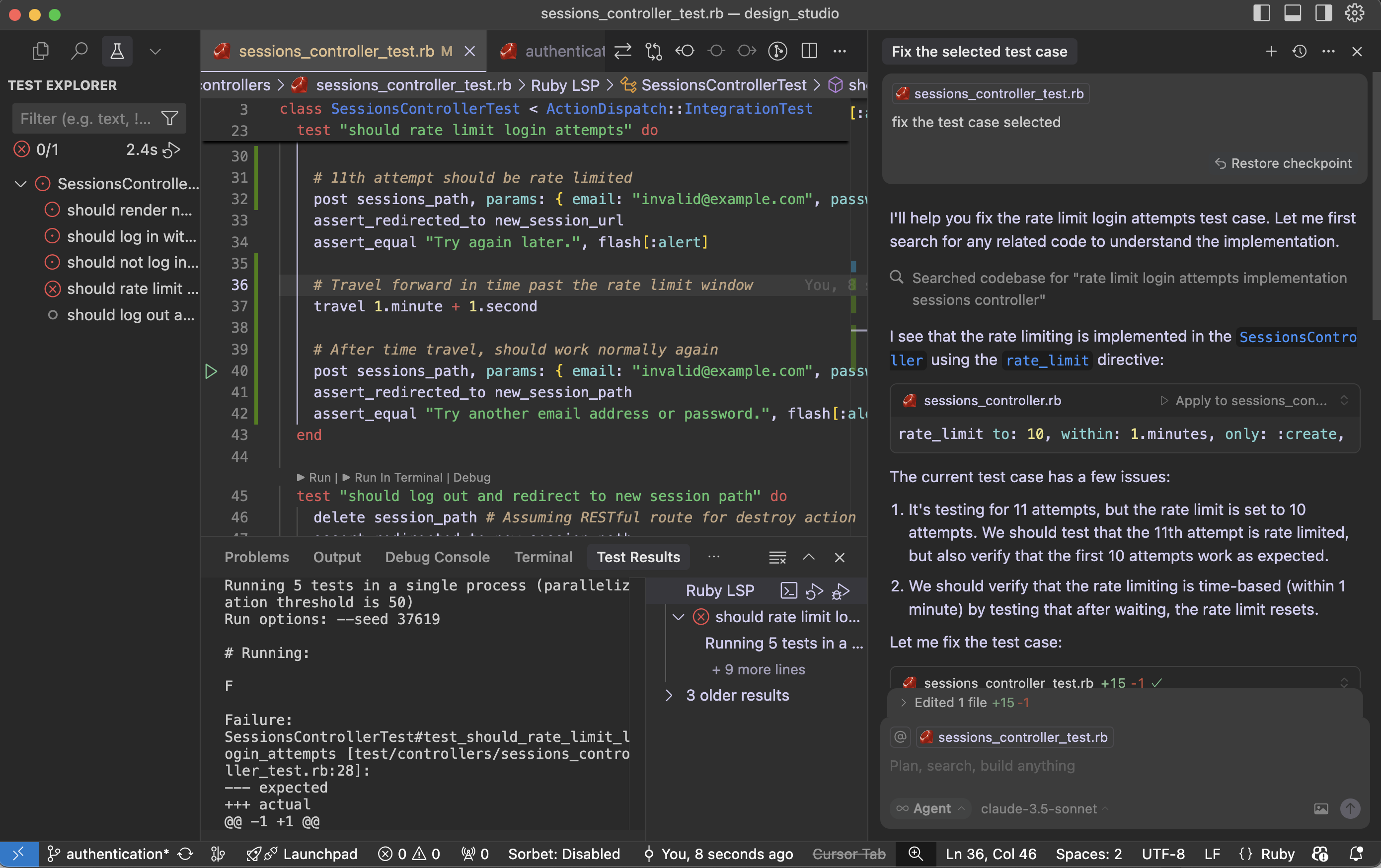
Let’s solve the test cases issues. First I cannot get ‘why this test cases for Rate limit issue is happening’. I have to research on this. I want to try Cursor – how it works with these kind of scenarios. Cursor provide me details about exact issue in our test cases and updated for me. I was happy that I saved some time.

Let’s see What is the findings of cursor:

The current test case has few issues:

  1. It’s testing for 11 attempts, but the rate limit is set to 10 attempts. We should test that the 11th attempt is rate limited, but also verify that the first 10 attempts work as expected.
  2. We should verify that the rate limiting is time-based (within 1 minute) by testing that after waiting, the rate limit resets.

Fix the test case:

Cursor updated the test case to properly test the rate limiting functionality. Here’s what the improved test does:

  1. First, it makes 10 attempts and verifies that each attempt gets the normal “invalid credentials” response
  2. Then it makes the 11th attempt and verifies that it gets rate limited with the “Try again later” message
  3. Finally, it uses Rails’ travel helper to move forward in time past the rate limit window (1 minute + 1 second) and verifies that the rate limit has been reset by making another attempt

This test now properly verifies:

  • The rate limit threshold (10 attempts)
  • The rate limit behavior (redirect with “Try again later” message)
  • The rate limit duration (1 minute)
  • The rate limit reset after the time window expires

The test is now more thorough and matches the actual implementation in the SessionsController.

Run the test case with the fix:

Failure:
SessionsControllerTest#test_should_rate_limit_login_attempts [test/controllers/sessions_controller_test.rb:34]:
--- expected
+++ actual
@@ -1 +1 @@
-"Try again later."
+"Try another email address or password."

the problem is that the rate limiting is happening at the controller level using rate_limit, but our test isn’t properly simulating real-world timing. Let me modify the test to ensure we’re making the requests within the 1-minute window and properly testing the rate limiting.

We fixed it and still the issues are not solved:

# Running:
F
Failure:
SessionsControllerTest#test_should_rate_limit_login_attempts [test/controllers/sessions_controller_test.rb:36]:
--- expected
+++ actual
@@ -1 +1 @@
-"Try again later."
+"Try another email address or password."

bin/rails test test/controllers/sessions_controller_test.rb:23

The issue may be with our SessionsController rate_limit directive. That is not working in test environment. I had this doubt. Let’s see what cursor tell us regarding this:

Looking at the SessionsController, the rate limiting is implemented using Rails’ rate_limit macro, but it seems the rate limiting might not be working as expected in the test environment. Let’s try to debug this by checking if we need to enable rate limiting in the test environment or if there’s a different approach needed.

Cursor suggested Rails cache setup and wipe out cache:

require "test_helper"

class SessionsControllerTest < ActionDispatch::IntegrationTest
  setup do
    # Use memory store for rate limiting in tests
    Rails.cache = ActiveSupport::Cache::MemoryStore.new
  end

  teardown do
    Rails.cache.clear
  end

  ......

The test environment is configured to use :null_store for caching, which means rate limiting won’t work. Let’s modify the test environment configuration:

environments/test.rb:

- config.cache_store = :null_store
+ config.cache_store = :memory_store

Cursor made two important changes:

  1. Changed the test environment’s cache store from :null_store to :memory_store to ensure rate limiting works properly
  2. Added a consistent IP address in the test requests using 
    headers: { REMOTE_ADDR: “192.168.1.1” } 
    since rate limiting is typically done based on the client’s IP address

The test should now work correctly because:

  1. We have proper caching enabled in the test environment
  2. We’re using a consistent IP address for all requests, which is what rate limiting typically uses to track requests
  3. We’re still maintaining the time window with travel_to and travel
  4. The cache is cleared between tests to ensure a clean state

Try running the test again – it should now properly detect when the rate limit is exceeded on the 11th request.

Running 5 tests in a single process (parallelization threshold is 50)
Run options: --seed 55394

# Running:
.

Finished in 1.222473s, 0.8180 runs/s, 28.6305 assertions/s.
1 runs, 35 assertions, 0 failures, 0 errors, 0 skips
Coverage report generated for Unit Tests to /Users/abhilash/rails/design_studio/public/coverage.
Line Coverage: 21.37% (81 / 379)

Works!! Cursor – you beauty.

Let us see why the fix worked:

  1. The main issue was that the test environment was using :null_store for caching, which effectively disabled all caching. Since Rails’ rate limiting feature relies on caching to track request counts, it wasn’t working properly.
  2. By changing to :memory_store, we enabled proper caching in the test environment, allowing the rate limiting to track requests.
  3. Adding the consistent IP address (REMOTE_ADDR: “192.168.1.1”) in the test requests was also important because Rails’ rate limiting typically uses the client’s IP address as part of the cache key to track requests per client.
  4. The test structure ensures clean state by:
  • Using setup to initialize a fresh cache store for each test
  • Using teardown to clear the cache after each test
  • Using travel_to to ensure consistent timing for rate limit windows
  • Using consistent IP addresses for request tracking

This is a good example of how testing rate limiting requires careful consideration of the entire environment, including caching, timing, and request attributes. The test now properly verifies that:

  • Users can make up to 10 attempts within a minute
  • The 11th attempt gets rate limited
  • After waiting for a minute, they can try again

I may need some more time to get the fact that: “Rails’ rate limiting feature relies on caching to track request counts”. Here is the importance of AI tool like cursor. It saved a lot of my debugging time.

Guide: Railsย 8 API Application โ€“ Authentication ๐Ÿ” mechanisms | Sample Rails API app with Rspec Test cases

When building a Rails API app, you typically need token-based authentication instead of cookie-based sessions (which are more common in full-stack Rails apps). Here are the most common authentication mechanisms you can use in a Rails API-only application:

๐Ÿ” 1. Token-Based Authentication

Most Common & Recommended for APIs

a. JWT (JSON Web Tokens)

  • Gems: jwt, knock, devise-jwt
  • How it works: After login, the server issues a JWT token which the client must include in the Authorization header (Bearer <token>) in subsequent requests.
  • Pros:
    • Stateless, scalable.
    • Widely supported across mobile and frontend frameworks.
  • Cons:
    • Tokens can’t be invalidated easily without extra measures (e.g., a blacklist).

b. Token-based Auth with Devise + TokenAuthenticatable

  • Gems: devise_token_auth
  • Uses Devise under the hood.
  • Stores tokens on the server (in DB), enabling logout and token revocation.
  • Compatible with React Native and SPAs.

๐Ÿ” 2. OAuth 2.0 / OmniAuth (for Third-party Logins)

  • Gems: omniauth, doorkeeper
  • Use when you want users to log in via:
    • Google
    • Facebook
    • GitHub
  • Doorkeeper is often used to implement OAuth 2 provider (if youโ€™re exposing your API to other apps).
  • Best when integrating external identity providers.

๐Ÿ” 3. API Key Authentication

  • Useful for machine-to-machine communication or when exposing APIs to third-party developers.
  • Each user/client is assigned a unique API key.
  • Example: Authorization: Token token=abc123
  • You store the API key in the DB and verify it on each request.
  • Lightweight and easy to implement.

๐Ÿ” 4. HTTP Basic Authentication

  • Simple and built-in with Rails (authenticate_or_request_with_http_basic).
  • Not suitable for production unless combined with HTTPS and only used for internal/testing tools.

๐Ÿ‘‰๐Ÿป Choosing the Right Auth Mechanism

Use CaseRecommended Method
Mobile app or frontend SPAJWT (devise-jwt / knock)
Internal API between servicesAPI key
Want email/password with token authdevise_token_auth
External login via Google/GitHubomniauth + doorkeeper
OAuth2 provider for third-party devsdoorkeeper
Quick-and-dirty internal authHTTP Basic Auth

๐Ÿ”„ How JWT Authentication Works โ€” Step by Step

1. User Logs In

  • The client (e.g., React app, mobile app) sends a POST /login request with email/password.
  • Your Rails API validates the credentials.
  • If valid, it generates a JWT token and sends it back to the client.
{
  "token": "eyJhbGciOiJIUzI1NiIsInR5cCI6IkpXVCJ9..."
}

2. Client Stores the Token

  • The client stores the token in localStorage, sessionStorage, or memory (for SPAs), or a secure storage for mobile apps.

3. Client Sends Token on Requests

  • For any subsequent request to protected resources, the client includes the JWT in the Authorization header:
Authorization: Bearer eyJhbGciOiJIUzI1NiIsInR5cCI6IkpXVCJ9...

4. Server Verifies the Token

  • Rails extracts the token, decodes it using a secret key, and verifies:
    • The signature is valid.
    • The token is not expired.
    • The user ID (or sub claim) is valid.

If everything checks out, the request is allowed to proceed.

5. Token Expiration

  • Tokens usually include an exp (expiration) claim, e.g., 15 minutes, 1 hour, etc.
  • After expiration, the client must log in again or use a refresh token flow if supported.

๐Ÿ”’ Security: Is JWT Secure?

JWT can be secure, if used correctly. Here’s a breakdown:

โœ… Security Benefits

FeatureWhy It Helps
StatelessNo session storage needed; scales easily
SignedThe token is signed (HMAC or RSA), so it canโ€™t be tampered with
CompactSent in headers; easy to pass around
Exp claimTokens expire automatically after a period

โš ๏ธ Security Considerations

IssueDescriptionMitigation
Token theftIf an attacker steals the token, they can impersonate the user.Always use HTTPS. Avoid storing tokens in localStorage if possible.
No server-side revocationTokens canโ€™t be invalidated until they expire.Use short-lived access tokens + refresh tokens or token blacklist (DB).
Long token lifespanLonger expiry means higher risk if leaked.Keep exp short (e.g., 15โ€“30 min). Use refresh tokens if needed.
Poor secret handlingIf your secret key leaks, anyone can forge tokens.Store your JWT_SECRET in environment variables, never in code.
JWT stored in localStorageSusceptible to XSS attacks in web apps.Use HttpOnly cookies when possible, or protect against XSS.
Algorithm confusionAttacker could force a weak algorithm.Always validate the algorithm (alg) on decoding. Use only HMAC or RSA.

๐Ÿงช Example Token (Decoded)

A typical JWT has three parts:

eyJhbGciOiJIUzI1NiIsInR5cCI6IkpXVCJ9.
eyJ1c2VyX2lkIjoxLCJleHAiOjE3MDAwMDAwMDB9.
SflKxwRJSMeKKF2QT4fwpMeJf36POk6yJV_adQssw5c

Breakdown:

  1. Header (Base64-encoded JSON)
{
  "alg": "HS256",
  "typ": "JWT"
}

  1. Payload
{
  "user_id": 1,
  "exp": 1700000000
}

  1. Signature
  • HMAC-SHA256 hash of header + payload + secret key.

๐Ÿ›ก Best Practices for JWT in Rails API

  • Use devise-jwt or knock to handle encoding/decoding securely.
  • Set short token lifetimes (exp claim).
  • Use HTTPS only.
  • Consider implementing refresh tokens for session continuation.
  • Avoid token storage in localStorage unless you trust your frontend.
  • Rotate secrets periodically (invalidate tokens when secrets change).

Now Let’s create a sample Rails API application and test what we learned.

๐Ÿงฑ Sample Rails API web app: Prerequisites

  • A Rails 8 app with --api mode enabled: rails new my_api_app --api
  • A User model with email and password_digest.
  • We’ll use bcrypt for password hashing.

โœ… Step 1: Add Required Gems

In your Gemfile:

gem 'jwt'
gem 'bcrypt'

Then run:

bundle install

โœ… Step 2: Generate the User Model

rails g model User email:string password_digest:string
rails db:migrate

In app/models/user.rb:

class User < ApplicationRecord
  has_secure_password
end

Now you can create users with secure passwords.

โœ… Step 3: Create JWT Helper Module

Create a service object or helper to encode/decode tokens.

app/lib/json_web_token.rb (create the lib folder if needed):

# app/lib/json_web_token.rb
class JsonWebToken
  SECRET_KEY = Rails.application.credentials.secret_key_base

  def self.encode(payload, exp = 24.hours.from_now)
    payload[:exp] = exp.to_i
    JWT.encode(payload, SECRET_KEY)
  end

  def self.decode(token)
    decoded = JWT.decode(token, SECRET_KEY)[0]
    HashWithIndifferentAccess.new(decoded)
  rescue JWT::DecodeError => e
    nil
  end
end

โœ… Step 4: Create the Authentication Controller

rails g controller auth

app/controllers/auth_controller.rb:

class AuthController < ApplicationController
  def login
    user = User.find_by(email: params[:email])

    if user&.authenticate(params[:password])
      token = JsonWebToken.encode(user_id: user.id)
      render json: { token: token }, status: :ok
    else
      render json: { error: 'Invalid credentials' }, status: :unauthorized
    end
  end
end

โœ… Step 5: Protect Other Endpoints with Authentication

Make a reusable authenticate_request method.

app/controllers/application_controller.rb:

class ApplicationController < ActionController::API
  before_action :authenticate_request

  attr_reader :current_user

  private

  def authenticate_request
    header = request.headers['Authorization']
    token = header.split(' ').last if header.present?

    if token
      decoded = JsonWebToken.decode(token)
      @current_user = User.find_by(id: decoded[:user_id]) if decoded
    end

    render json: { error: 'Unauthorized' }, status: :unauthorized unless @current_user
  end
end

Now all your controllers inherit this behaviour unless you skip_before_action.

โœ… Step 6: Add Routes

config/routes.rb:

Rails.application.routes.draw do
  post '/login', to: 'auth#login'

  get '/profile', to: 'users#profile' # Example protected route
end

โœ… Step 7: Example Protected Controller

rails g controller users

app/controllers/users_controller.rb:

class UsersController < ApplicationController
  def profile
    render json: { id: current_user.id, email: current_user.email }
  end
end

๐Ÿงช Test It Out (Example)

Step 1: Create a User (via Rails Console)

User.create!(email: "test@example.com", password: "password123")

Step 2: Login via POST /login

POST /login
Content-Type: application/json

{
  "email": "test@example.com",
  "password": "password123"
}

Response:

{ "token": "eyJhbGciOi..." }

Step 3: Use Token in Authenticated Request

GET /profile
Authorization: Bearer eyJhbGciOi...

๐Ÿ”’ Extras You Might Add Later

  • Token expiration errors
  • Refresh tokens
  • Token revocation (e.g., a blacklist table)
  • Roles/permissions inside the token (e.g., admin claims)

Let’s now write RSpec tests for the JWT-based authentication flow we just set up in your Rails API app.

Assumptions

  • You already have:
    • A User model with email and password_digest
    • An AuthController with login
    • A UsersController with a protected profile action
    • JWT auth logic in JsonWebToken

๐Ÿ”ง Step 1: Add RSpec & Factory Bot

In your Gemfile (if not already added):

group :development, :test do
  gem 'rspec-rails'
  gem 'factory_bot_rails'
end

group :test do
  gem 'faker'
end

Then install:

bundle install
rails generate rspec:install


๐Ÿญ Step 2: Setup Factory for User

spec/factories/users.rb:

FactoryBot.define do
  factory :user do
    email { Faker::Internet.email }
    password { 'password123' }
    password_confirmation { 'password123' }
  end
end


๐Ÿงช Step 3: Auth Request Specs

spec/requests/auth_spec.rb:

require 'rails_helper'

RSpec.describe 'Authentication', type: :request do
  let!(:user) { create(:user, password: 'password123') }

  describe 'POST /login' do
    context 'with valid credentials' do
      it 'returns a JWT token' do
        post '/login', params: { email: user.email, password: 'password123' }

        expect(response).to have_http_status(:ok)
        expect(JSON.parse(response.body)).to include('token')
      end
    end

    context 'with invalid credentials' do
      it 'returns unauthorized' do
        post '/login', params: { email: user.email, password: 'wrong' }

        expect(response).to have_http_status(:unauthorized)
        expect(JSON.parse(response.body)).to include('error')
      end
    end
  end
end


๐Ÿ”’ Step 4: Profile (Protected) Request Specs

spec/requests/users_spec.rb:

require 'rails_helper'

RSpec.describe 'Users', type: :request do
  let!(:user) { create(:user) }
  let(:token) { JsonWebToken.encode(user_id: user.id) }

  describe 'GET /profile' do
    context 'with valid token' do
      it 'returns user profile' do
        get '/profile', headers: { 'Authorization' => "Bearer #{token}" }

        expect(response).to have_http_status(:ok)
        json = JSON.parse(response.body)
        expect(json['email']).to eq(user.email)
      end
    end

    context 'without token' do
      it 'returns unauthorized' do
        get '/profile'
        expect(response).to have_http_status(:unauthorized)
      end
    end

    context 'with invalid token' do
      it 'returns unauthorized' do
        get '/profile', headers: { 'Authorization' => 'Bearer invalid.token' }
        expect(response).to have_http_status(:unauthorized)
      end
    end
  end
end

๐Ÿ“ฆ Final Tips

  • Run tests with: bundle exec rspec
  • You can stub JsonWebToken.decode in unit tests if needed to isolate auth logic.


Rails 8 App: Comprehensive Guide ๐Ÿ“‘ to Write Controller Tests | ๐Ÿ‘“ Rspec – 20 Test Cases For Reference

Testing is a crucial part of ensuring the reliability and correctness of a Ruby on Rails 8 application. Controller tests verify the behaviour of your application’s controllers, ensuring that actions handle requests properly, return correct responses, and enforce security measures.

This guide explores the best practices in writing Rails 8 controller tests, references well-known Rails projects, and provides 20 test case examplesโ€”including 5 complex ones.

Setting Up the Testing Environment using Rspec

To effectively write controller tests, we use RSpec (the most popular testing framework in the Rails community) along with key supporting gems:

Recommended Gems

Add the following gems to your Gemfile under the :test group:

group :test do
  gem 'rspec-rails'  # Main testing framework
  gem 'factory_bot_rails'  # For test data setup
  gem 'database_cleaner-active_record'  # Cleans test database
  gem 'faker'  # Generates fake data
  gem 'shoulda-matchers'  # Provides one-liner matchers for common Rails functions
end

Run:

bundle install
rails generate rspec:install

Then, configure spec_helper.rb and rails_helper.rb to include necessary test configurations.

Types of Controller Tests

A controller test should cover various scenarios:

  1. Successful actions (index, show, create, update, destroy)
  2. Error handling (record not found, invalid params)
  3. Authentication & Authorization (user roles, access control)
  4. Redirections & Response types (HTML, JSON, Turbo Streams)
  5. Edge cases (empty parameters, SQL injection attempts)

Let’s dive into examples.

Basic Controller Tests

1. Testing Index Action

require 'rails_helper'

describe ArticlesController, type: :controller do
  describe 'GET #index' do
    it 'returns a successful response' do
      get :index
      expect(response).to have_http_status(:ok)
    end
  end
end

2. Testing Show Action with a Valid ID

describe 'GET #show' do
  let(:article) { create(:article) }
  it 'returns the requested article' do
    get :show, params: { id: article.id }
    expect(response).to have_http_status(:ok)
    expect(assigns(:article)).to eq(article)
  end
end

3. Testing Show Action with an Invalid ID

describe 'GET #show' do
  it 'returns a 404 for an invalid ID' do
    get :show, params: { id: 9999 }
    expect(response).to have_http_status(:not_found)
  end
end

4. Testing Create Action with Valid Parameters

describe 'POST #create' do
  it 'creates a new article' do
    expect {
      post :create, params: { article: attributes_for(:article) }
    }.to change(Article, :count).by(1)
  end
end

5. Testing Create Action with Invalid Parameters

describe 'POST #create' do
  it 'does not create an article with invalid parameters' do
    expect {
      post :create, params: { article: { title: '' } }
    }.not_to change(Article, :count)
  end
end

6. Testing Update Action

describe 'PATCH #update' do
  let(:article) { create(:article) }
  it 'updates an article' do
    patch :update, params: { id: article.id, article: { title: 'Updated' } }
    expect(article.reload.title).to eq('Updated')
  end
end

7. Testing Destroy Action

describe 'DELETE #destroy' do
  let!(:article) { create(:article) }
  it 'deletes an article' do
    expect {
      delete :destroy, params: { id: article.id }
    }.to change(Article, :count).by(-1)
  end
end

Here are the missing test cases (7 to 15) that should be included in your blog post:

8. Testing Redirection After Create

describe 'POST #create' do
  it 'redirects to the article show page' do
    post :create, params: { article: attributes_for(:article) }
    expect(response).to redirect_to(assigns(:article))
  end
end

9. Testing JSON Response for Index Action

describe 'GET #index' do
  it 'returns a JSON response' do
    get :index, format: :json
    expect(response.content_type).to eq('application/json')
  end
end

10. Testing JSON Response for Show Action

describe 'GET #show' do
  let(:article) { create(:article) }
  it 'returns the article in JSON format' do
    get :show, params: { id: article.id }, format: :json
    expect(response.content_type).to eq('application/json')
    expect(response.body).to include(article.title)
  end
end

11. Testing Unauthorized Access to Update

describe 'PATCH #update' do
  let(:article) { create(:article) }
  it 'returns a 401 if user is not authorized' do
    patch :update, params: { id: article.id, article: { title: 'Updated' } }
    expect(response).to have_http_status(:unauthorized)
  end
end

12. Testing Strong Parameters Enforcement

describe 'POST #create' do
  it 'does not allow mass assignment of protected attributes' do
    expect {
      post :create, params: { article: { title: 'Valid', admin_only_field: true } }
    }.to raise_error(ActiveModel::ForbiddenAttributesError)
  end
end

13. Testing Destroy Action with Invalid ID

describe 'DELETE #destroy' do
  it 'returns a 404 when the article does not exist' do
    delete :destroy, params: { id: 9999 }
    expect(response).to have_http_status(:not_found)
  end
end

14. Testing Session Persistence

describe 'GET #dashboard' do
  before { session[:user_id] = create(:user).id }
  it 'allows access to the dashboard' do
    get :dashboard
    expect(response).to have_http_status(:ok)
  end
end

15. Testing Rate Limiting on API Requests

describe 'GET #index' do
  before do
    10.times { get :index }
  end
  it 'returns a 429 Too Many Requests when rate limit is exceeded' do
    get :index
    expect(response).to have_http_status(:too_many_requests)
  end
end

Complex Controller ๐ŸŽฎ Tests

16. Testing Admin Access Control

describe 'GET #admin_dashboard' do
  context 'when user is admin' do
    let(:admin) { create(:user, role: :admin) }
    before { sign_in admin }
    it 'allows access' do
      get :admin_dashboard
      expect(response).to have_http_status(:ok)
    end
  end
  context 'when user is not admin' do
    let(:user) { create(:user, role: :user) }
    before { sign_in user }
    it 'redirects to home' do
      get :admin_dashboard
      expect(response).to redirect_to(root_path)
    end
  end
end

17. Testing Turbo Stream Responses

describe 'PATCH #update' do
  let(:article) { create(:article) }
  it 'updates an article and responds with Turbo Stream' do
    patch :update, params: { id: article.id, article: { title: 'Updated' } }, format: :turbo_stream
    expect(response.media_type).to eq Mime[:turbo_stream]
  end
end

Here are three additional complex test cases (18, 19, and 20) to include in your blog post:

18. Testing WebSockets with ActionCable

describe 'WebSocket Connection' do
  let(:user) { create(:user) }
  
  before do
    sign_in user
  end

  it 'successfully subscribes to a channel' do
    subscribe room_id: 1
    expect(subscription).to be_confirmed
    expect(subscription).to have_stream_from("chat_1")
  end
end

Why? This test ensures that ActionCable properly subscribes users to real-time chat channels.

19. Testing Nested Resource Actions

describe 'POST #create in nested resource' do
  let(:user) { create(:user) }
  let(:post) { create(:post, user: user) }

  it 'creates a comment under the correct post' do
    expect {
      post :create, params: { post_id: post.id, comment: { body: 'Nice post!' } }
    }.to change(post.comments, :count).by(1)
  end
end

Why? This test ensures correct behavior when working with nested resources like comments under posts.

20. Testing Multi-Step Form Submission

describe 'PATCH #update (multi-step form)' do
  let(:user) { create(:user, step: 'personal_info') }

  it 'advances the user to the next step in a multi-step form' do
    patch :update, params: { id: user.id, user: { step: 'address_info' } }
    expect(user.reload.step).to eq('address_info')
  end
end

Why? This test ensures users can progress through a multi-step form properly.

๐Ÿ“ Conclusion

This guide provides an extensive overview of controller testing in Rails 8, ensuring robust coverage for all possible scenarios. By following these patterns, your Rails applications will have reliable, well-tested controllers that behave as expected.

Happy Testing! ๐Ÿš€

Setup Rspec, factory bot and database cleaner for Rails 5.2.6

To configure the best test suite in Rails using the RSpec framework and other supporting libraries, such as Factory Bot and Database Cleaner, we’ll remove the Rails native test folder and related configurations.

To begin, we’ll add the necessary gems to our Gemfile:

group :development, :test do
  # Rspec testing module and needed libs
  gem 'factory_bot_rails', '5.2.0'
  gem 'rspec-rails', '~> 4.0.0'
end

group :test do
  # db cleaner for test suite 
  gem 'database_cleaner-active_record', '~> 2.0.1'
end

Now do

bunde install # this installs all the above gems

If your Rails application already includes the built-in Rails test suite, you’ll need to remove it in order to use the RSpec module instead.

I recommend using RSpec over the Rails native test module, as RSpec provides more robust helpers and mechanisms for testing.

To disable the Rails test suite, navigate to the application.rb file and comment out the following line:

# require 'rails/test_unit/railtie'

inside the class Application add this line:

# Don't generate system test files.
config.generators.system_tests = nil

Remove the native rails test folder:

rm -r test/

We use factories over fixtures. Remove this line from rails_helper.rb

config.fixture_path = "#{::Rails.root}/spec/fixtures"

and modify this line to:

config.use_transactional_fixtures = false # instead of true

This is for preventing rails to generate the native test files when we run rails generators.

Database Cleaner

Now we configure the database cleaner that is used for managing data in our test cycles.

Open rails_helper.rb file and require that module

require 'rspec/rails'
require 'database_cleaner'  # <= add here

Note: Use only if you run integration tests with capybara or dealing with javascript codes in the test suite.

“Capybara spins up an instance of our Rails app that canโ€™t see our test data transaction so even tho weโ€™ve created a user in our tests, signing in will fail because to the Capybara run instance of our app, there are no users.”

I experienced database credentials issues:

โžœ rspec
An error occurred while loading ./spec/models/user_spec.rb.
Failure/Error: ActiveRecord::Migration.maintain_test_schema!

Mysql2::Error::ConnectionError:
  Access denied for user 'username'@'localhost' (using password: NO)

Initially, I planned to use Database Cleaner, but later I realized that an error I was experiencing was actually due to a corrupted credentials.yml.enc file. I’m not sure how it happened.

To check if your credentials are still intact, try editing the file and verifying that the necessary information is still present.

EDITOR="code --wait" bin/rails credentials:edit

Now in the Rspec configuration block we do the Database Cleaner configuration.

Add the following file:

spec/support/database_cleaner.rb

Inside, add the following:

# DB cleaner using database cleaner library
RSpec.configure do |config|
  # This says that before the entire test suite runs, clear 
  # the test database out completely
  config.before(:suite) do
    DatabaseCleaner.strategy = :transaction
    DatabaseCleaner.clean_with(:truncation)
  end

  # This sets the default database cleaning strategy to 
  # be transactions
  config.before(:each) do
    DatabaseCleaner.strategy = :transaction
  end

  # include this if you uses capybara integration tests
  config.before(:each, :js => true) do
    DatabaseCleaner.strategy = :truncation
  end

  # These lines hook up database_cleaner around the beginning 
  # and end of each test, telling it to execute whatever 
  # cleanup strategy we selected
  config.before(:each) do
    DatabaseCleaner.start
  end

  config.after(:each) do
    DatabaseCleaner.clean
  end
end

and be sure to require this file in rails_helper.rb

require 'rspec/rails'
require 'database_cleaner'
require_relative 'support/database_cleaner'  # <= here

Configure Factories

Note: We use factories over fixtures because factories provide better features that make writing test cases an easy task.

Create a folder to generate the factories:

mkdir spec/factories

Rails generators will automatically generate factory files for models inside this folder.

A generator for model automatically creating the following files:

spec/models/model_spec.rb
spec/factories/model.rb

Now lets load Factory bot configuration to rails test suite.

Add the following file:

spec/support/factory_bot.rb

and be sure to require this file in rails_helper.rb

require 'rspec/rails'
require 'database_cleaner'
require_relative 'support/database_cleaner'
require_relative 'support/factory_bot'  # <= here

You can see the following line commented

# Dir[Rails.root.join('spec', 'support', '**', '*.rb')].sort.each { |f| require f }

You can uncomment the line to make all factories available in your test suite, but I don’t recommend this approach as it can slow down test execution. Instead, it’s better to load each factory as needed.

Here’s the final version of the rails_helper.rb file. Note that we won’t be using Capybara for integration tests, so we’re not including the database_cleaner configuration:

# This file is copied to spec/ when you run 'rails generate rspec:install'
require 'spec_helper'
ENV['RAILS_ENV'] ||= 'test'
require File.expand_path('../config/environment', __dir__)
# Prevent database truncation if the environment is production
abort('The Rails environment is running in production mode!') if Rails.env.production?
require 'rspec/rails'
require_relative 'support/factory_bot'

# Checks for pending migrations and applies them before tests are run.
# If you are not using ActiveRecord, you can remove these lines.
begin
  ActiveRecord::Migration.maintain_test_schema!
rescue ActiveRecord::PendingMigrationError => e
  puts e.to_s.strip
  exit 1
end
RSpec.configure do |config|
  # If you're not using ActiveRecord, or you'd prefer not to run each of your
  # examples within a transaction, remove the following line or assign false
  # instead of true.
  config.use_transactional_fixtures = false

  config.infer_spec_type_from_file_location!

  # Filter lines from Rails gems in backtraces.
  config.filter_rails_from_backtrace!
  # arbitrary gems may also be filtered via:
  # config.filter_gems_from_backtrace("gem name")
end

A spec directory look something like this:

spec/
  controllers/
    user_controller_spec.rb
    product_controller_spec.rb
  factories/
    user.rb
    product.rb
  models/
    user_spec.rb
    product_spec.rb
  mailers/
    mailer_spec.rb
  services/
    service_spec.rb  
  rails_helper.rb
  spec_helper.rb

References:

https://github.com/rspec/rspec-rails
https://relishapp.com/rspec/rspec-rails/docs
https://github.com/thoughtbot/factory_bot/blob/master/GETTING_STARTED.md#configure-your-test-suite
https://github.com/DatabaseCleaner/database_cleaner

Model Specs

Lets generate a model spec. A model spec is used to test smaller parts of the system, such as classes or methods.

# RSpec also provides its own spec file generators
โžœ rails generate rspec:model user
      create  spec/models/user_spec.rb
      invoke  factory_bot
      create    spec/factories/users.rb

Now run the rpsec command. That’s it. You can see the output from rspec.

โžœ rspec
*

Pending: (Failures listed here are expected and do not affect your suite's status)

  1) Item add some examples to (or delete) /home/.../spec/models/user_spec.rb
     # Not yet implemented
     # ./spec/models/user_spec.rb:4

Finished in 0.00455 seconds (files took 1.06 seconds to load)
1 example, 0 failures, 1 pending

Lets discuss how to write a perfect model spec in the next lesson.