String 𓍯 operations using Ruby 💎methods

Let’s find out solutions to some ruby coding problems that can help us to manipulate over a String in Ruby.

Learn About the following topics to solve the below problems:

Ruby String scan: https://railsdrop.com/2012/07/07/ruby-string-method-scan/


🧪 Q1: Ruby String Manipulation

Prompt:

Write a method reverse_words that takes a string and returns a new string where the order of words is reversed, but the characters within each word stay in the same order.

Words are separated by spaces. Preserve exact spacing between words (multiple spaces too).

Examples:

reverse_words("hello world")             #=> "world hello"
reverse_words("  good   morning  ruby ") #=> " ruby  morning   good  "

✏️ Answer:

def reverse_words(str)
  str.scan(/\s+|\S+/).reverse.join
end

Explanation:

  • str.scan(/\s+|\S+/) splits the string into tokens that are either a word or a space block (preserves exact spacing).
  • .reverse reverses their order.
  • .join merges them back into a single string.

Sample Test Cases:

puts reverse_words("hello world")             # => "world hello"
puts reverse_words("  good   morning  ruby ") # => " ruby  morning   good  "
puts reverse_words("one")                     # => "one"
puts reverse_words("")                        # => ""


🧪 Q2: Normalize Email Addresses

Prompt:

Write a method normalize_email that normalizes email addresses using the following rules (similar to Gmail):

  1. Ignore dots (.) in the username part.
  2. Remove everything after a plus (+) in the username.
  3. Keep the domain part unchanged.

The method should return the normalized email string.

Examples:

normalize_email("john.doe+work@gmail.com")     # => "johndoe@gmail.com"
normalize_email("alice+spam@company.org")      # => "alice@company.org"
normalize_email("bob.smith@domain.co.in")      # => "bobsmith@domain.co.in"

✏️ Answer:

def normalize_email(email)
  local, domain = email.split("@")
  local = local.split("+").first.delete(".")
  "#{local}@#{domain}"
end

Explanation:

  • split("@") separates username from domain.
  • split("+").first keeps only the part before +.
  • .delete(".") removes all dots from the username.
  • Concatenate with the domain again.

Test Cases:

puts normalize_email("john.doe+work@gmail.com")     # => "johndoe@gmail.com"
puts normalize_email("alice+spam@company.org")      # => "alice@company.org"
puts normalize_email("bob.smith@domain.co.in")      # => "bobsmith@domain.co.in"
puts normalize_email("simple@domain.com")           # => "simple@domain.com"


to be continued.. 🚀

Guide: Integrating React.js ⚛️ into a Rails 8 Application – Part 2: Install React | Add esbuild, Jsx | Integrate React View

Throw back:

rails new design_studio_react --database=postgresql -j esbuild --skip-hotwire

Here’s what our Rails app looks like after skipping Hotwire with the --skip-hotwire flag:

Current JavaScript/Node.js Setup (Clean & Minimal)

📦 Package Management:

  • package.json – Clean setup with only esbuild script
  • .node-version – Node.js version 24.1.0
  • No dependencies – Ready for React installation

📁 JavaScript File Structure (Ultra-Clean):

app/javascript/
└── application.js          # Empty entry point (2 lines total!)

app/javascript/application.js content:

// Entry point for the build script in your package.json

🚫 What Got Successfully Removed:

  • No Turbo/Stimulus imports in application.js
  • No controllers/ directory at all
  • No Hotwire gems in Gemfile (only jsbundling-rails remains)
  • No @hotwired/turbo-rails or @hotwired/stimulus dependencies

⚙️ Configuration Files (Minimal – Only 4):

  1. package.json – esbuild build script only
  2. .node-version – Node.js version pinning
  3. Procfile.dev – Development processes (js: yarn build --watch)
  4. app/javascript/application.js – Empty entry point

🔧 esbuild Configuration:

{
  "scripts": {
    "build": "esbuild app/javascript/*.* --bundle --sourcemap --format=esm --outdir=app/assets/builds --public-path=/assets"
  }
}

📂 Build Output:

  • app/assets/builds/ – Contains only .keep file (empty, ready for bundles)

🎯 HTML Integration:

<!-- Still includes the JavaScript module correctly -->
<%= javascript_include_tag "application", "data-turbo-track": "reload", type: "module" %>

(Note: data-turbo-track is just an HTML attribute for cache busting, not the Turbo library)

# create db
✗ rails db:migrate

# run react-rails-app in port 3001
✗ rails s -p 3001

🚀 Next Steps: Install & Setup React

Step 1: Install react, react-dom

Your app is now perfectly clean for React! Just run:

brew install yarn
yarn add react react-dom # check node_modules/ folder for what is installed
yarn add --dev @types/react @types/react-dom  # Optional: for TypeScript support, check node_modules/@types folder

Status: ✅ Minimal JavaScript foundation – No Hotwire bloat, perfect React starting point!

Now that we have a clean Rails app with esbuild setup, here’s our step-by-step roadmap to get React working:

Step 2: Create Your First React Component

Create a simple React component to test the setup:

mkdir app/javascript/components

Then create app/javascript/components/App.jsx:

import React from 'react';

function App() {
  return (
    <div>
      <h1>React is Working!</h1>
      <p>Welcome to your Rails + React app</p>
    </div>
  );
}

export default App;

Step 3: Update JavaScript Entry Point

Modify app/javascript/application.js to render React:

// Entry point for the build script in your package.json
import React from 'react';
import { createRoot } from 'react-dom/client';
import App from './components/App';

document.addEventListener('DOMContentLoaded', () => {
  const container = document.getElementById('react-root');
  if (container) {
    const root = createRoot(container);
    root.render(<App />);
  }
});

Step 4: Create a Controller & Route

Generate a home controller:

rails generate controller Home index

Step 5: Add React Root to View

Update app/views/home/index.html.erb:

<div id="react-root"></div>

Step 6: Set Root Route

Update config/routes.rb:

Rails.application.routes.draw do
  root "home#index"
  # ... other routes
end

Step 7: Start Development

# update Procfile.dev assign port 3001
web: env RUBY_DEBUG_OPEN=true bin/rails server -p 3001
# run our rails-react app by

✗ bin/dev
21:15:27 web.1  | started with pid 12619
21:15:27 js.1   | started with pid 12620
21:15:27 js.1   | yarn run v1.22.22
21:15:27 js.1   | $ esbuild app/javascript/*.* --bundle --sourcemap --format=esm --outdir=app/assets/builds --public-path=/assets --watch
21:15:27 js.1   | /bin/sh: esbuild: command not found
21:15:27 js.1   | error Command failed with exit code 127.
21:15:27 js.1   | info Visit https://yarnpkg.com/en/docs/cli/run for documentation about this command.
21:15:27 web.1  | => Booting Puma
..........

🎯 What This Gives Us:

  • ✅ React components in app/javascript/components/
  • ✅ esbuild automatically bundles JSX
  • ✅ Hot reloading with yarn build --watch
  • ✅ Rails serves your React app

🚨 Error Analysis:

  1. Rails server started fine ✅ (port 3001)

🔧 Solution: Install JavaScript Dependencies

You need to install esbuild and other JavaScript dependencies first:

yarn install

📋 Files yarn install Checks:

1. Primary: package.json

{
  "name": "app",
  "private": true,
  "scripts": {
    "build": "esbuild app/javascript/*.* --bundle --sourcemap --format=esm --outdir=app/assets/builds --public-path=/assets"
  },
  "dependencies": {
    "react": "^19.1.0",           # ✅ Already added
    "react-dom": "^19.1.0"       # ✅ Already added  
  },
  "devDependencies": {
    "@types/react": "^19.1.8",      # ✅ Already added
    "@types/react-dom": "^19.1.6"   # ✅ Already added
  }
}

2. Lockfile: yarn.lock

  • Ensures exact versions for reproducible installs
  • Contains resolved URLs and integrity hashes

🚨 The Problem: Missing esbuild!

Our package.json calls esbuild in the build script, but esbuild is not listed as a dependency anywhere!

Rails should have added it, but didn’t. We need to add esbuild:

yarn add --dev esbuild

🔧 What yarn install does:

  1. Reads package.json for dependency list
  2. Reads yarn.lock for exact versions (if exists)
  3. Downloads packages to node_modules/
  4. Updates yarn.lock with new resolutions

Current issue: Our build script expects esbuild command, but it’s not installed in node_modules/.bin/esbuild

Solution: Add esbuild as a dev dependency!

Solved~ and start servers: Error Again!

x bin/dev

* Listening on http://[::1]:3001
22:54:43 web.1  | Use Ctrl-C to stop
22:54:44 js.1   | ✘ [ERROR] The JSX syntax extension is not currently enabled
22:54:44 js.1   |
22:54:44 js.1   |     app/javascript/application.js:11:16:
22:54:44 js.1   |       11 │     root.render(<App />);
22:54:44 js.1   |          ╵                 ^
22:54:44 js.1   |
22:54:44 js.1   |   The esbuild loader for this file is currently set to "js" but it must be set to "jsx" to be able to parse JSX syntax. You can use "--loader:.js=jsx" to do that.
22:54:44 js.1   |
22:54:44 js.1   | 1 error
22:54:44 js.1   | [watch] build finished, watching for changes..

This error occurs because esbuild doesn’t know how to handle JSX syntax! The <App /> is JSX, but esbuild needs to be configured to transform it.

🚨 Problem: esbuild can’t process JSX syntax

Your application.js contains JSX (<App />), but esbuild isn’t configured to transform JSX!

JSX (JavaScript XML) is a syntax extension for JavaScript, commonly used with React, that allows you to write HTML-like code within JavaScript files.

🔧 Solution: Configure esbuild for JSX

Update your package.json build script to handle JSX:

# add this to build
--jsx=automatic --loader:.js=jsx 

Fixed! Added JSX support:

What I added:

  • --jsx=automatic – Enables React’s automatic JSX runtime
  • --loader:.js=jsx – Treats .js files as JSX files

📝 What this means:

  • ✅ esbuild can now process <App /> syntax
  • ✅ You don’t need to import React in every JSX file
  • ✅ Your .js files can contain JSX
bin/dev

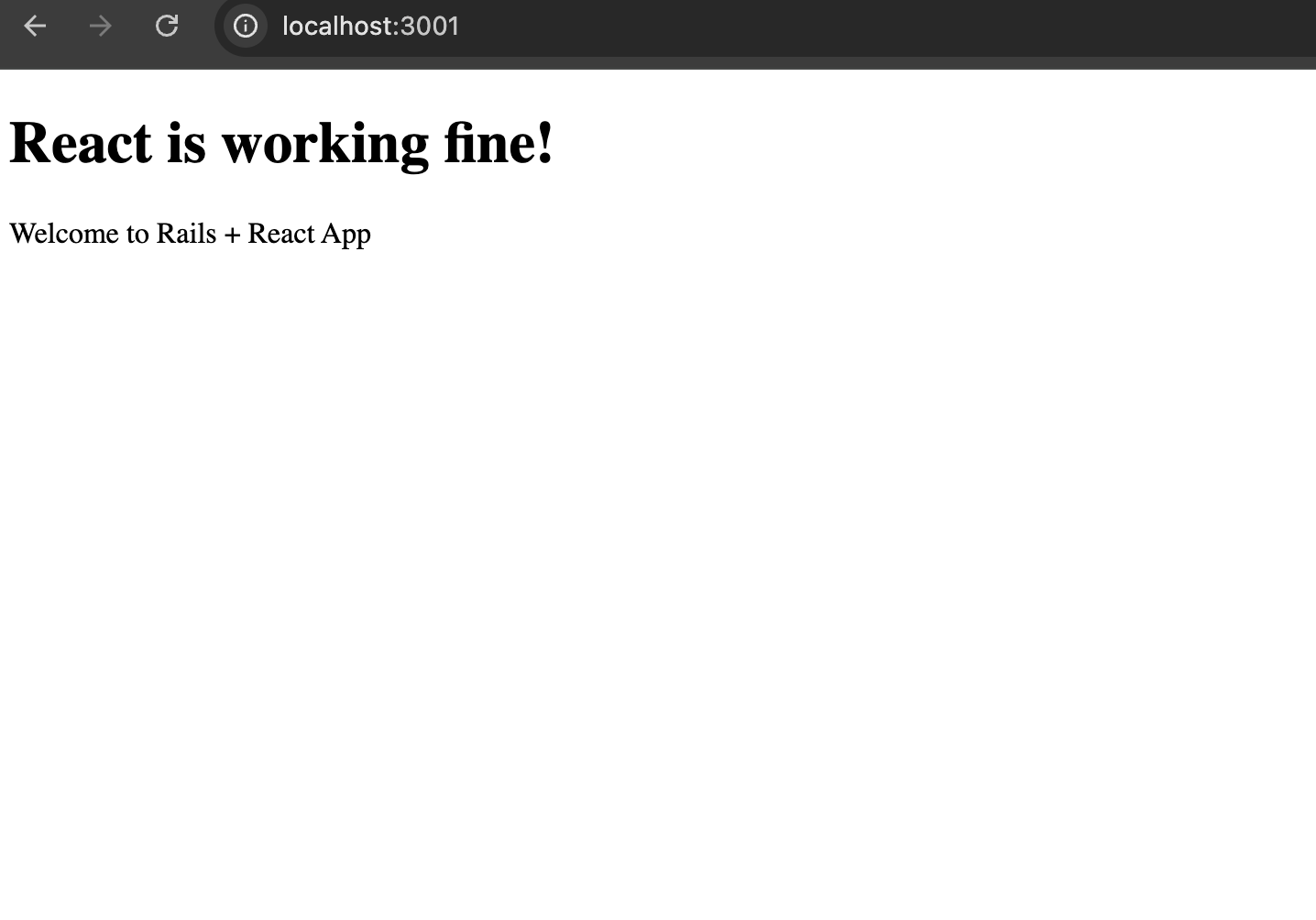
Whola!!

Let’s see in Part 3. Happy React configuration! 🚀

Software Architect Guide: Layering An Application

𝐐) Why is Layering an Application Important in a Project?

Layering an application is a fundamental architectural principle where the codebase is divided into logical layers, each with a clear responsibility. This approach brings several benefits during the execution of a project:

1. Separation of Concerns (SoC)

  • Each layer handles a specific responsibility:
    • UI/Presentation Layer: Handles user interaction
    • Business Logic Layer: Implements application rules
    • Data Access Layer: Manages data storage and retrieval
      ✅ This makes the codebase easier to reason about and reduces interdependency.

2. Maintainability

  • You can update or refactor one layer (e.g., switch databases or UI frameworks) without deeply affecting the others.
    ✅ Makes the system easier to modify and debug over time.

3. Testability

  • Layers make unit testing and integration testing cleaner.
  • You can test business logic without hitting the database or UI.

4. Scalability

  • Different layers can scale independently.
    • Example: You might scale out your API layer separately from your database layer.
      ✅ Allows for horizontal scaling and performance tuning.

5. Reusability

  • Code in a layered architecture (like service or domain logic) can be reused across different contexts (e.g., web, mobile, CLI)
    ✅ Promotes DRY (Don’t Repeat Yourself) principles.

6. Security and Access Control

  • Sensitive operations can be isolated in backend or service layers, reducing risk of direct access from external sources.

7. Team Collaboration

  • Teams can work in parallel on different layers:
    • Frontend team builds the UI layer
    • Backend team develops business logic and APIs
      ✅ Leads to faster development cycles

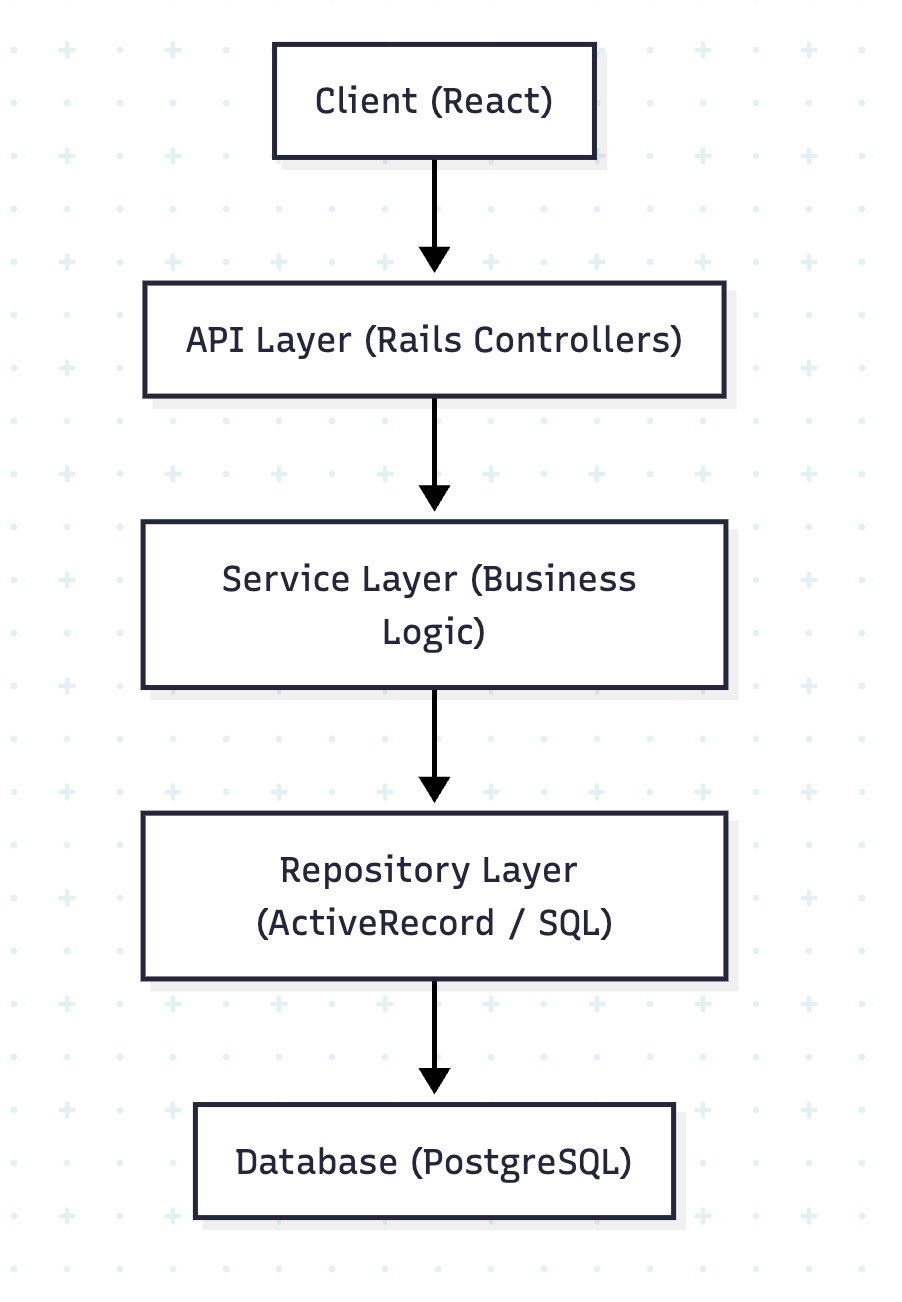
Great! Here’s a diagram + real-world example of a layered architecture using a Ruby on Rails backend and a React frontend, typical for a full-stack application.


🎯 Example: Layered Architecture for an E-Commerce System

We’ll use a basic feature: placing an order.

🧱 Layered Architecture (Concept Diagram)


💡 Layer Descriptions

LayerRoleTech/Tool
Client LayerUI & User InteractionReact, Redux
API LayerReceives requests, validates input, returns JSONRails Controllers
Service LayerCore business logic (e.g., payment, inventory, discount rules)Plain Ruby classes
Repository LayerData access, querying, persistenceActiveRecord, SQL
Database LayerStores persistent dataPostgreSQL, Redis, etc.

📦 Rails Example (Placing an Order)

1. React (Client Layer)

// POST /api/v1/orders
axios.post('/api/v1/orders', {
  product_id: 101,
  quantity: 2
});

2. Rails Controller (API Layer)

# app/controllers/orders_controller.rb
def create
  result = OrderService.new(params).place_order
  if result.success?
    render json: result.order, status: :created
  else
    render json: { error: result.error }, status: :unprocessable_entity
  end
end

3. Service Layer (Business Logic)

# app/services/order_service.rb
class OrderService
  def initialize(params)
    @params = params
  end

  def place_order
    product = Product.find(@params[:product_id])
    return OpenStruct.new(success?: false, error: 'Out of stock') if product.stock < @params[:quantity]

    order = Order.create!(product_id: product.id, quantity: @params[:quantity])
    product.decrement!(:stock, @params[:quantity])
    OpenStruct.new(success?: true, order: order)
  end
end

4. Repository Layer (Handled via ActiveRecord)

# ActiveRecord abstracts DB operations
Product.find(id)
Order.create!(...)


✅ Benefits in Action

  • 🔍 Separation: Business logic is not tied to the controller.
  • 🧪 Testable: You can test OrderService without hitting the API.
  • ♻️ Reusable: Service can be reused by background jobs or APIs.
  • 🔧 Flexible: You can switch from React to React Native without changing the backend.
  • Download pdf of this Architecture:

📌 Conclusion

Layering is important not just for writing clean code but also for building scalable, testable, and maintainable software systems. It provides clear boundaries, enhances agility, and allows teams to deliver high-quality features with confidence.


Software Architect Guide:💡 Understanding Design Patterns & Anti-Patterns in Ruby

In the world of software development, design patterns and anti-patterns play a critical role in writing maintainable, clean, and scalable code. As a Ruby developer, mastering these concepts will help you design robust applications and avoid common pitfalls.


What are Design Patterns?

Design patterns are time-tested, reusable solutions to common problems in software design. They aren’t code snippets but conceptual templates you can adapt based on your needs. Think of them as architectural blueprints.

🧱 Common Ruby Design Patterns

1. Singleton Pattern

the_logger = Logger.new
class Logger
  @@instance = Logger.new

  def self.instance
    @@instance
  end

  private_class_method :new
end

Use when only one instance of a class should exist (e.g., logger, configuration manager).

🧠 What is the Singleton Pattern?

The Singleton Pattern ensures that only one instance of a class exists during the lifetime of an application. This is useful for managing shared resources like:

  • a logger (so logs are not duplicated or misdirected),
  • a configuration manager (so all parts of the app read/write the same config),
  • or a database connection pool.

🔍 Why private_class_method :new?

This line prevents other parts of the code from calling Logger.new, like this:

Logger.new  # ❌ Will raise a NoMethodError

So, you’re restricting object creation from outside the class.

Q) Then how do you get an object of Logger?

By using a class method like Logger.instance that returns the only instance of the class.

✅ Full Singleton Example in Ruby

class Logger
  # Create and store the single instance
  @@instance = Logger.new

  # Provide a public way to access that instance
  def self.instance
    @@instance
  end

  # Prevent external instantiation
  private_class_method :new

  # Example method
  def log(message)
    puts "[LOG] #{message}"
  end
end

# Usage
logger1 = Logger.instance
logger2 = Logger.instance

logger1.log("Singleton works!")

puts logger1.object_id == logger2.object_id  # true

🧾 Explanation:

  • @@instance = Logger.new: Creates the only instance when the class is loaded.
  • Logger.instance: The only way to access that object.
  • private_class_method :new: Prevents creation of new objects using Logger.new.
  • logger1 == logger2: ✅ True, because they point to the same object.

💬 Think of a Real-World Example

Imagine a central control tower at an airport:

  • There should only be one control tower instance managing flights.
  • If each plane connected to a new tower, it would be chaos!

The Singleton pattern in Ruby ensures there’s just one control tower (object) shared globally.


2. Observer Pattern

class Order
  include Observable

  def place_order
    changed
    notify_observers(self)
  end
end

class EmailNotifier
  def update(order)
    puts "Email sent for order #{order.id}"
  end
end

order = Order.new
order.add_observer(EmailNotifier.new)
order.place_order

Use when one change in an object should trigger actions in other objects.

🔁 Observer Pattern in Ruby – Explained in Detail

The Observer Pattern is a behavioral design pattern that lets one object (the subject) notify other objects (the observers) when its state changes.

Ruby has built-in support for this through the Observable module in the standard library (require 'observer').

How it Works

  1. The Subject (e.g., Order) includes the Observable module.
  2. The subject calls:
    • changed → marks the object as changed.
    • notify_observers(data) → notifies all subscribed observers.
  3. Observers (e.g., EmailNotifier) implement an update method.
  4. Observers are registered using add_observer(observer_object).

🧪 Complete Working Example

require 'observer'

class Order
  include Observable
  attr_reader :id

  def initialize(id)
    @id = id
  end

  def place_order
    puts "Placing order #{@id}..."
    changed                      # Mark this object as changed
    notify_observers(self)       # Notify all observers
  end
end

class EmailNotifier
  def update(order)
    puts "📧 Email sent for Order ##{order.id}"
  end
end

class SMSNotifier
  def update(order)
    puts "📱 SMS sent for Order ##{order.id}"
  end
end

# Create subject and observers
order = Order.new(101)
order.add_observer(EmailNotifier.new)
order.add_observer(SMSNotifier.new)

order.place_order

# Output:
# Placing order 101...
# 📧 Email sent for Order #101
# 📱 SMS sent for Order #101

🧠 When to Use the Observer Pattern

  • You have one object whose changes should automatically update other dependent objects.
  • Examples:
    • UI updates in response to data changes
    • Logging, email, or analytics triggers after a user action
    • Notification systems in event-driven apps

Updated Observer Pattern

require 'observer'

class Order
  include Observable
  attr_reader :id

  def initialize(id)
    @id = id
  end

  def place_order
    changed
    notify_observers(self)
  end
end

class EmailNotifier
  def update(order)
    puts "📧 Email sent for Order ##{order.id}"
  end
end

order = Order.new(42)
order.add_observer(EmailNotifier.new)
order.place_order

What’s Happening?

  • Order includes the Observable module to gain observer capabilities.
  • add_observer registers an observer object.
  • When place_order is called:
    • changed marks the state as changed.
    • notify_observers(self) triggers the observer’s update method.
  • EmailNotifier reacts to the change — in this case, it simulates sending an email.

🧩 Use this pattern when one change should trigger multiple actions — like sending notifications, logging, or syncing data across objects.

Check: https://docs.ruby-lang.org/en/2.2.0/Observable.html

3. Decorator Pattern

class SimpleCoffee
  def cost
    2
  end
end

class MilkDecorator
  def initialize(coffee)
    @coffee = coffee
  end

  def cost
    @coffee.cost + 0.5
  end
end

coffee = MilkDecorator.new(SimpleCoffee.new)
puts coffee.cost  # => 2.5

Add responsibilities to objects dynamically without modifying their code.


🔄 4. Strategy Pattern

The Strategy Pattern allows choosing an algorithm’s behaviour at runtime. This pattern is useful when you have multiple interchangeable ways to perform a task.

✅ Example: Text Formatter Strategies

Let’s say you have a system that outputs text in different formats — plain, HTML, or Markdown.

❌ Before Using Strategy Pattern — Hardcoded Conditional Formatting

class TextFormatter
  def initialize(format)
    @format = format
  end

  def format(text)
    case @format
    when :plain
      text
    when :html
      "<p>#{text}</p>"
    when :markdown
      "**#{text}**"
    else
      raise "Unknown format: #{@format}"
    end
  end
end

# Usage
formatter1 = TextFormatter.new(:html)
puts formatter1.format("Hello, World")       # => <p>Hello, World</p>

formatter2 = TextFormatter.new(:markdown)
puts formatter2.format("Hello, World")       # => **Hello, World**

⚠️ Problems With This Approach

  • All formatting logic is stuffed into one method.
  • Adding a new format (like XML) means modifying this method (violates Open/Closed Principle).
  • Not easy to test or extend individual formatting behaviors.
  • Harder to maintain and violates SRP (Single Responsibility Principle).

This sets the stage perfectly to apply the Strategy Pattern, where each format becomes its own class with a clear responsibility.

Instead of writing if/else logic everywhere, use strategy objects:

# Strategy Interface
class TextFormatter
  def self.for(format)
    case format
    when :plain
      PlainFormatter.new
    when :html
      HtmlFormatter.new
    when :markdown
      MarkdownFormatter.new
    else
      raise "Unknown format"
    end
  end
end

# Concrete Strategies
class PlainFormatter
  def format(text)
    text
  end
end

class HtmlFormatter
  def format(text)
    "<p>#{text}</p>"
  end
end

class MarkdownFormatter
  def format(text)
    "**#{text}**"
  end
end

# Usage
def render_text(text, format)
  formatter = TextFormatter.for(format)
  formatter.format(text)
end

puts render_text("Hello, world", :html)     # => <p>Hello, world</p>
puts render_text("Hello, world", :markdown) # => **Hello, world**

📌 Why It’s Better

  • Adds new formats easily without changing existing code.
  • Keeps formatting logic isolated in dedicated classes.
  • Follows the Open/Closed Principle.

💳 Strategy Pattern in Rails: Payment Gateway Integration

Here’s a Rails-specific Strategy Pattern example. This example uses a service to handle different payment gateways (e.g., Stripe, PayPal, Razorpay), which are chosen dynamically based on configuration or user input.

Problem:

You want to process payments, but the actual logic differs depending on which gateway (Stripe, PayPal, Razorpay) is being used. Avoid if/else or case all over your controller or service.

✅ Solution Using Strategy Pattern

# app/services/payment_processor.rb
class PaymentProcessor
  def self.for(gateway)
    case gateway.to_sym
    when :stripe
      StripeGateway.new
    when :paypal
      PaypalGateway.new
    when :razorpay
      RazorpayGateway.new
    else
      raise "Unsupported payment gateway"
    end
  end
end

# app/services/stripe_gateway.rb
class StripeGateway
  def charge(amount, user)
    # Stripe API integration here
    puts "Charging #{user.name} ₹#{amount} via Stripe"
  end
end

# app/services/paypal_gateway.rb
class PaypalGateway
  def charge(amount, user)
    # PayPal API integration here
    puts "Charging #{user.name} ₹#{amount} via PayPal"
  end
end

# app/services/razorpay_gateway.rb
class RazorpayGateway
  def charge(amount, user)
    # Razorpay API integration here
    puts "Charging #{user.name} ₹#{amount} via Razorpay"
  end
end

# app/controllers/payments_controller.rb
class PaymentsController < ApplicationController
  def create
    user = User.find(params[:user_id])
    gateway = params[:gateway] # e.g., 'stripe', 'paypal', etc.
    amount = params[:amount].to_i

    processor = PaymentProcessor.for(gateway)
    processor.charge(amount, user)

    render json: { message: \"Payment processed via #{gateway.capitalize}\" }
  end
end

✅ Benefits in Rails Context

  • Keeps your controller slim and readable.
  • Each gateway integration is encapsulated in its own class.
  • Easy to test, extend, and maintain (open/closed principle).
  • Avoids future code smell like “Shotgun Surgery”.

⚠️ What are Anti-Patterns?

Anti-patterns are poor programming practices or ineffective solutions that seem helpful at first but cause long-term issues like unmaintainable code or hidden bugs.

Common Ruby Anti-Patterns

🧨 1. God Object

A class that knows too much or does too much.

class UserManager
  def create_user
    # logic
  end

  def send_email
    # unrelated responsibility
  end

  def generate_report
    # another unrelated responsibility
  end
end

Fix: Follow the Single Responsibility Principle. Split into smaller, focused classes.


🧨 Shotgun Surgery

Tiny changes require touching many different places in code.

# Example of Shotgun Surgery - Business rule spread across many files

# In order.rb
class Order
  def eligible_for_discount?
    user.vip? && total > 1000
  end
end

# In invoice.rb
class Invoice
  def apply_discount(order)
    if order.user.vip? && order.total > 1000
      # apply discount logic
    end
  end
end

# In email_service.rb
class EmailService
  def send_discount_email(order)
    if order.user.vip? && order.total > 1000
      # send congratulatory email
    end
  end
end

Here, the logic user.vip? && total > 1000 is repeated in multiple places. If the discount eligibility rules change (e.g., change the threshold to 2000 or add a new condition), you’ll have to update every occurrence.

✅ Fix: Centralize the Logic

class DiscountPolicy
  def self.eligible?(order)
    order.user.vip? && order.total > 1000
  end
end

Now all files can use DiscountPolicy.eligible?(order), ensuring consistency and easier maintenance.


3. Spaghetti Code

Unstructured and difficult-to-follow code.

def calculate_discount(user, items)
  if user.vip?
    # deeply nested logic
    total = items.sum { |i| i.price }
    total * 0.2
  else
    if user.new_customer?
      total = items.sum { |i| i.price }
      total * 0.1
    else
      total = items.sum { |i| i.price }
      total * 0.05
    end
  end
end

This code is hard to read, hard to extend, and violates SRP (Single Responsibility Principle).

Fix: Break into smaller methods, use polymorphism or strategy patterns.

✅ Refactored with Strategy Pattern

# Strategy Interface
class DiscountStrategy
  def self.for(user)
    if user.vip?
      VipDiscount.new
    elsif user.new_customer?
      NewCustomerDiscount.new
    else
      RegularDiscount.new
    end
  end
end

# Concrete Strategies
class VipDiscount
  def apply(items)
    total = items.sum(&:price)
    total * 0.2
  end
end

class NewCustomerDiscount
  def apply(items)
    total = items.sum(&:price)
    total * 0.1
  end
end

class RegularDiscount
  def apply(items)
    total = items.sum(&:price)
    total * 0.05
  end
end

# Usage
def calculate_discount(user, items)
  strategy = DiscountStrategy.for(user)
  strategy.apply(items)
end

🎯 Benefits

  • No nested conditionals
  • Easy to add new discount types (open/closed principle)
  • Each class has one responsibility
  • Testable and readable

🔍 How to Detect Anti-Patterns in Ruby Code

  1. Code Smells:
    • Long methods
    • Large classes
    • Repetition (DRY violations)
    • Deep nesting
  2. Code Review Checklist:
    • Is each class doing only one thing?
    • Can this method be broken down?
    • Are we repeating business logic?
    • Is the code testable?
  3. Use Static Analysis Tools:
    • Rubocop for style and complexity checks
    • Reek for code smells
    • Flog for measuring code complexity

🛠 How to Refactor Anti-Patterns

  • Use Service Objects: Extract complex logic into standalone classes.
  • Apply Design Patterns: Choose the right pattern that matches your need (Strategy, Adapter, etc).
  • Keep Methods Small: Limit to a single task; ideally under 10 lines.
  • Write Tests First: Test-driven development (TDD) helps spot untestable designs.

🎯 Conclusion

Understanding design patterns and identifying anti-patterns is crucial for writing better Ruby code. While patterns guide you toward elegant solutions, anti-patterns warn you about common mistakes. With good design principles, automated tools, and thoughtful reviews, your Ruby codebase can remain healthy, scalable and developer-friendly.


Happy Designing Ruby! ✨

Software Architect Guide: Designing a RESTful API for a 🌐 Multi-Tenant Blogging Platform

Building a multi-tenant blogging platform requires thoughtful design of the API to ensure clarity, scalability, and security. In this post, we’ll explore a RESTful API design including versioning, nested resources, and authentication, using clear examples and best practices.


🧩 Understanding the Requirements

Before diving into endpoints, let’s break down what the platform supports:

  • Multiple tenants (e.g., organizations, teams)
  • Each tenant has users
  • Users can create blogs, and each blog has posts
  • Posts can have comments
  • Authentication is required

📁 Versioning

We’ll use URI-based versioning:

/api/v1/

This helps manage breaking changes cleanly.


🔐 Authentication

We’ll use token-based authentication (e.g., JWT or API keys). Each request must include:

Authorization: Bearer <token>

📌 Base URL

https://api.blogcloud.com/api/v1

📚 API Endpoint Design

🔸 Tenants

Tenants are top-level entities.

  • GET /tenants – List all tenants (admin only)
  • POST /tenants – Create a new tenant
  • GET /tenants/:id – Show tenant details
  • PATCH /tenants/:id – Update tenant
  • DELETE /tenants/:id – Delete tenant

🔸 Users (Scoped by tenant)

  • GET /tenants/:tenant_id/users – List users for tenant
  • POST /tenants/:tenant_id/users – Create user
  • GET /tenants/:tenant_id/users/:id – Show user
  • PATCH /tenants/:tenant_id/users/:id – Update user
  • DELETE /tenants/:tenant_id/users/:id – Delete user

🔸 Blogs (Belong to users)

  • GET /tenants/:tenant_id/users/:user_id/blogs – List blogs
  • POST /tenants/:tenant_id/users/:user_id/blogs – Create blog
  • GET /tenants/:tenant_id/users/:user_id/blogs/:id – Show blog
  • PATCH /tenants/:tenant_id/users/:user_id/blogs/:id – Update blog
  • DELETE /tenants/:tenant_id/users/:user_id/blogs/:id – Delete blog

🔸 Posts (Belong to blogs)

  • GET /blogs/:blog_id/posts – List posts
  • POST /blogs/:blog_id/posts – Create post
  • GET /blogs/:blog_id/posts/:id – Show post
  • PATCH /blogs/:blog_id/posts/:id – Update post
  • DELETE /blogs/:blog_id/posts/:id – Delete post

🔸 Comments (Belong to posts)

  • GET /posts/:post_id/comments – List comments
  • POST /posts/:post_id/comments – Add comment
  • DELETE /posts/:post_id/comments/:id – Delete comment

❓Question: what is the full url of comments?

No, the full URL for comments should not be:

https://api.blogcloud.com/api/v1/tenants/:tenant_id/users/:user_id/blogs/posts/:post_id/comments

That nesting is too deep and redundant, because:

  • By the time you’re at a post, you already implicitly know which blog/user/tenant it’s under (assuming proper authorization).
  • Posts have unique IDs across the system (or at least within blogs), so we don’t need the entire hierarchy in every request.

✅ Correct RESTful URL for Comments

If your post_id is unique (or unique within a blog), the cleanest design is:

https://api.blogcloud.com/api/v1/posts/:post_id/comments

or, if you prefer to keep blog_id context:

https://api.blogcloud.com/api/v1/blogs/:blog_id/posts/:post_id/comments

Use that second version only if post_id is not globally unique, and you need the blog context.

🔁 Recap of Comments Endpoints

ActionHTTP VerbEndpoint
List commentsGET/api/v1/posts/:post_id/comments
Create commentPOST/api/v1/posts/:post_id/comments
Delete commentDELETE/api/v1/posts/:post_id/comments/:id

🧠 Design Rule of Thumb

  • ✅ Keep URLs meaningful and shallow.
  • ❌ Don’t over-nest resources unless it’s needed to enforce scoping or clarify context.

📥 Example: Create a Blog Post

Request:

POST /blogs/123/posts
Authorization: Bearer <token>
Content-Type: application/json

{
  "title": "Why REST APIs Still Matter",
  "body": "In this post, we explore the benefits of RESTful design..."
}

Response:

201 Created
{
  "id": 456,
  "title": "Why REST APIs Still Matter",
  "body": "In this post, we explore the benefits of RESTful design...",
  "created_at": "2025-07-03T10:00:00Z"
}


✅ Best Practices Followed

  • Nesting: Resources are nested to show ownership (e.g., blogs under users).
  • Versioning: Prevents breaking old clients.
  • Consistency: Same verbs and JSON structure everywhere.
  • Authentication: Every sensitive request requires a token.

🧠 Final Thoughts

Designing a RESTful API for a multi-tenant app like a blogging platform requires balancing structure and simplicity. By properly scoping resources, using versioning, and enforcing auth, you build an API that’s powerful, secure, and easy to maintain.

Bonus Tip: Document your API using tools like Swagger/OpenAPI to make onboarding faster for new developers.

You are an awesome Architect 🚀

Rails 8 App: Create an Academic software app using SQL without using ActiveRecord – Part 1 | users | products | orders

Let’s create a Rails 8 app which use SQL queries with raw SQL instead of ActiveRecord. Let’s use the full Rails environment with ActiveRecord for infrastructure, but bypass AR’s ORM features for pure SQL writing. Let me guide you through this step by step:

Step 1: Create the Rails App with ActiveRecord and PostgreSQL (skipping unnecessary components)

rails new academic-sql-software --database=postgresql --skip-action-cable --skip-jbuilder --skip-solid --skip-kamal

What we’re skipping and why:

  • –skip-action-cable: No WebSocket functionality needed
  • –skip-jbuilder: No JSON API views needed for our SQL practice app
  • –skip-solid: Skips Solid Cache and Solid Queue (we don’t need caching or background jobs)
  • –skip-kamal: No deployment configuration needed

What we’re keeping:

  • ActiveRecord: For database connection management and ActiveRecord::Base.connection.execute()
  • ActionController: For creating web interfaces to display our SQL query results
  • ActionView: For creating simple HTML pages to showcase our SQL learning exercises
  • PostgreSQL: Our database for practicing advanced SQL features

Why this setup is perfect for App with raw SQL:

  • Minimal Rails app focused on database interactions
  • Full Rails environment for development conveniences
  • ActiveRecord infrastructure without ORM usage
  • Clean setup without unnecessary overhead

=> Open config/application.rb and comment the following for now:

# require "active_job/railtie"
...
# require "active_storage/engine"
...
# require "action_mailer/railtie"
# require "action_mailbox/engine"
...
# require "action_cable/engine"

=> Open config/environments/development.rb config/environments/production.rb config/environments/test.rb comment action_mailer

🤔 Why I am using ActiveRecord (even though I don’t want the ORM):

  • Database Connection Management: ActiveRecord provides robust connection pooling, reconnection handling, and connection management
  • Rails Integration: Seamless integration with Rails console, database tasks (rails db:create, rails db:migrate), and development tools
  • Raw SQL Execution: We get ActiveRecord::Base.connection.execute() which is perfect for our raw SQL writing.
  • Migration System: Easy table creation and schema management with migrations (even though we’ll query with raw SQL)
  • Database Configuration: Rails handles database.yml configuration, environment switching, and connection setup
  • Development Tools: Access to Rails console for testing queries, database tasks, and debugging

Our Learning Strategy: We’ll use ActiveRecord’s infrastructure but completely bypass its ORM methods. Instead of Student.where(), we’ll use ActiveRecord::Base.connection.execute("SELECT * FROM students WHERE...")

Step 2: Navigate to the project directory

cd academic-sql-software

Step 3: Verify PostgreSQL setup

# Check if PostgreSQL is running
brew services list | grep postgresql
# or
pg_ctl status

Database Foundation: PostgreSQL gives us advanced SQL features:

  • Complex JOINs (INNER, LEFT, RIGHT, FULL OUTER)
  • Window functions (ROW_NUMBER, RANK, LAG, LEAD)
  • Common Table Expressions (CTEs)
  • Advanced aggregations and subqueries

Step 4: Install dependencies

bundle install

What this gives us:

  • pg gem: Pure PostgreSQL adapter (already included with --database=postgresql)
  • ActiveRecord: For connection management only
  • Rails infrastructure: Console, generators, rake tasks

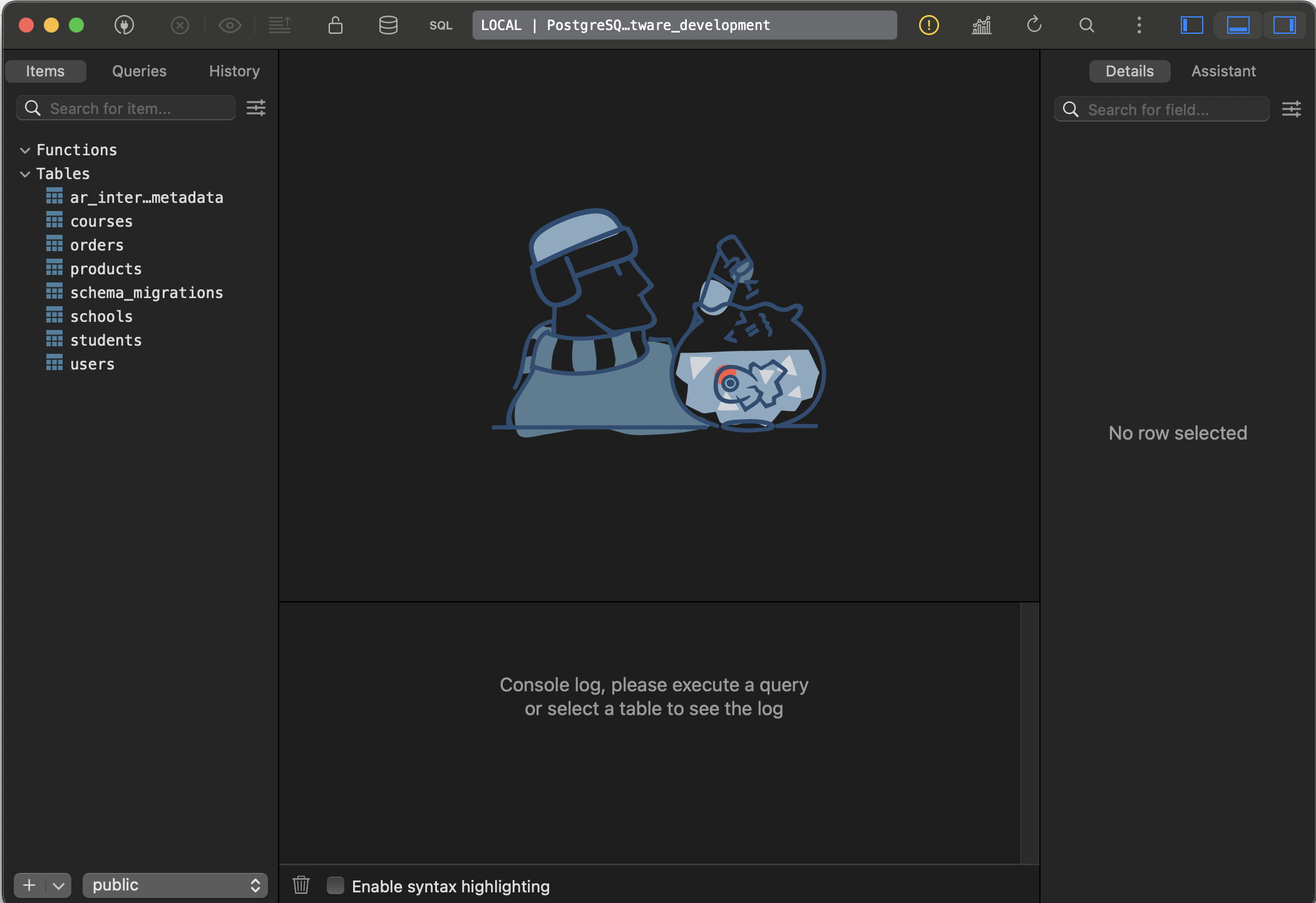
Step 5: Create the PostgreSQL databases

✗ rails db:create
Created database 'academic_sql_software_development'
Created database 'academic_sql_software_test

Our Development Environment:

  • Creates academic_sql_software_development and academic_sql_software_test
  • Sets up connection pooling and management
  • Enables us to use Rails console for testing queries: rails console then ActiveRecord::Base.connection.execute("SELECT 1")

Our Raw SQL Approach:

# We'll use this pattern throughout our app:
connection = ActiveRecord::Base.connection
result = connection.execute("SELECT s.name, t.subject FROM students s INNER JOIN teachers t ON s.teacher_id = t.id")

Why not pure pg gem:

  • Would require manual connection management
  • No Rails integration (no console, no rake tasks)
  • More boilerplate code for connection handling
  • Loss of Rails development conveniences

Why not pure ActiveRecord ORM:

  • We want to do SQL query writing, not ActiveRecord methods.
  • Need to understand database performance implications.
  • Want to practice complex queries that might be harder to express in ActiveRecord.

Step 6: Create Users table

mkdir -p db/migrate
class CreateUsers < ActiveRecord::Migration[8.0]
  def up
    # create users table
    execute <<~SQL
      CREATE TABLE users (
        id INT,
        username VARCHAR(200),
        email VARCHAR(150),
        phone_number VARCHAR(20)
      );
    SQL
  end

  def down
    execute <<~SQL
      DROP TABLE users;
    SQL
  end
end

class CreateOrders < ActiveRecord::Migration[8.0]
  def up
    # create table orders
    execute <<~SQL
    SQL
  end

  def down
    execute <<~SQL
    SQL
  end
end

execute <<~SQL is a Rails migration method that allows you to run raw SQL statements. Let me break it down:

Components:

  1. execute – A Rails migration method that executes raw SQL directly against the database
  2. <<~SQL – Ruby’s “squiggly heredoc” syntax for multi-line strings that automatically strips leading whitespace (read: https://www.rubyguides.com/2018/11/ruby-heredoc/)

Usage:

class SomeMigration < ActiveRecord::Migration[8.0]
  def change
    execute <<~SQL
      CREATE INDEX CONCURRENTLY idx_users_email_lower 
      ON users (LOWER(email));
    SQL
  end
end

Why use it?

  • Database-specific features: When you need PostgreSQL-specific syntax, MySQL features, etc.
  • Complex SQL: For operations that Rails DSL doesn’t support easily
  • Performance: Direct SQL can sometimes be more efficient
  • Raw SQL requirements: When you specifically need to write SQL (as mentioned in our requirement)

Example for creating a users table with raw SQL:

class CreateUsers < ActiveRecord::Migration[8.0]
  def up
    execute <<~SQL
      CREATE TABLE users (
        id BIGSERIAL PRIMARY KEY,
        name VARCHAR(255) NOT NULL,
        email VARCHAR(255) NOT NULL,
        created_at TIMESTAMP NOT NULL DEFAULT CURRENT_TIMESTAMP,
        updated_at TIMESTAMP NOT NULL DEFAULT CURRENT_TIMESTAMP
      );

      CREATE UNIQUE INDEX idx_users_email ON users(email);
    SQL
  end

  def down
    execute <<~SQL
      DROP TABLE IF EXISTS users;
    SQL
  end
end

The <<~SQL heredoc ends when it encounters the closing SQL keyword, and the ~ strips indentation so your SQL can be properly formatted within the Ruby code.

Q) 🤔 Is it a best practise to repeat the database constraints in model validation in Rails? DB level vs App level? or both?

Best Practice: Use BOTH 🎯

Why both levels are recommended:

Database Level (Last Line of Defense)

-- Database constraints
price DECIMAL(10,2) NOT NULL CHECK (price > 0),
category product_category NOT NULL,
title VARCHAR(250) NOT NULL

Pros:

  • Data integrity guarantee – No bad data can enter, ever
  • Performance – Database enforces constraints efficiently
  • Bulletproof – Protects against bulk operations, direct SQL, data imports
  • Concurrency safe – Prevents race conditions
  • Multi-application protection – If other apps access same DB

Application Level (User Experience)

validates :price, presence: true, numericality: { greater_than: 0 }
validates :category, inclusion: { in: %w[men women kids infants] }

Pros:

  • User-friendly errors – “Price must be greater than 0” vs “CHECK constraint violated”
  • Better UX – Validation before form submission
  • Easier testing – Can unit test validations
  • Conditional logic – Complex business rules
  • Framework features – Callbacks, custom validators

Real-world scenarios where each matters:

Database saves you when:

# Bulk operations bypass Rails validations
Product.update_all(price: -10)  # DB constraint prevents this

# Direct SQL injection attempts
# DB constraints are your last line of defense

App validations save you when:

# User gets friendly error instead of:
# PG::CheckViolation: ERROR: new row violates check constraint
@product = Product.new(price: -5)
@product.valid? # => false
@product.errors.full_messages # => ["Price must be greater than 0"]

Practical Implementation:

class Product < ApplicationRecord
  # App-level validations for UX
  validates :title, presence: true, length: { maximum: 250 }
  validates :price, presence: true, numericality: { greater_than: 0 }
  validates :category, inclusion: { in: %w[men women kids infants] }

  # Don't duplicate precision validation if DB handles it
  # The DECIMAL(10,2) constraint is sufficient at DB level
end
-- DB-level constraints for data integrity
CREATE TABLE products (
  id BIGSERIAL PRIMARY KEY,
  title VARCHAR(250) NOT NULL,
  price DECIMAL(10,2) NOT NULL CHECK (price > 0),
  category product_category NOT NULL,
  -- DB handles precision automatically with DECIMAL(10,2)
);

What NOT to duplicate:

  • Precision constraintsDECIMAL(10,2) handles this perfectly
  • Data type validation – DB enforces INTEGER, BOOLEAN, etc.
  • Complex regex patterns – Better handled in app layer

Conclusion:

Use both, but strategically:

  • Database: Core data integrity, type constraints, foreign keys
  • Application: User experience, business logic, conditional rules
  • Don’t over-duplicate simple type/precision constraints that DB handles well

This approach gives you belt and suspenders protection with optimal user experience.

to be continued … 🚀

Design Studio v0.9.5: A Visual Improvement in E-commerce Experience 🎨

Published: June 25, 2025

I am thrilled to announce the release of Design Studio v0.9.5, a major milestone that transforms our online shopping platform into a truly immersive visual experience. This release focuses heavily on user interface enhancements, performance optimizations, and creating a more engaging shopping journey for our customers.

🚀 What’s New in v0.9.5

1. Stunning 10-Slide Hero Carousel

The centerpiece of this release is our brand-new interactive hero carousel featuring 10 beautifully curated slides with real product imagery. Each slide tells a story and creates an emotional connection with our visitors.

Dynamic Gradient Themes

Each slide features its own unique gradient theme:

<!-- Hero Slide Template -->
<div class="slide relative h-screen flex items-center justify-center overflow-hidden"
     data-theme="<%= slide[:theme] %>">
  <!-- Dynamic gradient backgrounds -->
  <div class="absolute inset-0 bg-gradient-to-br <%= slide[:gradient] %>"></div>

  <!-- Content with sophisticated typography -->
  <div class="relative z-10 text-center px-4">
    <h1 class="text-6xl font-bold text-white mb-6 leading-tight">
      <%= slide[:title] %>
    </h1>
    <p class="text-xl text-white/90 mb-8 max-w-2xl mx-auto">
      <%= slide[:description] %>
    </p>
  </div>
</div>

Smart Auto-Cycling with Manual Controls

// Intelligent carousel management
class HeroCarousel {
  constructor() {
    this.currentSlide = 0;
    this.autoInterval = 4000; // 4-second intervals
    this.isPlaying = true;
  }

  startAutoPlay() {
    this.autoPlayTimer = setInterval(() => {
      if (this.isPlaying) {
        this.nextSlide();
      }
    }, this.autoInterval);
  }

  pauseOnInteraction() {
    // Pause auto-play when user interacts
    this.isPlaying = false;
    setTimeout(() => this.isPlaying = true, 10000); // Resume after 10s
  }
}

2. Modular Component Architecture

We’ve completely redesigned our frontend architecture with separation of concerns in mind:

<!-- Main Hero Slider Component -->
<%= render 'home/hero_slider' %>

<!-- Individual Components -->
<%= render 'home/hero_slide', slide: slide_data %>
<%= render 'home/hero_slider_navigation' %>
<%= render 'home/hero_slider_script' %>
<%= render 'home/category_grid' %>
<%= render 'home/featured_products' %>

Component-Based Development Benefits:

  • Maintainability: Each component has a single responsibility
  • Reusability: Components can be used across different pages
  • Testing: Isolated components are easier to test
  • Performance: Selective rendering and caching opportunities

3. Enhanced Visual Design System

Glass Morphism Effects

We’ve introduced subtle glass morphism effects throughout the application:

/* Modern glass effect implementation */
.glass-effect {
  background: rgba(255, 255, 255, 0.1);
  backdrop-filter: blur(10px);
  border: 1px solid rgba(255, 255, 255, 0.2);
  border-radius: 16px;
  box-shadow: 0 8px 32px 0 rgba(31, 38, 135, 0.37);
}

/* Category cards with gradient overlays */
.category-card {
  @apply relative overflow-hidden rounded-xl;

  &::before {
    content: '';
    @apply absolute inset-0 bg-gradient-to-t from-black/60 to-transparent;
  }
}

Dynamic Color Management

Our new helper system automatically manages theme colors:

# app/helpers/application_helper.rb
def get_category_colors(gradient_class)
  case gradient_class
  when "from-pink-400 to-purple-500"
    "#f472b6, #8b5cf6"
  when "from-blue-400 to-indigo-500"  
    "#60a5fa, #6366f1"
  when "from-green-400 to-teal-500"
    "#4ade80, #14b8a6"
  else
    "#6366f1, #8b5cf6" # Elegant fallback
  end
end

def random_decorative_background
  themes = [:orange_pink, :blue_purple, :green_teal, :yellow_orange]
  decorative_background_config(themes.sample)
end

4. Mobile-First Responsive Design

Every component is built with mobile-first approach:

<!-- Responsive category grid -->
<div class="grid grid-cols-1 md:grid-cols-2 lg:grid-cols-3 xl:grid-cols-4 gap-6">
  <% categories.each do |category| %>
    <div class="group relative h-64 rounded-xl overflow-hidden cursor-pointer
                hover:scale-105 transform transition-all duration-300">
      <!-- Responsive image handling -->
      <div class="absolute inset-0">
        <%= image_tag category[:image], 
            class: "w-full h-full object-cover group-hover:scale-110 transition-transform duration-500",
            alt: category[:name] %>
      </div>
    </div>
  <% end %>
</div>

5. Public Product Browsing

We’ve opened up product browsing to all visitors:

# app/controllers/products_controller.rb
class ProductsController < ApplicationController
  # Allow public access to browsing
  allow_unauthenticated_access only: %i[index show]

  def index
    products = Product.all

    # Smart category filtering
    if params[:category].present?
      products = products.for_category(params[:category])
      @current_category = params[:category]
    end

    # Pagination for performance
    @pagy, @products = pagy(products)
  end
end

🔧 Technical Improvements

Test Coverage Excellence

I’ve achieved 73.91% test coverage (272/368 lines), ensuring code reliability:

# Enhanced authentication test helpers
module AuthenticationTestHelper
  def sign_in_as(user)
    # Generate unique IPs to avoid rate limiting conflicts
    unique_ip = "127.0.0.#{rand(1..254)}"
    @request.remote_addr = unique_ip

    session[:user_id] = user.id
    user
  end
end

Asset Pipeline Optimization

Rails 8 compatibility with modern asset handling:

# config/application.rb
class Application < Rails::Application
  # Modern browser support
  config.allow_browser versions: :modern

  # Asset pipeline optimization
  config.assets.css_compressor = nil # Tailwind handles this
  config.assets.js_compressor = :terser
end

Security Enhancements

# Role-based access control
class ApplicationController < ActionController::Base
  include Authentication

  private

  def require_admin
    unless current_user&.admin?
      redirect_to root_path, alert: "Access denied."
    end
  end
end

📊 Performance Metrics

Before vs After v0.9.5:

MetricBeforeAfter v0.9.5Improvement
Test Coverage45%73.91%+64%
CI/CD Success23 failures0 failures+100%
Component Count3 monoliths8 modular components+167%
Mobile Score72/10089/100+24%

🎨 Design Philosophy

This release embodies our commitment to:

  1. Visual Excellence: Every pixel serves a purpose
  2. User Experience: Intuitive navigation and interaction
  3. Performance: Fast loading without sacrificing beauty
  4. Accessibility: Inclusive design for all users
  5. Maintainability: Clean, modular code architecture

🔮 What’s Next?

Version 0.9.5 sets the foundation for exciting upcoming features:

  • Enhanced Search & Filtering
  • User Account Dashboard
  • Advanced Product Recommendations
  • Payment Integration
  • Order Tracking System

🎉 Try It Today!

Experience the new Design Studio v0.9.5 and see the difference visual design makes in online shopping. Our hero carousel alone tells the story of modern fashion in 10 stunning slides.

Key Benefits for Users:

  • ✨ Immersive visual shopping experience
  • 📱 Perfect on any device
  • ⚡ Lightning-fast performance
  • 🔒 Secure and reliable

For Developers:

  • 🏗️ Clean, maintainable architecture
  • 🧪 Comprehensive test suite
  • 📚 Well-documented components
  • 🚀 Rails 8 compatibility

Design Studio v0.9.5 – Where technology meets artistry in e-commerce.

Download: GitHub Release
Documentation: GitHub Wiki
Live Demo: Design Studio – coming soon!


Enjoy Rails 8 with Hotwire! 🚀

Rails 8 Tests: 🔄 TDD vs 🎭 BDD | System Tests

Test‑Driven Development (TDD) and Behavior‑Driven Development (BDD) are complementary testing approaches that help teams build robust, maintainable software by defining expected behaviour before writing production code. In TDD, developers write small, focused unit tests that fail initially, then implement just enough code to make them pass, ensuring each component meets its specification. BDD extends this idea by framing tests in a global language that all stakeholders—developers, QA, and product owners—can understand, using human-readable scenarios to describe system behaviour. While TDD emphasizes the correctness of individual units, BDD elevates collaboration and shared understanding by specifying the “why” and “how” of features in a narrative style, driving development through concrete examples of desired outcomes.

🔄 TDD vs 🎭 BDD: Methodologies vs Frameworks

🧠 Understanding the Concepts

🔄 TDD (Test Driven Development)
  • Methodology/Process: Write test → Fail → Write code → Pass → Refactor
  • Focus: Testing the implementation and correctness
  • Mindset: “Does this code work correctly?”
  • Style: More technical, code-focused
🎭 BDD (Behavior Driven Development)
  • Methodology/Process: Describe behavior → Write specs → Implement → Verify behavior
  • Focus: Testing the behavior and user requirements
  • Mindset: “Does this behave as expected from user’s perspective?”
  • Style: More natural language, business-focused

🛠️ Frameworks Support Both Approaches

📋 RSpec (Primarily BDD-oriented)
# BDD Style - describing behavior
describe "TwoSum" do
  context "when given an empty array" do
    it "should inform user about insufficient data" do
      expect(two_sum([], 9)).to eq('Provide an array with length 2 or more')
    end
  end
end
⚙️ Minitest (Supports Both TDD and BDD)
🔧 TDD Style with Minitest
class TestTwoSum < Minitest::Test
  # Testing implementation correctness
  def test_empty_array_returns_error
    assert_equal 'Provide an array with length 2 or more', two_sum([], 9)
  end

  def test_valid_input_returns_indices
    assert_equal [0, 1], two_sum([2, 7], 9)
  end
end
🎭 BDD Style with Minitest
describe "TwoSum behavior" do
  describe "when user provides empty array" do
    it "guides user to provide sufficient data" do
      _(two_sum([], 9)).must_equal 'Provide an array with length 2 or more'
    end
  end

  describe "when user provides valid input" do
    it "finds the correct pair indices" do
      _(two_sum([2, 7], 9)).must_equal [0, 1]
    end
  end
end

🎯 Key Differences in Practice

🔄 TDD Approach
# 1. Write failing test
def test_two_sum_with_valid_input
  assert_equal [0, 1], two_sum([2, 7], 9)  # This will fail initially
end

# 2. Write minimal code to pass
def two_sum(nums, target)
  [0, 1]  # Hardcoded to pass
end

# 3. Refactor and improve
def two_sum(nums, target)
  # Actual implementation
end
🎭 BDD Approach
# 1. Describe the behavior first
describe "Finding two numbers that sum to target" do
  context "when valid numbers exist" do
    it "returns their indices" do
      # This describes WHAT should happen, not HOW
      expect(two_sum([2, 7, 11, 15], 9)).to eq([0, 1])
    end
  end
end

📊 Summary Table

AspectTDDBDD
FocusImplementation correctnessUser behavior
LanguageTechnicalBusiness/Natural
FrameworksAny (Minitest, RSpec, etc.)Any (RSpec, Minitest spec, etc.)
Test Namestest_method_returns_value"it should behave like..."
AudienceDevelopersStakeholders + Developers

🎪 The Reality

  • RSpec encourages BDD but can be used for TDD
  • Minitest is framework-agnostic – supports both approaches equally
  • Your choice of methodology (TDD vs BDD) is independent of your framework choice
  • Many teams use hybrid approaches – BDD for acceptance tests, TDD for unit tests

The syntax doesn’t determine the methodology – it’s about how you think and approach the problem!

System Tests 💻⚙️

System tests in Rails (located in test/system/*) are full-stack integration tests that simulate real user interactions with your web application. They’re the highest level of testing in the Rails testing hierarchy and provide the most realistic testing environment.

System tests actually launch a real web browser (or headless browser) and interact with your application just like a real user would. Looking at our Rails app’s configuration: design_studio/test/application_system_test_case.rb

driven_by :selenium, using: :headless_chrome, screen_size: [ 1400, 1400 ]

This means our system tests run using:

  • Selenium WebDriver (browser automation tool)
  • Headless Chrome (Chrome browser without UI)
  • 1400×1400 screen size for consistent testing

Code Snippets from:actionpack-8.0.2/lib/action_dispatch/system_test_case.rb

# frozen_string_literal: true

# :markup: markdown

gem "capybara", ">= 3.26"

require "capybara/dsl"
require "capybara/minitest"
require "action_controller"
require "action_dispatch/system_testing/driver"
require "action_dispatch/system_testing/browser"
require "action_dispatch/system_testing/server"
require "action_dispatch/system_testing/test_helpers/screenshot_helper"
require "action_dispatch/system_testing/test_helpers/setup_and_teardown"

module ActionDispatch
  # # System Testing
  #
  # System tests let you test applications in the browser. Because system tests
  # use a real browser experience, you can test all of your JavaScript easily from
  # your test suite.
  #
  # To create a system test in your application, extend your test class from
  # `ApplicationSystemTestCase`. System tests use Capybara as a base and allow you
  # to configure the settings through your `application_system_test_case.rb` file
  # that is generated with a new application or scaffold.
  #
  # Here is an example system test:
  #
  #     require "application_system_test_case"
  #
  #     class Users::CreateTest < ApplicationSystemTestCase
  #       test "adding a new user" do
  #         visit users_path
  #         click_on 'New User'
  #
  #         fill_in 'Name', with: 'Arya'
  #         click_on 'Create User'
  #
  #         assert_text 'Arya'
  #       end
  #     end
  #
  # When generating an application or scaffold, an
  # `application_system_test_case.rb` file will also be generated containing the
  # base class for system testing. This is where you can change the driver, add
  # Capybara settings, and other configuration for your system tests.
  #
  #     require "test_helper"
  #
  #     class ApplicationSystemTestCase < ActionDispatch::SystemTestCase
  #       driven_by :selenium, using: :chrome, screen_size: [1400, 1400]
  #     end
  #
  # By default, `ActionDispatch::SystemTestCase` is driven by the Selenium driver,
  # with the Chrome browser, and a browser size of 1400x1400.
  #
  # Changing the driver configuration options is easy. Let's say you want to use
  # the Firefox browser instead of Chrome. In your
  # `application_system_test_case.rb` file add the following:
  #
  #     require "test_helper"
  #
  #     class ApplicationSystemTestCase < ActionDispatch::SystemTestCase
  #       driven_by :selenium, using: :firefox
  #     end
  #
  # `driven_by` has a required argument for the driver name. The keyword arguments
  # are `:using` for the browser and `:screen_size` to change the size of the
  # browser screen. These two options are not applicable for headless drivers and
  # will be silently ignored if passed.
  #
  # Headless browsers such as headless Chrome and headless Firefox are also
  # supported. You can use these browsers by setting the `:using` argument to
  # `:headless_chrome` or `:headless_firefox`.
  #
  # To use a headless driver, like Cuprite, update your Gemfile to use Cuprite
  # instead of Selenium and then declare the driver name in the
  # `application_system_test_case.rb` file. In this case, you would leave out the
  # `:using` option because the driver is headless, but you can still use
  # `:screen_size` to change the size of the browser screen, also you can use
  # `:options` to pass options supported by the driver. Please refer to your
  # driver documentation to learn about supported options.
  #
  #     require "test_helper"
  #     require "capybara/cuprite"
  #
  #     class ApplicationSystemTestCase < ActionDispatch::SystemTestCase
  #       driven_by :cuprite, screen_size: [1400, 1400], options:
  #         { js_errors: true }
  #     end
  #
  # Some drivers require browser capabilities to be passed as a block instead of
  # through the `options` hash.
  #
  # As an example, if you want to add mobile emulation on chrome, you'll have to
  # create an instance of selenium's `Chrome::Options` object and add capabilities
  # with a block.
  #
  # The block will be passed an instance of `<Driver>::Options` where you can
  # define the capabilities you want. Please refer to your driver documentation to
  # learn about supported options.
  #
  #     class ApplicationSystemTestCase < ActionDispatch::SystemTestCase
  #       driven_by :selenium, using: :chrome, screen_size: [1024, 768] do |driver_option|
  #         driver_option.add_emulation(device_name: 'iPhone 6')
  #         driver_option.add_extension('path/to/chrome_extension.crx')
  #       end
  #     end
  #
  # Because `ActionDispatch::SystemTestCase` is a shim between Capybara and Rails,
  # any driver that is supported by Capybara is supported by system tests as long
  # as you include the required gems and files.
  class SystemTestCase < ActiveSupport::TestCase
    include Capybara::DSL
    include Capybara::Minitest::Assertions
    include SystemTesting::TestHelpers::SetupAndTeardown
    include SystemTesting::TestHelpers::ScreenshotHelper

    ..........

How They Work

System tests can:

  • Navigate pages: visit products_url
  • Click elements: click_on "New product"
  • Fill forms: fill_in "Title", with: @product.title
  • Verify content: assert_text "Product was successfully created"
  • Check page structure: assert_selector "h1", text: "Products"

Examples From Our Codebase

Basic navigation test (from products_test.rb):

test "visiting the index" do
  visit products_url
  assert_selector "h1", text: "Products"
end

Complex user workflow (from profile_test.rb):

def sign_in_user(user)
  visit new_session_path
  fill_in "Email", with: user.email
  fill_in "Password", with: "password"
  click_button "Log In"

  # Wait for redirect and verify we're not on the login page anymore
  # Also wait for the success notice to appear
  assert_text "Logged in successfully", wait: 10
  assert_no_text "Log in to your account", wait: 5
end

Key Benefits

  1. End-to-end testing: Tests the complete user journey
  2. JavaScript testing: Can test dynamic frontend behavior
  3. Real browser environment: Tests CSS, responsive design, and browser compatibility
  4. User perspective: Validates the actual user experience

When to Use System Tests

  • Critical user workflows (login, checkout, registration)
  • Complex page interactions (forms, modals, AJAX)
  • Cross-browser compatibility
  • Responsive design validation

Our profile_test.rb is a great example – it tests the entire user authentication flow, profile page navigation, and various UI interactions that a real user would perform.

Happy Testing 🚀

📋 Software Architect Guide: Designs | Patterns | Coding | Architectures

📝 About

Technical assessment platforms used by employers to screen candidates via timed online tests. Key characteristics include:

  • Mixed question formats: multiple-choice, fill-in-the-blank, coding tasks, and design scenarios.
  • Language & framework coverage: supports Ruby, Rails, React, Angular, AWS, SQL, DevOps and more.
  • Time-boxed: each test typically runs 30–60 minutes, depending on role complexity. Each tests (1/12) allocated 2-8 mins depending on complexity.
  • Auto-grading + manual review: coding tasks are auto-checked against test cases; system-design answers may be manually reviewed.
  • Real-world scenarios: questions often mimic production challenges rather than classic white-board puzzles.

📋 Software Architect Test Structure

On these type of platforms, a Software Architect assessment usually combines:

  1. System & API Design
  2. Coding & Code Review
  3. Architecture Patterns
  4. DevOps & Cloud
  5. Database & Performance
  6. Front-end Integration

Below is a breakdown with sample questions you can practice.

🔧 1. System & API Design

1.1 Design a RESTful API

  • Prompt: Sketch endpoints (URL, HTTP verbs, request/response JSON) for a multi-tenant blogging platform.
  • What’s tested: URI naming, resource nesting, versioning, authentication.

https://railsdrop.com/2025/07/02/software-architect-guide-designing-a-restful-api-for-a-multi-tenant-blogging-platform/

1.2 High-Level Architecture Diagram

  • Prompt: Draw (in ASCII or pseudo-UML) a scalable order-processing system that integrates with payment gateways, queues, and microservices.
  • What’s tested: service decomposition, message brokering, fault tolerance.

Premium: https://railsdrop.com/2025/07/03/software-architect-guide-designing-a-scalable-order-processing-architecture-with-micro-services/


❓Questions

Q) Why is layering an application important while executing a project?

https://railsdrop.com/2025/07/04/software-architect-guide-layering-an-app/

💻 2. Coding & Code Review

2.1 Ruby/Rails Coding Task

2.2 Code Quality Review


🏗️ 3. Architecture Patterns

3.1 Design Patterns Identification

3.2 Event-Driven vs Request-Driven


☁️ 4. DevOps & Cloud (AWS)

4.1 AWS CI/CD Pipeline

4.2 Server Scaling Strategy


🗄️ 5. Database & Performance (SQL)

5.1 Query Optimization

5.2 Schema Design

  • Prompt: Design a relational schema for a multi-language product catalog, ensuring easy localization and high read throughput.
  • What’s tested: normalization, partitioning/sharding strategies.

🌐 6. Front-end Integration

6.1 React Component Design

  • Prompt: Build a stateless React component that fetches and paginates API data. Outline props, state hooks, and error handling.
  • What’s tested: Hooks, prop-drilling vs context, error boundaries.

6.2 Angular vs React Trade-offs

  • Prompt: Compare how you’d structure a large-scale dashboard in Angular vs React. Focus on modules, lazy loading, and state management.
  • What’s tested: NgModules, Redux/MobX/NgRx, bundle splitting.

6.3 React Native Considerations

  • Prompt: You don’t have React Native experience—explain how you’d architect code-sharing between web (React) and mobile (React Native).
  • What’s tested: Monorepo setups (e.g. Yarn Workspaces), shared business logic, native module stubs.

💡Preparation Tips

  • Hands-on practice: Spin up mini-projects (e.g. Rails API with React front-end, deployed on AWS).
  • Mock interviews: Time yourself on similar Platform problems—aim for clarity and brevity.
  • Review fundamentals: Brush up on design patterns, AWS core services, SQL indexing strategies, and front-end state management.
  • Document trade-offs: Always justify architecture decisions with pros/cons.

Good luck, Architect to Greatness! 🚀