Hi, I’m Abhilash! A seasoned web developer with 15 years of experience specializing in Ruby and Ruby on Rails. Since 2010, I’ve built scalable, robust web applications and worked with frameworks like Angular, Sinatra, Laravel, Node.js, Vue and React.
Passionate about clean, maintainable code and continuous learning, I share insights, tutorials, and experiences here. Let’s explore the ever-evolving world of web development together!
Cookies are fundamental to web applications, but choosing the right storage method can make or break your app’s security and performance. Rails 7 offers multiple cookie storage mechanisms, each with distinct security properties and use cases. Let’s explore when to use each approach and why it matters.
The Cookie Storage Spectrum
Rails provides four main cookie storage methods, each offering different levels of security:
# 1. Plain cookies - readable and modifiable by client
cookies[:theme] = 'dark'
# 2. Signed cookies - readable but tamper-proof
cookies.signed[:discount_code] = 'SAVE10'
# 3. Encrypted cookies - hidden and tamper-proof
cookies.encrypted[:user_preferences] = { notifications: true }
# 4. Session storage - server-side with encrypted session cookie
session[:current_user_id] = user.id
1. Plain Cookies: When Transparency is Acceptable
Use for: Non-sensitive data where client-side reading/modification is acceptable or even desired.
Signed cookies prevent modification while remaining readable. Rails uses HMAC-SHA1 with your secret_key_base to create a cryptographic signature.
# Setting signed cookies
cookies.signed[:discount_code] = 'SAVE10'
cookies.signed[:referral_source] = 'google_ads'
# Reading signed cookies
discount = cookies.signed[:discount_code] # Returns 'SAVE10' or nil if tampered
# ❌ Don't store sensitive data in plain cookies
cookies[:ssn] = '123-45-6789' # Visible to everyone!
# ✅ Use appropriate security level
cookies.encrypted[:ssn] = '123-45-6789' # Hidden and protected
session[:user_id] = user.id # Server-side, encrypted
2. Set Proper Cookie Attributes
# Secure cookies for HTTPS
cookies[:theme] = {
value: 'dark',
secure: Rails.env.production?, # HTTPS only
httponly: true, # No JavaScript access
samesite: :strict # CSRF protection
}
3. Handle Cookie Tampering Gracefully
def current_discount_code
code_name = cookies.signed[:discount]
return nil unless code_name
DiscountCode.find_by(name: code_name)&.tap do |code|
# Remove if expired or invalid
cookies.delete(:discount) unless code.usable?
end
end
Create dedicated classes for complex cookie management:
class Session::CookieDiscountAccessor
def initialize(cookies)
@cookies = cookies
end
def discount_code
@cookies.signed[:discount] && DiscountCode.find_by(name: @cookies.signed[:discount])
end
def set_discount_code(code)
@cookies.signed[:discount] = {
value: code.name,
expires: code.expiration || 30.days.from_now
}
end
def remove_discount_code
@cookies.delete(:discount)
end
end
2. Validation and Cleanup
class Session::CheckAndRemoveDiscountCode
def initialize(cookies:)
@accessor = Session::CookieDiscountAccessor.new(cookies)
end
def run
# Remove referral conflicts
@accessor.referral_code && @accessor.remove_discount_code && return
# Remove expired codes
discount_code = @accessor.discount_code
@accessor.remove_discount_code if discount_code && !discount_code.usable?
end
end
3. Error Handling for Corrupted Cookies
def safe_read_encrypted_cookie(key)
cookies.encrypted[key]
rescue ActiveSupport::MessageVerifier::InvalidSignature,
ActiveSupport::MessageEncryptor::InvalidMessage
# Cookie was corrupted or created with different secret
cookies.delete(key)
nil
end
Performance Considerations
Cookie Size Limits
Total limit: 4KB per domain
Individual limit: ~4KB per cookie
Count limit: ~50 cookies per domain
CPU Overhead
# Benchmark different storage methods
require 'benchmark'
Benchmark.bm do |x|
x.report("plain") { 1000.times { cookies[:test] = 'value' } }
x.report("signed") { 1000.times { cookies.signed[:test] = 'value' } }
x.report("encrypted") { 1000.times { cookies.encrypted[:test] = 'value' } }
end
# Results (approximate):
# user system total real
# plain 0.001000 0.000000 0.001000 ( 0.001000)
# signed 0.010000 0.000000 0.010000 ( 0.009000)
# encrypted 0.050000 0.000000 0.050000 ( 0.048000)
# config/application.rb
config.force_ssl = true # HTTPS in production
# Use Secure Headers gem
SecureHeaders::Configuration.default do |config|
config.cookies = {
secure: true,
httponly: true,
samesite: {
lax: true
}
}
end
Testing Cookie Security
# spec/lib/session/coupon_code_spec.rb
RSpec.describe Session::CouponCode do
describe 'cookie tampering protection' do
it 'handles corrupted signed cookies gracefully' do
# Simulate tampered cookie
cookies.signed[:discount] = 'SAVE10'
cookies[:discount] = 'tampered_value' # Direct manipulation
accessor = Session::CookieDiscountAccessor.new(cookies)
expect(accessor.discount_code).to be_nil
end
end
end
Migration Strategies
Upgrading Cookie Security
def upgrade_cookie_security
# Read from old plain cookie
if (old_value = cookies[:legacy_data])
# Migrate to encrypted
cookies.encrypted[:legacy_data] = old_value
cookies.delete(:legacy_data)
end
end
Handling Secret Key Rotation
# config/credentials.yml.enc
secret_key_base: new_secret
legacy_secret_key_base: old_secret
# In application
def read_with_fallback(key)
cookies.encrypted[key] || begin
# Try with old secret
old_verifier = ActiveSupport::MessageEncryptor.new(
Rails.application.credentials.legacy_secret_key_base
)
old_verifier.decrypt_and_verify(cookies[key])
rescue
nil
end
end
Quick Decision Matrix
Data Type
Sensitivity
Client Access Needed
Recommended Storage
Theme preferences
Low
Yes
Plain cookies
Discount codes
Medium
No
Signed cookies
User settings
Medium
No
Encrypted cookies
Authentication
High
No
Session
Credit card data
High
No
Database + session ID
Shopping cart
Medium
No
Session or encrypted
CSRF tokens
High
Limited
Session (built-in)
Common Pitfalls to Avoid
Don’t mix storage types for the same data
# ❌ Inconsistent
cookies[:user_id] = user.id # Sometimes
cookies.signed[:user_id] = user.id # Other times
# ✅ Consistent
session[:user_id] = user.id # Always
Don’t store large objects in cookies
# ❌ Will hit 4KB limit
cookies.encrypted[:full_user] = user.to_json
# ✅ Store reference
session[:user_id] = user.id
Cookie storage in Rails 7 offers a rich toolkit for different security and performance needs. The key is matching the storage method to your data’s sensitivity and access patterns:
Plain cookies for non-sensitive, client-accessible data
Signed cookies when you need tamper protection but not confidentiality
Encrypted cookies for sensitive data that must remain client-side
Session storage for server-side state with automatic encryption
Remember: the best cookie strategy combines appropriate storage methods with proper security headers, validation, and graceful error handling. When in doubt, err on the side of more security rather than less.
The Rails cookie system is designed to make secure defaults easy—take advantage of it to build applications that are both performant and secure.
Recommended: Use a GIN index with pg_trgm extension
Benefits:
Faster than LIKE/ILIKE
Supports partial matches
Handles typos with similarity function
For description column:
Recommendation: Add a separate searchable column
Why?:
Text fields can be large
Better to index a pre-processed version
Consider using tsvector for better performance
Implementation Steps:
First, create a migration to update the indexes:
# db/migrate/[timestamp]_add_search_to_products.rb
class AddSearchToProducts < ActiveRecord::Migration[8.0]
def change
# Enable pg_trgm extension for fuzzy matching
enable_extension 'pg_trgm' unless extension_enabled?('pg_trgm')
# Add a searchable column for description (optional)
add_column :products, :searchable_description, :tsvector
add_index :products, :searchable_description, using: :gin
# Replace the simple index with a GIN index for name
remove_index :products, name: 'idx_products_name'
add_index :products, 'name gin_trgm_ops', using: :gin, name: 'index_products_on_name_trgm'
# Optional: Add a generated column for combined search
execute <<-SQL
UPDATE products
SET searchable_description = to_tsvector('english', coalesce(description, ''));
SQL
end
end
In your Product model:
# app/models/product.rb
class Product < ApplicationRecord
# For name search
def self.search_by_name(query)
where("name % ?", query)
.order("similarity(name, #{ActiveRecord::Base.connection.quote(query)}) DESC")
end
# For description search (if needed)
def self.search_in_description(query)
where("searchable_description @@ plainto_tsquery('english', :q)", q: query)
end
end
Usage:
# Search in name (fuzzy matching)
products = Product.search_by_name("laptp") # Will match "laptop"
# Search in description (exact matching)
products = Product.search_in_description("high performance")
Recommendation:
Start with name-only search – It’s the most common use case
Monitor performance – Check query times with EXPLAIN ANALYZE
Add description search later if needed, using the searchable_description column
Let’s implement a unified search that looks for matches in both name and description. Here’s a streamlined approach using PostgreSQL’s full-text search capabilities:
1. First, create a migration to add search functionality:
# db/migrate/[timestamp]_add_search_to_products.rb
class AddSearchToProducts < ActiveRecord::Migration[8.0]
def up
# Enable necessary extensions
enable_extension 'pg_trgm' unless extension_enabled?('pg_trgm')
enable_extension 'unaccent' unless extension_enabled?('unaccent')
# Add a generated column for combined search
add_column :products, :searchable, :tsvector
execute <<-SQL
UPDATE products
SET searchable =
setweight(to_tsvector('english', coalesce(name, '')), 'A') ||
setweight(to_tsvector('english', coalesce(description, '')), 'B');
SQL
# Create a function to automatically update the searchable column
execute <<-SQL
CREATE OR REPLACE FUNCTION products_search_trigger() RETURNS trigger AS $$
begin
new.searchable :=
setweight(to_tsvector('english', coalesce(new.name, '')), 'A') ||
setweight(to_tsvector('english', coalesce(new.description, '')), 'B');
return new;
end
$$ LANGUAGE plpgsql;
SQL
# Create a trigger to update the searchable column
execute <<-SQL
CREATE TRIGGER tsvector_update_products BEFORE INSERT OR UPDATE
ON products FOR EACH ROW EXECUTE FUNCTION products_search_trigger();
SQL
# Create a GIN index for the searchable column
add_index :products, :searchable, using: :gin, name: 'index_products_on_searchable'
end
def down
remove_index :products, name: 'index_products_on_searchable'
execute 'DROP TRIGGER IF EXISTS tsvector_update_products ON products'
execute 'DROP FUNCTION IF EXISTS products_search_trigger()'
remove_column :products, :searchable
end
end
2. In our Product model, add the search method:
ruby# app/models/product.rb
class Product < ApplicationRecord
# ... existing code ...
def self.search_in_name_and_desc(query)
return all if query.blank?
# Remove any existing tsvector_update_products trigger to prevent recursion
connection.execute('DROP TRIGGER IF EXISTS tsvector_update_products ON products')
# Update the searchable column for all records
Product.find_each do |product|
product.update_columns(
searchable:
set_weight(to_tsvector('english', product.name || ' '), 'A') ||
set_weight(to_tsvector('english', product.description || ' '), 'B')
)
end
# Search using the tsvector column
where("searchable @@ plainto_tsquery('english', :q)", q: query)
.order("ts_rank(searchable, plainto_tsquery('english', :q)) DESC", q: query)
end
private
def self.set_weight(vector, weight)
Arel::Nodes::InfixOperation.new('||',
Arel::Nodes::SqlLiteral.new("setweight("),
Arel::Nodes::Grouping.new(vector)
),
Arel::Nodes::SqlLiteral.new(",'#{weight}')")
)
end
end
3. Usage:
# Basic search (searches both name and description)
results = Product.search_in_name_and_desc("laptop")
# You can chain other scopes
results = Product.in_stock.search_in_name_and_desc("gaming laptop").order(price: :asc)
How It Works:
Weighted Search:
Name matches (‘A’ weight) are ranked higher than description matches (‘B’ weight)
Full-text search handles word stemming and stop words automatically
Performance:
The GIN index on the searchable tsvector column makes searches fast
The trigger keeps the searchable column in sync automatically
Features:
Handles partial matches
Ranks results by relevance
Case-insensitive
Handles common words and stop words
Test the search:
# Test with different search terms
Product.search_in_name_and_desc("gaming laptop") # Matches in either name or description
Product.search_in_name_and_desc("gaming -mouse") # Excludes products with "mouse"
Product.search_in_name_and_desc("gaming OR laptop") # Either term
This implementation gives you a single, efficient search method that handles both name and description fields with proper ranking and performance characteristics.
What unaccent Does:
The unaccent extension in PostgreSQL is a text search dictionary that removes accents (diacritic signs) from lexemes, making searches accent-insensitive. Here’s why it’s useful:
Normalizes Text: Converts accented characters to their unaccented equivalents
Example: café → cafe, Héllo → Hello
Improves Search:
Without it: Searching for “cafe” won’t match “café”
With it: Both “cafe” and “café” will match
Common Use Cases:
User search functionality where you want to ignore accents
International product catalogs
User names or locations with special characters
Example in Our Code:
In your search migration, it ensures that:
A search for “resume” will also match “résumé”
A search for “cafe” will match “café”
“Jalapeño” matches “jalapeno”
How It Works with Your Search:
When combined with pg_trgm, it makes your search more user-friendly by:
Removing accents from both the search term and the stored text
Then performing the similarity comparison
Disabling/Enabling:
The extension is enabled only if it’s not already enabled (unless extension_enabled?('unaccent'))
It’s safe to keep enabled as it doesn’t affect existing data unless explicitly used
(PostgreSQL Trigram) extension is specifically designed for fuzzy string matching and searching. Here’s what it does:
Key Features of pg_trgm:
Trigram Matching:
Breaks strings into groups of 3 consecutive characters
# Finds "Samsung" even if spelled "Samsng" or "Samsing"
Product.where("name % ?", "Samsng")
# Ranks "iPhone 13" higher than "iPhone 12" when searching for "iPhone 13 Pro"
Product.where("name % ?", "iPhone 13 Pro").order("name <-> 'iPhone 13 Pro'")
Benefits in Our Case:
Typo Tolerance: Users can make small mistakes and still find products
Partial Matches: Finds “phone” in “smartphone”
Ranked Results: More relevant matches appear first
The combination of pg_trgm with unaccent (which handles accents) gives you robust, user-friendly search capabilities right in the database.
Final model and migration
Product Model:
class Product < ApplicationRecord
has_many :order_items, dependent: :destroy
has_many :orders, through: :order_items
validates :name, presence: true
validates :price, presence: true, numericality: { greater_than: 0 }
validates :stock, presence: true, numericality: { greater_than_or_equal_to: 0 }
# Search across both name and description
# @param query [String] search term
# @return [ActiveRecord::Relation] matching products ordered by relevance
def self.search_in_name_and_desc(query)
return all if query.blank?
# Remove any existing tsvector_update_products trigger to prevent recursion
connection.execute('DROP TRIGGER IF EXISTS tsvector_update_products ON products')
# Update the searchable column for all records
Product.find_each do |product|
product.update_columns(
searchable:
set_weight(to_tsvector('english', product.name || ' '), 'A') ||
set_weight(to_tsvector('english', product.description || ' '), 'B')
)
end
# Search using the tsvector column
where("searchable @@ plainto_tsquery('english', :q)", q: query)
.order("ts_rank(searchable, plainto_tsquery('english', :q)) DESC", q: query)
end
# Helper method to set weight for tsvector
def self.set_weight(vector, weight)
Arel::Nodes::InfixOperation.new('||',
Arel::Nodes::SqlLiteral.new("setweight("),
Arel::Nodes::Grouping.new(vector)
),
Arel::Nodes::SqlLiteral.new(",'#{weight}')")
)
end
private_class_method :set_weight
end
Product Migration:
class AddSearchableToProducts < ActiveRecord::Migration[8.0]
def up
# Enable necessary extensions
enable_extension 'pg_trgm' unless extension_enabled?('pg_trgm')
enable_extension 'unaccent' unless extension_enabled?('unaccent')
# Add searchable column
add_column :products, :searchable, :tsvector
# Create a function to update the searchable column
execute <<-SQL
CREATE OR REPLACE FUNCTION products_search_trigger() RETURNS trigger AS $$
begin
new.searchable :=
setweight(to_tsvector('english', coalesce(new.name, '')), 'A') ||
setweight(to_tsvector('english', coalesce(new.description, '')), 'B');
return new;
end
$$ LANGUAGE plpgsql;
SQL
# Create a trigger to update the searchable column
execute <<-SQL
CREATE TRIGGER tsvector_update_products
BEFORE INSERT OR UPDATE ON products
FOR EACH ROW EXECUTE FUNCTION products_search_trigger();
SQL
# Update existing records
Product.find_each(&:touch)
# Create GIN index for the searchable column
add_index :products, :searchable, using: :gin, name: 'gin_idx_products_on_searchable'
end
def down
remove_index :products, name: 'gin_idx_products_on_searchable'
execute 'DROP TRIGGER IF EXISTS tsvector_update_products ON products'
execute 'DROP FUNCTION IF EXISTS products_search_trigger()'
remove_column :products, :searchable
end
end
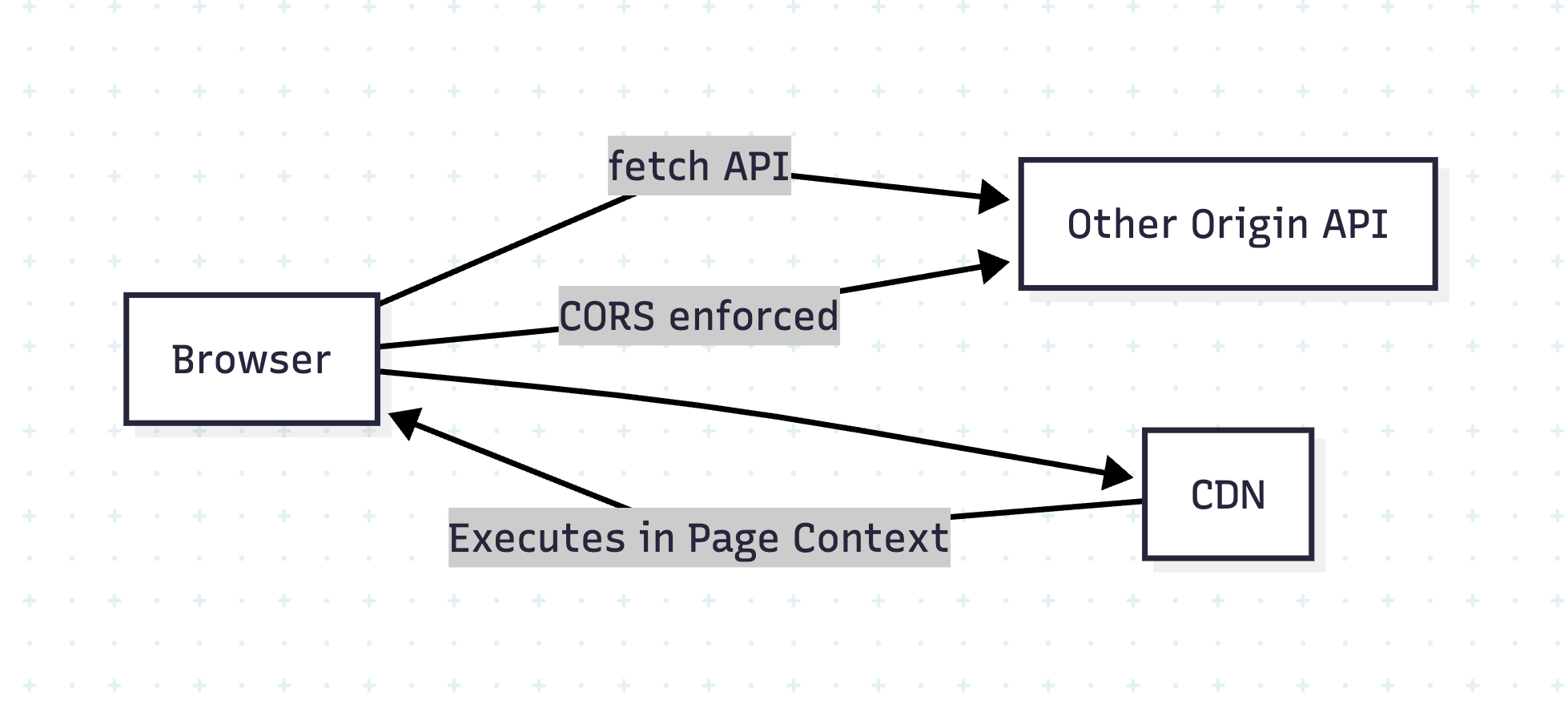
Developers often assume CORS (Cross-Origin Resource Sharing) protects their websites from all cross-origin risks. However, while CORS effectively controls data access via APIs, it does NOT stop risks from external scripts like those served via a CDN (Content Delivery Network).
This blog explains:
Why CORS and CDN behave differently
Why external scripts can compromise your site
Best practices to secure your app
🤔 What Does CORS Actually Do?
CORS is a browser-enforced security mechanism that prevents JavaScript from reading responses from another origin unless explicitly allowed.
Example:
// Your site: https://example.com
fetch('https://api.example2.com/data') // blocked unless API sets CORS headers
If api.example2.com does not send:
Access-Control-Allow-Origin: https://example.com
The browser blocks the response.
Why?
To prevent cross-site data theft.
🧐 Why CDN Scripts Load Without CORS?
When you include a script via <script> or CSS via <link>:
External scripts are powerful and dangerous if compromised.
Use HTTPS, SRI, CSP, and self-hosting for maximum safety.
🔐 Content Security Policy (CSP) – The Complete Guide for Web Security
🔍 Introduction
Even if you secure your API with CORS and validate CDN scripts with SRI, there’s still a risk of inline scripts, XSS (Cross-Site Scripting), and malicious script injections. That’s where Content Security Policy (CSP) comes in.
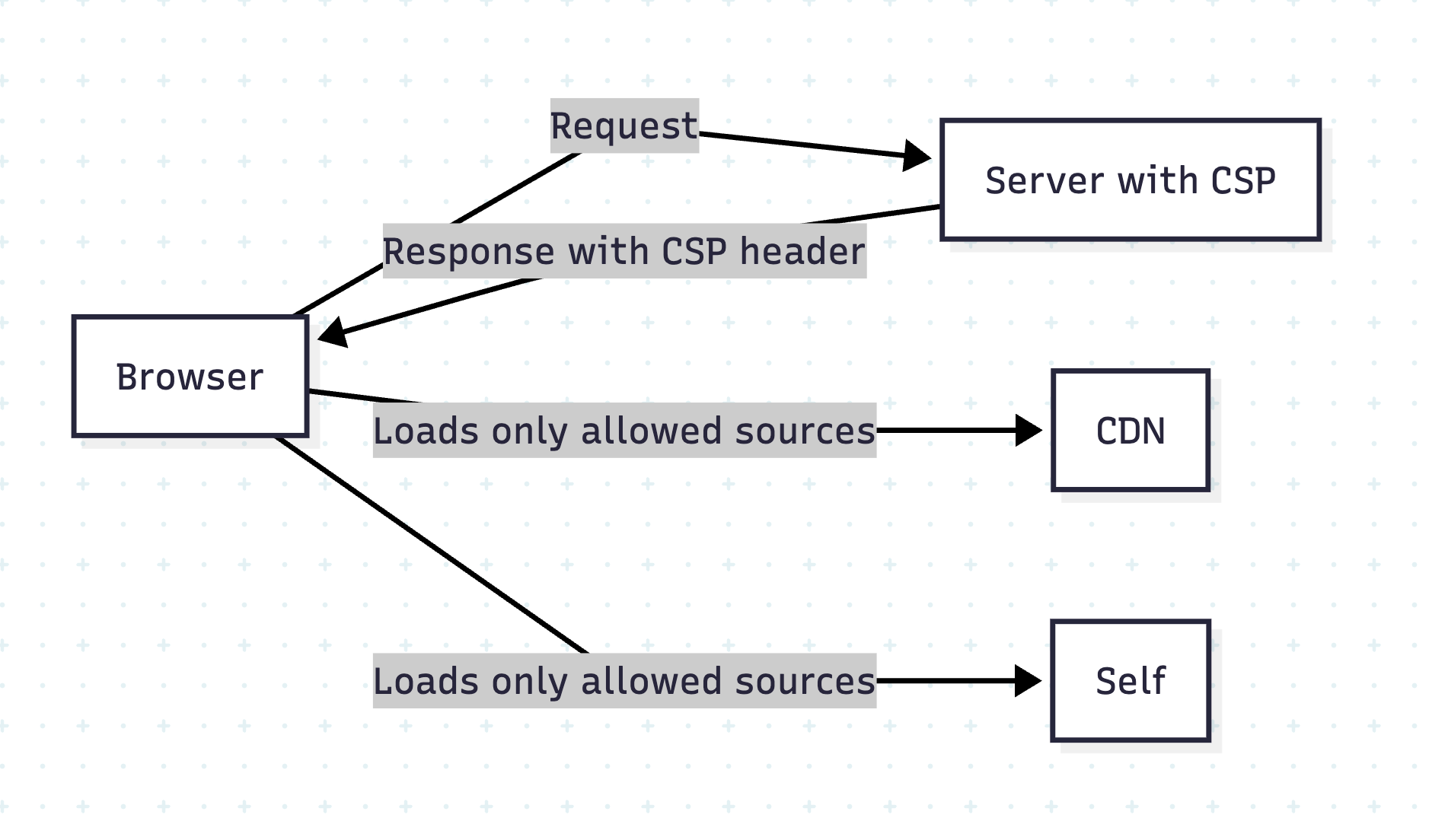
CSP is a powerful HTTP header that tells the browser which resources are allowed to load and execute.
🧐 Why CSP?
Blocks inline scripts and unauthorized external resources.
Reduces XSS attacks by whitelisting script origins.
Adds an extra layer beyond CORS and HTTPS.
How CSP Works
The server sends a Content-Security-Policy header, defining allowed resource sources.
Ruby’s meta-programming capabilities let you write code that writes code, opening doors to DSLs (Check my post on DSL), dynamic behaviours, and DRY abstractions. In this two-part series, we’ll explore:
Part 1:class_eval, instance_eval, eval, define_method, and method_missing
Part 2: Additional metaprogramming methods like define_singleton_method, module_eval, send, and more
🏷️ Part 1: Core Metaprogramming Methods
🔨 1. What is class_eval?
class_eval is a method that allows you to evaluate a block of code or a string within the context of a class. It’s part of Ruby’s metaprogramming toolkit and is inherited from the Module class.
Basic Syntax
class MyClass
# class definition
end
MyClass.class_eval do
# code executed in the context of MyClass
def new_method
puts "Hello from class_eval!"
end
end
Key Features
1. Context Execution
The code inside class_eval is executed as if it were written directly inside the class definition:
class Example
def existing_method
puts "I exist"
end
end
Example.class_eval do
def dynamic_method
puts "I was added dynamically!"
end
end
# Now you can use the new method
obj = Example.new
obj.dynamic_method # => "I was added dynamically!"
2. String Evaluation
You can also pass a string instead of a block:
class MyClass
end
MyClass.class_eval("def hello; puts 'Hello!'; end")
3. Access to Class Variables and Constants
The evaluated code has access to the class’s variables and constants:
class Calculator
OPERATIONS = [:add, :subtract, :multiply, :divide]
end
Calculator.class_eval do
OPERATIONS.each do |op|
define_method(op) do |a, b|
case op
when :add then a + b
when :subtract then a - b
when :multiply then a * b
when :divide then a / b
end
end
end
end
Common Use Cases
1. Dynamic Method Creation
class User
attr_accessor :name, :email
end
# Dynamically add validation methods
User.class_eval do
[:name, :email].each do |field|
define_method("validate_#{field}") do
!send(field).nil? && !send(field).empty?
end
end
end
2. Plugin Systems
class Plugin
def self.register(plugin_name, &block)
class_eval(&block)
end
end
Plugin.register(:logger) do
def log(message)
puts "[LOG] #{message}"
end
end
3. Configuration DSLs
class Config
def self.configure(&block)
class_eval(&block)
end
end
Config.configure do
def database_url
"postgresql://localhost/myapp"
end
def api_key
ENV['API_KEY']
end
end
Differences from instance_eval
class_eval: Executes code in the context of the class (like being inside the class definition)
instance_eval: Executes code in the context of an instance of the class
class Example
def self.class_method
puts "I'm a class method"
end
def instance_method
puts "I'm an instance method"
end
end
# class_eval - can define class methods
Example.class_eval do
def self.new_class_method
puts "New class method"
end
end
# instance_eval - can define instance methods
Example.instance_eval do
def new_instance_method
puts "New instance method"
end
end
Security Considerations
⚠️ Warning: Using class_eval with user input can be dangerous:
# DANGEROUS - don't do this with user input
user_code = gets.chomp
MyClass.class_eval(user_code) # Could execute malicious code
Performance Notes
class_eval with blocks is generally faster than with strings
The block version is also safer and more readable
Use string evaluation only when you need to evaluate dynamic code
Real-World Example
Here’s how you might use class_eval in a practical scenario:
class ActiveRecord
def self.has_many(association_name)
class_eval do
define_method(association_name) do
# Implementation for has_many association
puts "Fetching #{association_name} for #{self.class}"
end
end
end
end
class User < ActiveRecord
has_many :posts
end
user = User.new
user.posts # => "Fetching posts for User"
class_eval is a powerful tool for meta-programming in Ruby, allowing you to dynamically modify classes at runtime. It’s commonly used in frameworks like Rails for creating DSLs and dynamic method generation.
🛠️ 2. What is instance_eval?
instance_eval is a method that allows you to evaluate a block of code or a string within the context of a specific object instance. It’s inherited from the BasicObject class and is available on all Ruby objects.
Basic Syntax
class MyClass
def initialize(name)
@name = name
end
end
obj = MyClass.new("Alice")
obj.instance_eval do
# code executed in the context of this specific object
puts @name # Can access instance variables
end
Key Features
1. Instance Context Execution
The code inside instance_eval is executed as if it were an instance method of the object:
class Person
def initialize(name, age)
@name = name
@age = age
end
def introduce
puts "Hi, I'm #{@name}"
end
end
person = Person.new("Bob", 30)
person.instance_eval do
puts "Name: #{@name}" # => "Name: Bob"
puts "Age: #{@age}" # => "Age: 30"
introduce # => "Hi, I'm Bob"
end
2. Access to Instance Variables
You can read and modify instance variables:
class BankAccount
def initialize(balance)
@balance = balance
end
end
account = BankAccount.new(1000)
account.instance_eval do
puts "Current balance: #{@balance}" # => "Current balance: 1000"
@balance += 500 # Modify instance variable
puts "New balance: #{@balance}" # => "New balance: 1500"
end
3. String Evaluation
You can also pass a string instead of a block:
class Example
def initialize(value)
@value = value
end
end
obj = Example.new("test")
obj.instance_eval("puts @value") # => "test"
Common Use Cases
1. Testing Private Methods
class Calculator
private
def secret_calculation(x, y)
x * y + 42
end
end
calc = Calculator.new
# Access private method in tests
result = calc.instance_eval { secret_calculation(5, 3) }
puts result # => 57
2. Dynamic Property Access
class Config
def initialize
@settings = {}
end
def set(key, value)
@settings[key] = value
end
end
config = Config.new
config.set(:api_url, "https://api.example.com")
config.set(:timeout, 30)
# Access settings dynamically
config.instance_eval do
puts @settings[:api_url] # => "https://api.example.com"
puts @settings[:timeout] # => 30
end
3. Object Inspection and Debugging
class ComplexObject
def initialize
@data = { a: 1, b: 2, c: 3 }
@metadata = { created: Time.now }
end
end
obj = ComplexObject.new
obj.instance_eval do
puts "All instance variables:"
instance_variables.each do |var|
puts "#{var}: #{instance_variable_get(var)}"
end
end
4. DSL (Domain Specific Language) Implementation
class Builder
def initialize
@result = []
end
def build(&block)
instance_eval(&block)
@result
end
end
builder = Builder.new
result = builder.build do
@result << "item1"
@result << "item2"
@result << "item3"
end
puts result # => ["item1", "item2", "item3"]
Differences from class_eval
Feature
instance_eval
class_eval
Context
Object instance
Class
Self
Points to the object
Points to the class
Method Definition
Defines instance methods
Access
Instance variables, private methods
Class methods, constants
class Example
def initialize
@value = "instance value"
end
@@class_var = "class variable"
end
obj = Example.new
# instance_eval - context is the object
obj.instance_eval do
puts @value # => "instance value"
puts self.class # => Example
end
# class_eval - context is the class
Example.class_eval do
puts @@class_var # => "class variable"
puts self # => Example
end
Advanced Examples
1. Method Chaining with instance_eval
class QueryBuilder
def initialize
@conditions = []
end
def where(field, value)
@conditions << "#{field} = '#{value}'"
self
end
def build
@conditions.join(" AND ")
end
end
query = QueryBuilder.new.instance_eval do
where("name", "John")
where("age", 25)
build
end
puts query # => "name = 'John' AND age = '25'"
2. Configuration Objects
class AppConfig
def initialize
@config = {}
end
def configure(&block)
instance_eval(&block)
end
def database(url)
@config[:database] = url
end
def api_key(key)
@config[:api_key] = key
end
def get_config
@config
end
end
config = AppConfig.new
config.configure do
database "postgresql://localhost/myapp"
api_key ENV['API_KEY']
end
puts config.get_config
3. Object Serialization
class Serializable
def to_hash
result = {}
instance_eval do
instance_variables.each do |var|
key = var.to_s.delete('@').to_sym
result[key] = instance_variable_get(var)
end
end
result
end
end
class User < Serializable
def initialize(name, email)
@name = name
@email = email
end
end
user = User.new("Alice", "alice@example.com")
puts user.to_hash # => {:name=>"Alice", :email=>"alice@example.com"}
Security Considerations
⚠️ Warning: Like class_eval, using instance_eval with user input can be dangerous:
# DANGEROUS - don't do this with user input
user_code = gets.chomp
obj.instance_eval(user_code) # Could execute malicious code
Performance Notes
instance_eval with blocks is faster than with strings
The block version is safer and more readable
Use string evaluation only when necessary for dynamic code
Real-World Usage
instance_eval is commonly used in:
Testing frameworks (RSpec, Minitest)
Configuration systems (Rails initializers)
Builder patterns (ActiveRecord queries)
DSL implementations (Rake tasks, Capistrano)
# RSpec example
describe User do
it "has a name" do
user = User.new("John")
expect(user.instance_eval { @name }).to eq("John")
end
end
instance_eval is a powerful tool for metaprogramming that allows you to execute code in the context of any object, making it invaluable for testing, debugging, and creating flexible APIs.
⚡ 3. What is eval?
Ruby’s eval method, which is the most powerful and potentially dangerous meta-programming tool in Ruby.
eval is a method that evaluates a string as Ruby code in the current context. It’s inherited from the Kernel module and is available everywhere in Ruby. Unlike class_eval and instance_eval, eval executes code in the current binding (the current execution context).
Basic Syntax
# Basic eval usage
eval("puts 'Hello from eval!'")
# With variables
x = 10
y = 20
result = eval("x + y")
puts result # => 30
Key Features
1. Current Context Execution
eval executes code in the current binding (local variables, methods, etc.):
name = "Alice"
age = 25
city = "New York"
eval("puts \"#{name} is #{age} years old and lives in #{city}\"")
# => "Alice is 25 years old and lives in New York"
3. Dynamic Method Calls
class Calculator
def add(x, y)
x + y
end
def multiply(x, y)
x * y
end
end
calc = Calculator.new
method_name = "add"
args = [5, 3]
result = eval("calc.#{method_name}(#{args.join(', ')})")
puts result # => 8
class MathEvaluator
def self.evaluate(expression)
eval(expression)
rescue => e
"Error: #{e.message}"
end
end
puts MathEvaluator.evaluate("2 + 3 * 4") # => 14
puts MathEvaluator.evaluate("Math.sqrt(16)") # => 4.0
puts MathEvaluator.evaluate("10 / 0") # => "Error: divided by 0"
3. Template Processing
class Template
def initialize(template)
@template = template
end
def render(binding)
eval("\"#{@template}\"", binding)
end
end
template = Template.new("Hello <%= name %>, you are <%= age %> years old!")
name = "Bob"
age = 30
result = template.render(binding)
puts result # => "Hello Bob, you are 30 years old!"
4. Code Generation
class CodeGenerator
def self.generate_method(method_name, body)
eval("
def #{method_name}
#{body}
end
")
end
end
class MyClass
CodeGenerator.generate_method(:greet, "puts 'Hello, World!'")
CodeGenerator.generate_method(:calculate, "2 + 2")
end
obj = MyClass.new
obj.greet # => "Hello, World!"
puts obj.calculate # => 4
Advanced Examples
1. Dynamic Class Creation
class DynamicClassCreator
def self.create_class(class_name, methods = {})
eval("
class #{class_name}
#{methods.map { |name, body| "def #{name}; #{body}; end" }.join("\n")}
end
")
end
end
DynamicClassCreator.create_class("Person", {
greet: "puts 'Hello!'",
age: "25"
})
person = Person.new
person.greet # => "Hello!"
puts person.age # => 25
2. Expression Parser
class ExpressionParser
def self.parse(expression, variables = {})
# Create a safe binding with variables
binding_obj = binding
variables.each do |key, value|
binding_obj.local_variable_set(key, value)
end
eval(expression, binding_obj)
end
end
result = ExpressionParser.parse("x * y + z", { x: 5, y: 3, z: 10 })
puts result # => 25
⚠️ CRITICAL WARNING: eval is extremely dangerous when used with untrusted input!
Dangerous Examples:
# NEVER do this with user input!
user_input = gets.chomp
eval(user_input) # User could input: system('rm -rf /')
# Dangerous with file input
file_content = File.read('user_provided_file.rb')
eval(file_content) # Could contain malicious code
Safe Alternatives:
# Instead of eval, use safer alternatives
class SafeCalculator
def self.calculate(expression)
# Use a math library or parser instead
case expression
when /^\d+\s*\+\s*\d+$/
# Safe addition
eval(expression)
else
raise "Unsafe expression"
end
end
end
Binding and Context
1. Custom Binding
def create_binding(variables = {})
binding_obj = binding
variables.each do |key, value|
binding_obj.local_variable_set(key, value)
end
binding_obj
end
my_binding = create_binding(x: 10, y: 20)
result = eval("x + y", my_binding)
puts result # => 30
2. Different Contexts
class ContextExample
def initialize(value)
@value = value
end
def evaluate_in_context(code)
eval(code)
end
end
obj = ContextExample.new("test")
result = obj.evaluate_in_context("@value")
puts result # => "test"
Performance Considerations
eval is slower than direct code execution
The string must be parsed every time
No compile-time optimization
Use sparingly and only when necessary
Best Practices
1. Avoid When Possible
# Bad - using eval
method_name = "calculate"
eval("result = #{method_name}(5, 3)")
# Good - using send
result = send(method_name, 5, 3)
2. Whitelist Allowed Operations
class SafeEvaluator
ALLOWED_OPERATIONS = %w[+ - * /]
def self.evaluate(expression)
operation = expression.match(/(\d+)\s*([+\-*/])\s*(\d+)/)
return "Invalid expression" unless operation
op = operation[2]
return "Operation not allowed" unless ALLOWED_OPERATIONS.include?(op)
eval(expression)
end
end
3. Use Sandboxing
class SandboxedEval
def self.safe_eval(code, timeout: 1)
Timeout::timeout(timeout) do
eval(code)
end
rescue Timeout::Error
"Execution timed out"
rescue => e
"Error: #{e.message}"
end
end
Real-World Usage
eval is used in:
Template engines (ERB, Haml)
Configuration systems (Rails initializers)
Code generators (Rails generators)
REPLs (Interactive Ruby shells)
# ERB template example
require 'erb'
template = ERB.new("Hello <%= name %>!")
name = "World"
result = template.result(binding)
puts result # => "Hello World!"
Summary
eval is the most powerful metaprogramming tool in Ruby, but also the most dangerous. Use it only when:
You have complete control over the input
No safer alternative exists
You understand the security implications
You implement proper validation and sandboxing
For most use cases, prefer safer alternatives like send, method_missing, or dedicated parsing libraries.
✍️ 4. What is define_method?
Ruby’s define_method, which is a powerful meta-programming tool for dynamically creating methods at runtime.
define_method is a method that allows you to dynamically define instance methods on a class or module. It’s inherited from the Module class and is a key tool for meta-programming in Ruby.
Basic Syntax
class MyClass
define_method :dynamic_method do |*args|
puts "Hello from dynamic method with args: #{args}"
end
end
obj = MyClass.new
obj.dynamic_method("test", 123) # => "Hello from dynamic method with args: [\"test\", 123]"
Key Features
1. Dynamic Method Creation
class Calculator
# Define methods dynamically based on operations
[:add, :subtract, :multiply, :divide].each do |operation|
define_method operation do |a, b|
case operation
when :add then a + b
when :subtract then a - b
when :multiply then a * b
when :divide then a / b
end
end
end
end
calc = Calculator.new
puts calc.add(5, 3) # => 8
puts calc.multiply(4, 2) # => 8
puts calc.divide(10, 2) # => 5
2. Access to Instance Variables
class Person
def initialize(name, age)
@name = name
@age = age
end
# Create getter methods dynamically
[:name, :age].each do |attribute|
define_method attribute do
instance_variable_get("@#{attribute}")
end
end
end
person = Person.new("Alice", 25)
puts person.name # => "Alice"
puts person.age # => 25
3. Method with Parameters
class DynamicAPI
define_method :api_call do |endpoint, params = {}|
puts "Calling #{endpoint} with params: #{params}"
# Simulate API call
"Response from #{endpoint}"
end
end
api = DynamicAPI.new
api.api_call("/users", { id: 1 }) # => "Calling /users with params: {:id=>1}"
Common Use Cases
1. Attribute Accessors
class Model
def self.attr_accessor(*attributes)
attributes.each do |attribute|
# Define getter
define_method attribute do
instance_variable_get("@#{attribute}")
end
# Define setter
define_method "#{attribute}=" do |value|
instance_variable_set("@#{attribute}", value)
end
end
end
attr_accessor :name, :email, :age
end
user = Model.new
user.name = "John"
user.email = "john@example.com"
puts user.name # => "John"
puts user.email # => "john@example.com"
2. Validation Methods
class User
def initialize(attributes = {})
attributes.each do |key, value|
instance_variable_set("@#{key}", value)
end
end
# Create validation methods dynamically
[:name, :email, :age].each do |field|
define_method "validate_#{field}" do
value = instance_variable_get("@#{field}")
case field
when :name
!value.nil? && !value.empty?
when :email
value =~ /\A[\w+\-.]+@[a-z\d\-]+(\.[a-z\d\-]+)*\.[a-z]+\z/i
when :age
value.is_a?(Integer) && value > 0 && value < 150
end
end
end
end
user = User.new(name: "Alice", email: "alice@example.com", age: 25)
puts user.validate_name # => true
puts user.validate_email # => true
puts user.validate_age # => true
3. API Method Generation
class APIClient
def initialize(base_url)
@base_url = base_url
end
# Generate API methods for different resources
[:users, :posts, :comments].each do |resource|
define_method "get_#{resource}" do |id = nil|
endpoint = id ? "#{resource}/#{id}" : resource
puts "GET #{@base_url}/#{endpoint}"
# Actual HTTP request would go here
end
define_method "create_#{resource.singularize}" do |data|
puts "POST #{@base_url}/#{resource}"
puts "Data: #{data}"
# Actual HTTP request would go here
end
end
end
api = APIClient.new("https://api.example.com")
api.get_users # => "GET https://api.example.com/users"
api.get_users(123) # => "GET https://api.example.com/users/123"
api.create_user(name: "John") # => "POST https://api.example.com/users"
4. Database Query Methods
class ActiveRecord
def self.has_many(association_name)
define_method association_name do
puts "Fetching #{association_name} for #{self.class}"
# Actual database query would go here
[]
end
end
def self.belongs_to(association_name)
define_method association_name do
puts "Fetching #{association_name} for #{self.class}"
# Actual database query would go here
nil
end
end
end
class User < ActiveRecord
has_many :posts
belongs_to :company
end
user = User.new
user.posts # => "Fetching posts for User"
user.company # => "Fetching company for User"
Advanced Examples
1. Method with Dynamic Logic
class DynamicCalculator
def self.create_operation(operation_name, &block)
define_method operation_name do |*args|
instance_eval(&block)
end
end
create_operation :custom_add do
args = method(__method__).parameters.map { |_, name| local_variable_get(name) }
args.inject(:+)
end
create_operation :power do
base, exponent = method(__method__).parameters.map { |_, name| local_variable_get(name) }
base ** exponent
end
end
calc = DynamicCalculator.new
puts calc.custom_add(1, 2, 3, 4) # => 10
puts calc.power(2, 3) # => 8
2. Conditional Method Definition
class FeatureToggle
def self.define_feature_method(feature_name, enabled = true)
if enabled
define_method feature_name do
puts "Feature #{feature_name} is enabled"
# Feature implementation
end
else
define_method feature_name do
puts "Feature #{feature_name} is disabled"
# Fallback or no-op
end
end
end
define_feature_method :new_ui, true
define_feature_method :beta_feature, false
end
app = FeatureToggle.new
app.new_ui # => "Feature new_ui is enabled"
app.beta_feature # => "Feature beta_feature is disabled"
3. Method with Different Signatures
class FlexibleAPI
def self.define_flexible_method(method_name)
define_method method_name do |*args, **kwargs, &block|
puts "Method: #{method_name}"
puts "Arguments: #{args}"
puts "Keyword arguments: #{kwargs}"
puts "Block given: #{block_given?}"
# Process based on arguments
if block_given?
block.call(args.first)
elsif !kwargs.empty?
kwargs.values.first
else
args.first
end
end
end
define_flexible_method :process
end
api = FlexibleAPI.new
api.process("hello") # => "hello"
api.process(data: "world") # => "world"
api.process("test") { |x| x.upcase } # => "TEST"
4. Method Aliasing
class MethodAliaser
def self.create_aliases(base_method, *aliases)
aliases.each do |alias_name|
define_method alias_name do |*args, &block|
send(base_method, *args, &block)
end
end
end
def original_method
puts "Original method called"
end
create_aliases :original_method, :alias1, :alias2, :alternative_name
end
obj = MethodAliaser.new
obj.alias1 # => "Original method called"
obj.alternative_name # => "Original method called"
Performance Considerations
1. Method Definition Timing
class PerformanceExample
# Methods defined at class definition time (faster)
define_method :static_method do
puts "Static method"
end
def self.create_dynamic_methods
# Methods defined at runtime (slower)
1000.times do |i|
define_method "dynamic_method_#{i}" do
puts "Dynamic method #{i}"
end
end
end
end
2. Memory Usage
class MemoryEfficient
# More memory efficient - methods defined once
METHODS = [:method1, :method2, :method3]
METHODS.each do |method_name|
define_method method_name do
puts "Called #{method_name}"
end
end
end
Best Practices
1. Use Meaningful Names
# Good
define_method :calculate_total do
# implementation
end
# Bad
define_method :m1 do
# implementation
end
2. Handle Errors Gracefully
class SafeMethodDefiner
def self.define_safe_method(method_name, &block)
define_method method_name do |*args|
begin
instance_eval(&block)
rescue => e
puts "Error in #{method_name}: #{e.message}"
nil
end
end
end
end
3. Document Dynamic Methods
class DocumentedClass
# Dynamically creates getter methods for attributes
# @param attributes [Array<Symbol>] list of attribute names
def self.create_getters(*attributes)
attributes.each do |attr|
define_method attr do
instance_variable_get("@#{attr}")
end
end
end
create_getters :name, :email
end
Real-World Usage
define_method is commonly used in:
Rails ActiveRecord (associations, validations)
RSpec (dynamic test methods)
Configuration systems (dynamic setters/getters)
API clients (dynamic endpoint methods)
ORM frameworks (dynamic query methods)
# Rails-like example
class ActiveRecord
def self.validates_presence_of(*attributes)
attributes.each do |attribute|
define_method "validate_#{attribute}_presence" do
value = send(attribute)
value.nil? || value.to_s.empty?
end
end
end
end
class User < ActiveRecord
validates_presence_of :name, :email
end
define_method is a powerful tool for creating flexible, dynamic APIs and reducing code duplication through meta-programming.
🌀 5. What is method_missing?
Ruby’s method_missing, which is a powerful meta-programming tool that allows you to handle calls to undefined methods dynamically.
method_missing is a special method in Ruby that gets called automatically when an object receives a message (method call) for a method that doesn’t exist. It’s inherited from the BasicObject class and is a key component of Ruby’s dynamic nature.
Basic Syntax
class MyClass
def method_missing(method_name, *args, &block)
puts "Method '#{method_name}' called with args: #{args}"
# Handle the missing method call
end
end
obj = MyClass.new
obj.undefined_method("hello", 123) # => "Method 'undefined_method' called with args: [\"hello\", 123]"
Key Features
1. Automatic Invocation
class DynamicHandler
def method_missing(method_name, *args, &block)
puts "Trying to call: #{method_name}"
puts "Arguments: #{args}"
puts "Block given: #{block_given?}"
# Return a default value or handle the call
"Handled by method_missing"
end
end
obj = DynamicHandler.new
result = obj.some_random_method("arg1", "arg2") { puts "block" }
puts result
# Output:
# Trying to call: some_random_method
# Arguments: ["arg1", "arg2"]
# Block given: true
# Handled by method_missing
2. Method Name and Arguments
class FlexibleAPI
def method_missing(method_name, *args, **kwargs, &block)
puts "Method: #{method_name}"
puts "Arguments: #{args}"
puts "Keyword arguments: #{kwargs}"
# Handle different method patterns
case method_name.to_s
when /^get_(.+)$/
"Getting #{$1}"
when /^set_(.+)$/
"Setting #{$1} to #{args.first}"
else
"Unknown method: #{method_name}"
end
end
end
api = FlexibleAPI.new
puts api.get_user_info # => "Getting user_info"
puts api.set_name("Alice") # => "Setting name to Alice"
puts api.random_method # => "Unknown method: random_method"
Common Use Cases
1. Dynamic Property Access
class DynamicProperties
def initialize
@data = {}
end
def method_missing(method_name, *args)
method_str = method_name.to_s
if method_str.end_with?('=')
# Setter method
property_name = method_str.chomp('=')
@data[property_name] = args.first
else
# Getter method
@data[method_str]
end
end
end
obj = DynamicProperties.new
obj.name = "Alice"
obj.age = 25
obj.city = "New York"
puts obj.name # => "Alice"
puts obj.age # => 25
puts obj.city # => "New York"
2. API Method Generation
class APIClient
def initialize(base_url)
@base_url = base_url
end
def method_missing(method_name, *args)
method_str = method_name.to_s
case method_str
when /^get_(.+)$/
resource = $1
puts "GET #{@base_url}/#{resource}"
# Actual HTTP GET request
when /^post_(.+)$/
resource = $1
data = args.first || {}
puts "POST #{@base_url}/#{resource}"
puts "Data: #{data}"
# Actual HTTP POST request
when /^put_(.+)$/
resource = $1
data = args.first || {}
puts "PUT #{@base_url}/#{resource}"
puts "Data: #{data}"
# Actual HTTP PUT request
when /^delete_(.+)$/
resource = $1
puts "DELETE #{@base_url}/#{resource}"
# Actual HTTP DELETE request
else
super
end
end
end
api = APIClient.new("https://api.example.com")
api.get_users # => "GET https://api.example.com/users"
api.post_user(name: "John") # => "POST https://api.example.com/user"
api.put_user(1, name: "Jane") # => "PUT https://api.example.com/user"
api.delete_user(1) # => "DELETE https://api.example.com/user"
3. Configuration DSL
class Configuration
def initialize
@config = {}
end
def method_missing(method_name, *args)
method_str = method_name.to_s
if method_str.end_with?('=')
# Setter
key = method_str.chomp('=')
@config[key] = args.first
else
# Getter
@config[method_str]
end
end
def to_hash
@config
end
end
config = Configuration.new
config.database_url = "postgresql://localhost/myapp"
config.api_key = ENV['API_KEY']
config.debug_mode = true
puts config.database_url # => "postgresql://localhost/myapp"
puts config.to_hash # => {"database_url"=>"postgresql://localhost/myapp", ...}
4. Builder Pattern
class HTMLBuilder
def initialize
@html = []
end
def method_missing(tag_name, *args, &block)
content = args.first || ""
attributes = args.last.is_a?(Hash) ? args.last : {}
if block_given?
@html << "<#{tag_name}#{format_attributes(attributes)}>"
@html << yield
@html << "</#{tag_name}>"
else
@html << "<#{tag_name}#{format_attributes(attributes)}>#{content}</#{tag_name}>"
end
self
end
private
def format_attributes(attributes)
return "" if attributes.empty?
" " + attributes.map { |k, v| "#{k}=\"#{v}\"" }.join(" ")
end
def to_s
@html.join("\n")
end
end
builder = HTMLBuilder.new
html = builder.html do
builder.head do
builder.title("My Page")
end
builder.body(class: "main") do
builder.h1("Hello World")
builder.p("This is a paragraph", class: "intro")
end
end
puts html
# Output:
# <html>
# <head>
# <title>My Page</title>
# </head>
# <body class="main">
# <h1>Hello World</h1>
# <p class="intro">This is a paragraph</p>
# </body>
# </html>
Advanced Examples
1. Method Caching with respond_to_missing?
class CachedMethodHandler
def initialize
@cache = {}
end
def method_missing(method_name, *args)
method_str = method_name.to_s
# Check if we should handle this method
if method_str.start_with?('cached_')
cache_key = "#{method_str}_#{args.hash}"
if @cache.key?(cache_key)
puts "Returning cached result for #{method_name}"
@cache[cache_key]
else
puts "Computing result for #{method_name}"
result = compute_result(method_str, args)
@cache[cache_key] = result
result
end
else
super
end
end
def respond_to_missing?(method_name, include_private = false)
method_name.to_s.start_with?('cached_') || super
end
private
def compute_result(method_name, args)
# Simulate expensive computation
sleep(1)
"Result for #{method_name} with #{args}"
end
end
handler = CachedMethodHandler.new
puts handler.cached_expensive_calculation(1, 2, 3) # Slow
puts handler.cached_expensive_calculation(1, 2, 3) # Fast (cached)
puts handler.respond_to?(:cached_expensive_calculation) # => true
2. Dynamic Delegation
class Delegator
def initialize(target)
@target = target
end
def method_missing(method_name, *args, &block)
if @target.respond_to?(method_name)
@target.send(method_name, *args, &block)
else
super
end
end
def respond_to_missing?(method_name, include_private = false)
@target.respond_to?(method_name, include_private) || super
end
end
class User
def initialize(name, email)
@name = name
@email = email
end
def display_info
"Name: #{@name}, Email: #{@email}"
end
end
user = User.new("Alice", "alice@example.com")
delegator = Delegator.new(user)
puts delegator.display_info # => "Name: Alice, Email: alice@example.com"
3. Method Chaining with method_missing
class QueryBuilder
def initialize
@conditions = []
@order_by = nil
@limit = nil
end
def method_missing(method_name, *args)
method_str = method_name.to_s
case method_str
when /^where_(.+)$/
field = $1
value = args.first
@conditions << "#{field} = '#{value}'"
self
when /^order_by_(.+)$/
field = $1
direction = args.first || 'ASC'
@order_by = "#{field} #{direction}"
self
when /^limit$/
@limit = args.first
self
when /^execute$/
build_query
else
super
end
end
private
def build_query
query = "SELECT * FROM table"
query += " WHERE #{@conditions.join(' AND ')}" unless @conditions.empty?
query += " ORDER BY #{@order_by}" if @order_by
query += " LIMIT #{@limit}" if @limit
query
end
end
query = QueryBuilder.new
result = query.where_name("John")
.where_age(25)
.order_by_created_at("DESC")
.limit(10)
.execute
puts result
# => "SELECT * FROM table WHERE name = 'John' AND age = '25' ORDER BY created_at DESC LIMIT 10"
4. Event Handling
class EventHandler
def initialize
@handlers = {}
end
def method_missing(event_name, *args)
method_str = event_name.to_s
if method_str.end_with?('=')
# Register event handler
handler_name = method_str.chomp('=')
@handlers[handler_name] = args.first
else
# Trigger event
handler = @handlers[method_str]
if handler
handler.call(*args)
else
puts "No handler registered for event: #{method_str}"
end
end
end
end
handler = EventHandler.new
# Register event handlers
handler.on_click = ->(x, y) { puts "Clicked at (#{x}, #{y})" }
handler.on_hover = ->(element) { puts "Hovered over #{element}" }
# Trigger events
handler.on_click(100, 200) # => "Clicked at (100, 200)"
handler.on_hover("button") # => "Hovered over button"
handler.on_keypress # => "No handler registered for event: on_keypress"
Important Considerations
1. respond_to_missing?
Always implement respond_to_missing? when using method_missing:
class ProperHandler
def method_missing(method_name, *args)
if method_name.to_s.start_with?('dynamic_')
"Handled: #{method_name}"
else
super
end
end
def respond_to_missing?(method_name, include_private = false)
method_name.to_s.start_with?('dynamic_') || super
end
end
obj = ProperHandler.new
puts obj.respond_to?(:dynamic_method) # => true
puts obj.respond_to?(:real_method) # => false
2. Performance Impact
class PerformanceExample
def method_missing(method_name, *args)
# This gets called for EVERY undefined method
# Can be slow if called frequently
puts "Handling #{method_name}"
end
end
# Better approach: Define methods when first called
class BetterExample
def method_missing(method_name, *args)
if method_name.to_s.start_with?('dynamic_')
# Define the method for future calls
self.class.define_method(method_name) do |*method_args|
"Handled: #{method_name} with #{method_args}"
end
# Call the newly defined method
send(method_name, *args)
else
super
end
end
end
3. Debugging
class DebuggableHandler
def method_missing(method_name, *args, &block)
puts "DEBUG: method_missing called for #{method_name}"
puts "DEBUG: arguments: #{args}"
puts "DEBUG: block given: #{block_given?}"
# Your handling logic here
super
end
end
Real-World Usage
method_missing is commonly used in:
Rails ActiveRecord (dynamic finders)
RSpec (dynamic matchers)
Sinatra (dynamic route handlers)
Configuration systems (dynamic setters/getters)
API clients (dynamic endpoint methods)
# Rails-like example
class ActiveRecord
def method_missing(method_name, *args)
method_str = method_name.to_s
if method_str.start_with?('find_by_')
field = method_str.sub('find_by_', '')
value = args.first
puts "Finding record where #{field} = #{value}"
# Actual database query
else
super
end
end
end
class User < ActiveRecord
end
User.find_by_name("Alice") # => "Finding record where name = Alice"
User.find_by_email("alice@example.com") # => "Finding record where email = alice@example.com"
method_missing is a powerful tool for creating flexible, dynamic APIs, but should be used carefully with proper implementation of respond_to_missing? and consideration for performance.
🏷️ Part 2: Other Metaprogramming Tools
Ruby provides many more hooks for dynamic behavior:
🔗 1. define_singleton_method
Creates a method on a single object, similar to instance_eval + def.
str = "hello"
def str.shout; upcase + '!'; end
# vs.
str.define_singleton_method(:whisper) { downcase + '...' }
📦 2. module_eval / module_exec
Like class_eval but in a module’s context, useful to mix in behavior.
module Mixin; end
Mixin.module_eval do
def helper; "I'm mixed in"; end
end
🧩 3. send / public_send
Invoke methods by name, bypassing visibility with send, or respecting it with public_send.
Both send and public_send in Ruby allow you to dynamically call methods on an object by name (as a symbol or string). But the difference lies in method visibility (public, private, protected).
Key Difference
Method
Can call private/protected methods?
Example Usage
send
✅ Yes
"hello".send(:upcase)
public_send
❌ No (only public methods)
"hello".public_send(:upcase)
Example
class MyClass
def public_method
"I'm public"
end
private
def secret_method
"I'm private"
end
end
obj = MyClass.new
puts obj.send(:public_method) # ✅ Works: "I'm public"
puts obj.public_send(:public_method) # ✅ Works: "I'm public"
puts obj.send(:secret_method) # ✅ Works (can access private method)
puts obj.public_send(:secret_method) # ❌ Raises NoMethodError
? Why this matters
send is very powerful (and dangerous) because it ignores method visibility. It’s often used in metaprogramming (e.g., ActiveRecord uses it internally).
public_send is safer because it respects encapsulation. Use this when you don’t want to accidentally call private methods.
Best Practice
Use public_send whenever possible (especially if the method name comes from user input) to avoid security issues.
Use send only when you explicitly need access to private methods (e.g., in testing or metaprogramming).
Open the singleton class to define methods or mixins.
class << obj
def special; 'only me'; end
end
📡 8. autoload / require_relative
Delay loading of modules until first reference.
autoload :Parser, 'parser'
📐 9. respond_to_missing?
Complement method_missing to accurately report capabilities.
def respond_to_missing?(m, include_private=false)
@target.respond_to?(m) || super
end
🔀 10. Refinements
Scoped monkey-patching without global impact.
module StringExtensions
refine String do
def shout; upcase; end
end
end
using StringExtensions
puts 'hi'.shout # => HI
✅ Conclusion
Ruby’s metaprogramming toolbox is vast—from the core five methods in Part 1 to the advanced techniques in Part 2. By mastering these, you can write highly dynamic, DRY, and expressive code, but always balance power with clarity and maintainability.
Happy Ruby coding! 🚀
🔍 1. Why Use class_eval and instance_eval?
Ruby classes and objects are open, meaning you can modify them at runtime.
class_eval lets you inject instance methods into a class after it’s defined.
instance_eval lets you add singleton methods or access private state on a single object.
✨ Dynamic Method Generation
When you don’t know ahead of time what methods you’ll need—say you’re reading an external schema or configuration—you can’t hand‑write every method. Metaprogramming with class_eval/instance_eval generates them on the fly.
🔧 Building DSLs
Internal DSLs (e.g. Rails’ routing or configuration blocks) rely on evaluating blocks in the right context:
# routes.rb
Rails.application.routes.draw do
resources :users do
resources :posts
end
end
Here, instance_eval on the routing object makes resources available inside the block.
If you know all your methods at design time, define them normally. Lean on metaprogramming when you need flexibility, DRY generation, or want to craft a clean DSL.
🛠️ 2. When to Use define_method?
define_method is Ruby’s block‑based way to dynamically add methods in a class or module—safer than eval and can close over local variables:
class Serializer
%i[name age email].each do |attr|
define_method("serialize_#{attr}") do |user|
user.public_send(attr).to_s
end
end
end
Ideal for generating many similar methods (attribute serializers, dynamic finders).
Keeps code DRY without string interpolation.
📦 3. Ruby’s *arg and **arg Operators
⭐ Single Splat: *args
Definition: Packs extra positional args into an array, or unpacks an array into individual arguments. def foo(a, *others) p a # first arg p others # rest as an array end foo(1, 2, 3) # a=1, others=[2,3] foo(*[4,5,6]) # same as foo(4,5,6)
✨ Double Splat: **kwargs
Definition: Packs extra keyword args into a hash, or unpacks a hash into keyword arguments. def bar(x:, **opts) p x # required keyword p opts # other keywords in a hash end bar(x: 10, y: 20, z: 30) # opts={y:20, z:30} bar(**{x:1, y:2}) # same as bar(x:1, y:2)
📚 4. What Is a DSL? Main Ruby DSLs in Rails
A DSL (Domain‑Specific Language) is an internal API that reads like its own language, tailored to a task. Rails ships with many:
🚦 Routing DSL
Rails.application.routes.draw do
resources :users
end
Below is a practical, production-ready approach that covers controller hooks, controllers, models/libs, background jobs, and more—illustrated with a real scenario from Session::CouponCode.
Core principles
Keep transport (HTTP, JSON) in controllers; keep domain logic in models/libs.
Map known, expected failures to specific HTTP statuses.
Log unexpected failures; return a generic message to clients.
Centralize API error rendering in a base controller.
1) A single error boundary for all API controllers
Create a base Error::ApiError and rescue it (plus a safe catch‑all) in your ApiController.
# lib/error/api_error.rb
module Error
class ApiError < StandardError
attr_reader :status, :details
def initialize(message, status = :unprocessable_entity, details: nil)
super(message)
@status = status
@details = details
end
end
end
Order matters. Specific rescue_from before StandardError.
This pattern avoids duplicating rescue_from across controllers and keeps HTML controllers unaffected.
2) Errors in before actions
Because before_action runs inside controllers, the same rescue_from handlers apply.
Two patterns:
Render in the hook for simple guard clauses:
before_action :require_current_client
def require_current_client
return if current_client
render json: { success: false, error: 'require_login' }, status: :unauthorized
end
Raise a domain/auth error and let rescue_from handle JSON:
# lib/error/unauthorized_error.rb
module Error
class UnauthorizedError < Error::ApiError
def initialize(message = 'require_login') = super(message, :unauthorized)
end
end
before_action :require_current_client
def require_current_client
raise Error::UnauthorizedError unless current_client
end
Prefer raising if you want consistent global handling and logging.
3) Errors inside controllers
Use explicit renders for happy-path control flow; raise for domain failures:
def create
form = CreateThingForm.new(params.require(:thing).permit(:name))
result = CreateThing.new(form: form).call
if result.success?
render json: { success: true, thing: result.thing }, status: :created
else
# Known domain failure → raise an ApiError to map to 422
raise Error::ApiError.new(result.message, :unprocessable_entity, details: result.details)
end
end
Common controller exceptions (auto-mapped above):
ActionController::ParameterMissing → 400
ActiveRecord::RecordNotFound → 404
ActiveRecord::RecordInvalid → 422
ActiveRecord::RecordNotUnique → 409
4) Errors in models, services, and libs
Do not call render here. Either:
Return a result object (Success/Failure), or
Raise a domain‑specific exception that the controller maps to an HTTP response.
Example from our scenario, Session::CouponCode:
# lib/error/session/coupon_code_error.rb
module Error
module Session
class CouponCodeError < Error::ApiError; end
end
end
# lib/session/coupon_code.rb
class Session::CouponCode
def discount_dollars
# ...
case
when coupon_code.gift_card?
# ...
when coupon_code.discount_code?
# ...
when coupon_code.multiorder_discount_code?
# ...
else
raise Error::Session::CouponCodeError, 'Unrecognized discount code'
end
end
end
Then, in ApiController, the specific handler (or the Error::ApiError handler) renders JSON with a 422.
This preserves separation: models/libs raise; controllers decide HTTP.
5) Other important surfaces
ActiveJob / Sidekiq
Prefer retry_on, discard_on, and job‑level rescue with logging.
Return no HTTP here; jobs are async.
class MyJob < ApplicationJob
retry_on Net::OpenTimeout, wait: 10.seconds, attempts: 3
discard_on Error::ApiError
rescue_from(StandardError) { |e| Rollbar.error(e) }
end
Mailers
Use rescue_from to avoid bubble‑ups crashing deliveries:
class ApplicationMailer < ActionMailer::Base
rescue_from Postmark::InactiveRecipientError, Postmark::InvalidEmailRequestError do
# no-op / log
end
end
Routing / 404
For APIs, keep 404 mapping at the controller boundary with rescue_from ActiveRecord::RecordNotFound.
For HTML, config.exceptions_app = routes + ErrorsController.
Middleware / Rack
For truly global concerns, use middleware. This is rarely necessary for controller-scoped API errors in Rails.
Validation vs. Exceptions
Use validations (ActiveModel/ActiveRecord) for expected user errors.
Raise exceptions for exceptional conditions (invariants violated, external systems fail unexpectedly).
6) Observability
Always log unexpected errors in the catch‑all (StandardError).
Ruby, the language that brought joy back into programming, is now over two decades old. It revolutionized web development through Rails and championed a developer-first philosophy. But in the era of AI, server-less, and systems programming, is Ruby still relevant? With Python dominating AI, Go owning the backend space, and Elixir praised for concurrency — where does Ruby stand?
Let’s explore Ruby’s current state, the challenges it faces, and what the future might hold.
🧱 What Ruby Still Does Exceptionally Well
1. Web Development with Rails
Ruby on Rails remains one of the fastest and most pleasant ways to build web applications. It’s productive, expressive, and mature.
Companies like GitHub, Shopify, Basecamp, and Hey.com still use Rails at scale.
Rails 8 introduced modern features like Turbo, Hotwire, and Kamal (for zero-downtime deploys).
It’s still a top pick for startups wanting to build MVPs quickly.
2. Developer Happiness
The principle of “developer happiness” is deeply embedded in Ruby’s philosophy:
Intuitive syntax
Expressive and readable code
A community that values elegance over boilerplate
Ruby continues to be one of the best languages for teaching programming, prototyping ideas, or building software that feels joyful to write.
⚠️ Challenges Facing Ruby Today
1. Performance Limitations
Ruby’s performance has improved dramatically with YJIT, MJIT, and better memory handling. But it still lags behind languages like Go or Rust in raw speed, especially in CPU-bound or concurrent environments.
2. Concurrency and Parallelism
Ruby has a Global Interpreter Lock (GIL) in MRI, which limits real parallelism.
While Fibers and async gems (async, polyphony, concurrent-ruby) help, it’s not as seamless as Go’s goroutines or Elixir’s lightweight processes.
3. Ecosystem Narrowness
Ruby’s ecosystem is tightly tied to Rails.
Unlike Python, which powers AI, data science, and automation…
Or JavaScript, which rules the browser and serverless space…
Ruby hasn’t made significant inroads outside web development.
4. Enterprise Perception
Many large enterprises shy away from Ruby, viewing it as either:
A “legacy startup language“, or
Too dynamic and flexible for highly-regulated or enterprise-scale environments.
🛠️ How Can Ruby Improve?
💡 1. Concurrency and Async Programming
Embrace the shift toward non-blocking IO, async/await patterns.
Invest in the ecosystem around async, falcon, and evented web servers.
💡 2. AI/ML Integration
Ruby doesn’t need to compete with Python in AI, but it can bridge to Python using gems like pycall, pybind11, or ruby-dlib.
Better interop with other platforms like JRuby, TruffleRuby, or even WebAssembly can unlock new domains.
💡 3. Broaden Ecosystem Use
Encourage usage outside web: CLI tools, static site generation, scripting, DevOps, etc.
Frameworks like Hanami, Roda, Dry-rb, and Trailblazer are promising.
💡 4. Stronger Developer Outreach
More documentation, YouTube tutorials, free courses, and evangelism.
Encourage open source contribution in tools beyond Rails.
📉 Will Rails Usage Decline?
Not disappear, but become more specialized.
Rails is no longer the hottest framework — but it’s still one of the most productive and complete options for web development.
Startups love it for speed of development.
Mid-sized businesses rely on it for stability and maintainability.
But serverless-first, JavaScript-heavy, or cloud-native stacks may bypass it in favor of Next.js, Go, or Elixir/Phoenix.
The challenge is staying competitive in the face of frameworks that promise better real-time capabilities and lightweight microservices.
🌟 Why Ruby Still Matters
Despite all that, Ruby still offers:
🧘♂️ Developer productivity
🧩 Readable, expressive syntax
🚀 Fast prototyping
❤️ A helpful, mature community
🧪 First-class TDD culture
It’s a joy to write in Ruby. For many developers, that alone is enough.
🔚 Final Thoughts: The Joyful Underdog
Ruby is no longer the main character in the programming language race. But that’s okay.
In a world chasing performance benchmarks, Ruby quietly reminds us: “Programming can still be beautiful.“
The future of Ruby lies in:
Focusing on what it does best (developer experience, productivity)
Expanding into new areas (concurrency, scripting, interop)
And adapting — not by competing with Go or Python, but by embracing its unique strengths.
Let’s transform our DesignStudioMobileApp from the default template into a proper design studio interface. I’ll create the folder structure and implement all the features that is requested (https://github.com/MIRA-Designs/DesignStudioMobileApp/issues/4).
Step 1: Create Assets Folder Structure 📁
mkdir -p assets/images
📁 Image Location:
Place our design studio image at: assets/images/featured-design.png
📝 Detailed Code Explanation:
1. Import Statements (Lines 8-19)
import React from 'react';
import {
SafeAreaView,
ScrollView,
StatusBar,
StyleSheet,
Text,
View,
TextInput,
Image,
TouchableOpacity,
useColorScheme,
Alert,
} from 'react-native';
What Each Import Does:
React – Core React library for component creation
SafeAreaView – Renders content within safe area (avoids notch/home indicator)
ScrollView – Container that allows scrolling when content exceeds screen
StatusBar – Controls device status bar appearance
StyleSheet – Creates optimized styling objects
Text – Displays text (like <span> in HTML)
View – Basic container (like <div> in HTML)
TextInput – Input field for user text entry
Image – Displays images
TouchableOpacity – Touchable button with opacity feedback
useColorScheme – Hook to detect dark/light mode
Alert – Shows native alert dialogs
2. Component State and Handlers (Lines 21-37)
function App() {
// Hook to detect if device is in dark mode
const isDarkMode = useColorScheme() === 'dark';
// Handler function for search input
const handleSearch = (text: string) => {
console.log('Search query:', text);
// You can add search logic here later
};
// Handler function for category button press
const handleCategoryPress = (category: string) => {
Alert.alert('Category Selected', `You selected: ${category}`);
// You can add navigation logic here later
};
Explanation:
isDarkMode – Boolean that’s true when device is in dark mode
handleSearch – Function called when user types in search bar
Parameter:text: string – what user typed
Action: Logs to console (you can add real search later)
handleCategoryPress – Function called when category button is pressed
Parameter:category: string – which category was pressed
Welcome to my new series where I combine the power of Ruby with the discipline of Test-Driven Development (TDD) to tackle popular algorithm problems from LeetCode! 🧑💻💎 Whether you’re a Ruby enthusiast looking to sharpen your problem-solving skills, or a developer curious about how TDD can transform the way you approach coding challenges, you’re in the right place.
🎲 Episode 7: Minimum Size Subarray Sum
###########################################################
# #209
# Given an array of positive integers nums and a positive integer target, return the minimal length of a subarray
# whose @sum is greater than or equal to target. If there is no such subarray, return 0 instead.
#
# Example 1:
#
# Input: target = 7, nums = [2,3,1,2,4,3]
# Output: 2
# Explanation: The subarray [4,3] has the minimal length under the problem constraint.
# Example 2:
#
# Input: target = 4, nums = [1,4,4]
# Output: 1
# Example 3:
#
# Input: target = 11, nums = [1,1,1,1,1,1,1,1]
# Output: 0
#
#
# Constraints:
#
# 1 <= target <= 109
# 1 <= nums.length <= 105
# 1 <= nums[i] <= 104
#
###########################################################
# ❌ Fail
# frozen_string_literal: true
#######################################################
# #209
# Given an array of positive integers nums and a positive integer target, return the minimal length of a subarray
# whose sum is greater than or equal to target. If there is no such subarray, return 0 instead.
#
#######################################################
require 'minitest/autorun'
require_relative 'subarray_sum_min_size'
class TestSubArraySumMinSize < Minitest::Test
def set_up; end
def test_array_of_length_one
assert_equal 0, SubArray.new([2], 3).min_size
assert_equal 1, SubArray.new([2], 2).min_size
assert_equal 0, SubArray.new([3], 4).min_size
end
end
Source Code:
# frozen_string_literal: true
# disable rubocop GuardClause for better readability in the code
###########################################################
# #209
# Given an array of positive integers nums and a positive integer target, return the minimal length of a subarray
# whose @sum is greater than or equal to target. If there is no such subarray, return 0 instead.
# ............
#
###########################################################
class SubArray
def min_size
end
end
✗ ruby test_subarray_sum_min_size.rb
Run options: --seed 5914
# Running:
E
Finished in 0.000386s, 2590.6736 runs/s, 0.0000 assertions/s.
1) Error:
TestSubArraySumMinSize#test_array_of_length_one:
ArgumentError: wrong number of arguments (given 2, expected 0)
test_subarray_sum_min_size.rb:16:in 'BasicObject#initialize'
test_subarray_sum_min_size.rb:16:in 'Class#new'
test_subarray_sum_min_size.rb:16:in 'TestSubArraySumMinSize#test_array_of_length_one'
1 runs, 0 assertions, 0 failures, 1 errors, 0 skips
➜ minimum-size-subarray-sum git:(main) ✗
✅ Green: Making it pass
# Pass ✅
# frozen_string_literal: true
###########################################################
# #209
# Given an array of positive integers nums and a positive integer target, return the minimal length of a subarray
# whose sum is greater than or equal to target. If there is no such subarray, return 0 instead.
#
# Example 1:
#........
#
###########################################################
class SubArray
def initialize(nums, target)
@nums = nums
@target = target
end
def min_size
0 if @nums.length == 1 && @nums.first < @target
end
end
# Solution for upto 5 Array Input Length ✅
# frozen_string_literal: true
# disable rubocop GuardClause for better readability in the code
# rubocop:disable Style/GuardClause
###########################################################
# ...............
###########################################################
class SubArray
def initialize(nums, target)
@nums = nums
@target = target
@min_length = 0 # default 0 -> solution not found
@left_pos = 0
@right_pos = 0
@sum = nil
end
def min_size
while @right_pos < @nums.length
# first position where left and right positions are at starting point
@sum = if @left_pos.zero? && @right_pos.zero?
@nums[@right_pos]
else
# add elements inside the window
@nums[@left_pos..@right_pos].sum
end
if solution_found?
update_min_length
return 1 if @min_length == 1 # best scenario found, stop here
else
@right_pos += 1 # increase window size by 1
end
end
@min_length
end
private
def update_min_length
new_length = @right_pos - @left_pos + 1
if min_length_empty? || min_or_equal_length?(new_length)
@min_length = new_length
@left_pos += 1
end
end
def solution_found?
@sum >= @target
end
def min_length_empty?
@min_length.zero?
end
# if new length of subarray found is less than already found min length
# or new length found is equal to previous min length (should decrease window size
# by increasing left pos to find the less length subarray)
def min_or_equal_length?(new_length)
new_length <= @min_length
end
end
# Solution 1 ✅
# frozen_string_literal: true
# disable rubocop GuardClause for better readability in the code
# rubocop:disable Style/GuardClause
###########################################################
# #209
# .............
###########################################################
class SubArray
def initialize(nums, target)
@nums = nums
@target = target
@min_length = 0 # default 0 -> solution not found
@left_pos = 0
@right_pos = 0
@sum = nil
end
def min_size
while @right_pos < @nums.length
@sum = calculate_sum
if solution_found?
update_min_length
return 1 if @min_length == 1 # best scenario found, stop here
else
@right_pos += 1 # increase window size by 1
end
end
@min_length
end
private
def calculate_sum
# first position where left and right positions are at starting point
return @nums[@right_pos] if @left_pos.zero? && @right_pos.zero?
# add elements inside the window
@nums[@left_pos..@right_pos].sum
end
def update_min_length
new_length = @right_pos - @left_pos + 1
if min_length_empty? || min_or_equal_length?(new_length)
@min_length = new_length
@left_pos += 1
end
end
def solution_found?
@sum >= @target
end
def min_length_empty?
@min_length.zero?
end
# if new length of subarray found is less than already found min length
# or new length found is equal to previous min length (should decrease window size
# by increasing left pos to find the less length subarray)
def min_or_equal_length?(new_length)
new_length <= @min_length
end
end
# Solution 2 ✅
# frozen_string_literal: true
# disable rubocop GuardClause for better readability in the code
###########################################################
# #209
# .............
###########################################################
class SubArray
def initialize(nums, target)
@nums = nums
@target = target
@min_length = 0 # default 0 -> solution not found
@left_pos = 0
@right_pos = 0
@sum = nil
end
def min_size
while @right_pos < @nums.length
@sum = calculate_sum
if solution_found?
update_min_length
return 1 if @min_length == 1 # best scenario found, stop here
else
@right_pos += 1 # increase window size by 1
end
end
@min_length
end
private
def calculate_sum
# first position where left and right positions are at starting point
return @nums[@right_pos] if @left_pos.zero? && @right_pos.zero?
# add elements inside the window
@nums[@left_pos..@right_pos].sum
end
def update_min_length
new_length = @right_pos - @left_pos + 1
@min_length = new_length if min_length_empty? || min_length_greater?(new_length)
@left_pos += 1
end
def solution_found?
@sum >= @target
end
def min_length_empty?
@min_length.zero?
end
# if new length of subarray found is less than already found min length
# or new length found is equal to previous min length (should decrease window size
# by increasing left pos to find the less length subarray)
def min_length_greater?(new_length)
@min_length > new_length
end
end
🧮 Algorithm Complexity Analysis
Time Complexity: O(n²)
Our current algorithm has quadratic time complexity due to the calculate_sum method:
def calculate_sum(nums, left_pos, right_pos)
# This line causes O(n) complexity in each iteration
nums[left_pos..right_pos].sum
end
Solution: We should change this logic of repeated addition of numbers that are already added before. We can add the next Number (Right position) and substract the Left Number that is out of the window.
Space Complexity: O(1)
Only uses a constant number of variables regardless of input size
No additional data structures that grow with input
🚀 Optimized Version (O(n) Time):
Here’s how to make it linear time complexity:
Let’s Try to Optimize our solution with the Solution given above:
# frozen_string_literal: true
# disable rubocop GuardClause for better readability in the code
###########################################################
# ..................
###########################################################
class SubArray
def initialize(nums, target)
@nums = nums
@target = target
@min_length = 0 # default 0 -> solution not found
@left_pos = 0
@right_pos = 0
@sum = 0
end
def min_size
while @right_pos < @nums.length
# Add the new element at right_pos to the current sum
@sum += @nums[@right_pos]
update_min_length if solution_found?
@right_pos += 1 # always move right pointer
end
@min_length
end
private
def update_min_length
new_length = @right_pos - @left_pos + 1
@min_length = new_length if min_length_empty? || min_length_greater?(new_length)
# Shrink the window from the left as much as possible while maintaining sum >= target
while @left_pos < @right_pos && (@sum - @nums[@left_pos]) >= @target
@sum -= @nums[@left_pos]
@left_pos += 1
new_length = @right_pos - @left_pos + 1
@min_length = new_length if min_length_greater?(new_length)
end
end
def solution_found?
@sum >= @target
end
def min_length_empty?
@min_length.zero?
end
# if new length of subarray found is less than already found min length
# or new length found is equal to previous min length (should decrease window size
# by increasing left pos to find the less length subarray)
def min_length_greater?(new_length)
@min_length > new_length
end
end
📊 Complexity Comparison:
Version
Time Complexity
Space Complexity
Why
Your Current
O(n²)
O(1)
Recalculates sum each time
Optimized
O(n)
O(1)
Maintains running sum
Key Optimization:
Instead of recalculating the sum each time:
# Your approach (O(n) each time)
nums[left_pos..right_pos].sum
# Optimized approach (O(1) each time)
current_sum += num # Add new element
current_sum -= nums[left] # Remove old element
Our algorithm works correctly but can be optimized from O(n²) to O(n) time complexity!
LeetCode Submission (simplified version of 0(n)):
# @param {Integer} target
# @param {Integer[]} nums
# @return {Integer}
def min_sub_array_len(target, nums)
return 0 if nums.empty?
min_length = Float::INFINITY
left = 0
sum = 0
nums.each_with_index do |num, right|
sum += num
# Shrink window from left as much as possible while maintaining sum >= target
while sum >= target && left <= right
min_length = [min_length, right - left + 1].min
sum -= nums[left]
left += 1
end
end
min_length == Float::INFINITY ? 0 : min_length
end
Software development methodologies provide structured approaches to planning, managing, and executing software projects. Among these, the Waterfall model stands as one of the most traditional and well-known methodologies. In this comprehensive guide, I’ll explain software development methodologies in general and then focus specifically on the Waterfall model, including its phases, advantages, disadvantages, and practical examples.
Understanding Software Development Methodologies
Software development methodologies are frameworks used to structure, plan, and control the process of developing information systems. They define project steps, roles, responsibilities, activities, communication standards, and deliverables . The diversity in methodologies allows organizations to choose approaches that align with their specific needs and project requirements .
The choice of methodology depends on factors like project size, complexity, requirement stability, team size, and organizational culture .
The Waterfall Model: A Sequential Approach
The Waterfall model is the most classic and sequential method of software development, developed in 1970 . It follows a linear workflow where the development process is divided into distinct phases that must be completed sequentially, much like a waterfall flowing downward through several stages .
Waterfall Model Phases
Requirements Analysis: Gathering and documenting all system requirements
System Design: Creating architectural and detailed designs
Implementation: Writing the actual code
Testing: Verifying the system against requirements
Deployment: Releasing the product to users
Maintenance: Fixing issues and making updates
Diagram: Sequential phases of the Waterfall model
Key Characteristics of Waterfall
Linear and sequential: Each phase must be completed before the next begins
Document-heavy: Extensive documentation is produced at each stage
Fixed requirements: Requirements are frozen after the initial phase
Limited customer involvement: Mainly at the beginning (requirements) and end (testing)
Advantages of Waterfall
Simple and easy to understand: Its linear nature makes it accessible, especially for beginners
Clear milestones and deliverables: Each phase has defined outputs
Good for stable requirements: Works well when requirements are well-understood upfront
Easier to manage: Due to its structured nature
Comprehensive documentation: Helps in maintenance and future updates
Disadvantages of Waterfall
Inflexible to changes: Difficult to accommodate changing requirements
Late testing: Testing occurs only after implementation is complete
Delayed working software: No working product until late in the cycle
High risk: Errors in requirements may not be discovered until late
Limited customer feedback: Customers don’t see the product until it’s nearly complete
When to Use Waterfall
The Waterfall model is suitable for:
Projects with well-defined, unchanging requirements
Small to medium-sized projects
Projects where technology is well-understood
Situations where timeline and budget control is critical
Projects with predictable outcomes
Teams with inexperienced developers
Real-World Example: Building a Bridge
The Waterfall model works well for projects like bridge construction:
Just as you wouldn’t change bridge specifications midway through construction, Waterfall works best when requirements are fixed early on.
Variations of Waterfall
V-Model: An extension that emphasizes testing in parallel with development
Sashimi Model: Allows some overlap between phases
Comparison with Other Methodologies
Unlike Agile methodologies which embrace change, Waterfall assumes requirements can be fully defined upfront . While Agile is like jazz (improvisational), Waterfall is like classical music (precisely planned) .
Conclusion
The Waterfall model remains relevant for certain types of projects despite the popularity of Agile approaches. Its structured, document-driven approach works best when requirements are stable and well-understood. However, for projects with evolving requirements or needing frequent customer feedback, more flexible methodologies like Agile may be more appropriate.
Understanding the strengths and limitations of Waterfall helps teams select the right methodology for their specific project needs, balancing structure with flexibility as required.