📋 Software Architect Guide: Designs | Patterns | Coding | Architectures

📝 About

Technical assessment platforms used by employers to screen candidates via timed online tests. Key characteristics include:

  • Mixed question formats: multiple-choice, fill-in-the-blank, coding tasks, and design scenarios.
  • Language & framework coverage: supports Ruby, Rails, React, Angular, AWS, SQL, DevOps and more.
  • Time-boxed: each test typically runs 30–60 minutes, depending on role complexity. Each tests (1/12) allocated 2-8 mins depending on complexity.
  • Auto-grading + manual review: coding tasks are auto-checked against test cases; system-design answers may be manually reviewed.
  • Real-world scenarios: questions often mimic production challenges rather than classic white-board puzzles.

📋 Software Architect Test Structure

On these type of platforms, a Software Architect assessment usually combines:

  1. System & API Design
  2. Coding & Code Review
  3. Architecture Patterns
  4. DevOps & Cloud
  5. Database & Performance
  6. Front-end Integration

Below is a breakdown with sample questions you can practice.

🔧 1. System & API Design

1.1 Design a RESTful API

  • Prompt: Sketch endpoints (URL, HTTP verbs, request/response JSON) for a multi-tenant blogging platform.
  • What’s tested: URI naming, resource nesting, versioning, authentication.

https://railsdrop.com/2025/07/02/software-architect-guide-designing-a-restful-api-for-a-multi-tenant-blogging-platform/

1.2 High-Level Architecture Diagram

  • Prompt: Draw (in ASCII or pseudo-UML) a scalable order-processing system that integrates with payment gateways, queues, and microservices.
  • What’s tested: service decomposition, message brokering, fault tolerance.

Premium: https://railsdrop.com/2025/07/03/software-architect-guide-designing-a-scalable-order-processing-architecture-with-micro-services/


❓Questions

Q) Why is layering an application important while executing a project?

https://railsdrop.com/2025/07/04/software-architect-guide-layering-an-app/

💻 2. Coding & Code Review

2.1 Ruby/Rails Coding Task

2.2 Code Quality Review


🏗️ 3. Architecture Patterns

3.1 Design Patterns Identification

3.2 Event-Driven vs Request-Driven


☁️ 4. DevOps & Cloud (AWS)

4.1 AWS CI/CD Pipeline

4.2 Server Scaling Strategy


🗄️ 5. Database & Performance (SQL)

5.1 Query Optimization

5.2 Schema Design

  • Prompt: Design a relational schema for a multi-language product catalog, ensuring easy localization and high read throughput.
  • What’s tested: normalization, partitioning/sharding strategies.

🌐 6. Front-end Integration

6.1 React Component Design

  • Prompt: Build a stateless React component that fetches and paginates API data. Outline props, state hooks, and error handling.
  • What’s tested: Hooks, prop-drilling vs context, error boundaries.

6.2 Angular vs React Trade-offs

  • Prompt: Compare how you’d structure a large-scale dashboard in Angular vs React. Focus on modules, lazy loading, and state management.
  • What’s tested: NgModules, Redux/MobX/NgRx, bundle splitting.

6.3 React Native Considerations

  • Prompt: You don’t have React Native experience—explain how you’d architect code-sharing between web (React) and mobile (React Native).
  • What’s tested: Monorepo setups (e.g. Yarn Workspaces), shared business logic, native module stubs.

💡Preparation Tips

  • Hands-on practice: Spin up mini-projects (e.g. Rails API with React front-end, deployed on AWS).
  • Mock interviews: Time yourself on similar Platform problems—aim for clarity and brevity.
  • Review fundamentals: Brush up on design patterns, AWS core services, SQL indexing strategies, and front-end state management.
  • Document trade-offs: Always justify architecture decisions with pros/cons.

Good luck, Architect to Greatness! 🚀

🏃‍♂️ Solving LeetCode Problems the TDD Way (Test-First Ruby): Longest Substring Without Repeating Characters

Welcome to my new series where I combine the power of Ruby with the discipline of Test-Driven Development (TDD) to tackle popular algorithm problems from LeetCode! 🧑‍💻💎 Whether you’re a Ruby enthusiast looking to sharpen your problem-solving skills, or a developer curious about how TDD can transform the way you approach coding challenges, you’re in the right place.

Since this problem is based on a String let’s consider the ways in which we can traverse through a string in Ruby.

Here are the various ways you can traverse a string in Ruby:

🔤 Character-by-Character Traversal

🔄 Using each_char
str = "hello"
str.each_char do |char|
  puts char
end
# Output: h, e, l, l, o
📊 Using chars (returns array)
str = "hello"
str.chars.each do |char|
  puts char
end
# Or get the array directly
char_array = str.chars  # => ["h", "e", "l", "l", "o"]
🔢 Using index access with loop
str = "hello"
(0...str.length).each do |i|
  puts str[i]
end
📍 Using each_char.with_index
str = "hello"
str.each_char.with_index do |char, index|
  puts "#{index}: #{char}"
end
# Output: 0: h, 1: e, 2: l, 3: l, 4: o

💾 Byte-Level Traversal

🔄 Using each_byte
str = "hello"
str.each_byte do |byte|
  puts byte  # ASCII values
end
# Output: 104, 101, 108, 108, 111
📊 Using bytes (returns array)
str = "hello"
byte_array = str.bytes  # => [104, 101, 108, 108, 111]

🌐 Codepoint Traversal (Unicode)

🔄 Using each_codepoint
str = "hello👋"
str.each_codepoint do |codepoint|
  puts codepoint
end
# Output: 104, 101, 108, 108, 111, 128075
📊 Using codepoints (returns array)
str = "hello👋"
codepoint_array = str.codepoints  # => [104, 101, 108, 108, 111, 128075]

📝 Line-by-Line Traversal

🔄 Using each_line
str = "line1\nline2\nline3"
str.each_line do |line|
  puts line.chomp  # chomp removes newline
end
📊 Using lines (returns array)
str = "line1\nline2\nline3"
line_array = str.lines  # => ["line1\n", "line2\n", "line3"]

✂️ String Slicing and Ranges

📏 Using ranges
str = "hello"
puts str[0..2]     # "hel"
puts str[1..-1]    # "ello"
puts str[0, 3]     # "hel" (start, length)
🍰 Using slice
str = "hello"
puts str.slice(0, 3)    # "hel"
puts str.slice(1..-1)   # "ello"

🔍 Pattern-Based Traversal

📋 Using scan with regex
str = "hello123world456"
str.scan(/\d+/) do |match|
  puts match
end
# Output: "123", "456"

# Or get array of matches
numbers = str.scan(/\d+/)  # => ["123", "456"]
🔄 Using gsub for traversal and replacement
str = "hello"
result = str.gsub(/[aeiou]/) do |vowel|
  vowel.upcase
end
# result: "hEllO"

🪓 Splitting and Traversal

✂️ Using split
str = "apple,banana,cherry"
str.split(',').each do |fruit|
  puts fruit
end

# With regex
str = "one123two456three"
str.split(/\d+/).each do |word|
  puts word
end
# Output: "one", "two", "three"

🚀 Advanced Iteration Methods

🌐 Using each_grapheme_cluster (for complex Unicode)
str = "नमस्ते"  # Hindi word
str.each_grapheme_cluster do |cluster|
  puts cluster
end
📂 Using partition and rpartition
str = "hello-world-ruby"
left, sep, right = str.partition('-')
# left: "hello", sep: "-", right: "world-ruby"

left, sep, right = str.rpartition('-')
# left: "hello-world", sep: "-", right: "ruby"

🎯 Functional Style Traversal

🗺️ Using map with chars
str = "hello"
upcase_chars = str.chars.map(&:upcase)
# => ["H", "E", "L", "L", "O"]
🔍 Using select with chars
str = "hello123"
letters = str.chars.select { |c| c.match?(/[a-zA-Z]/) }
# => ["h", "e", "l", "l", "o"]

⚡ Performance Considerations

  1. each_char is generally more memory-efficient than chars for large strings
  2. each_byte is fastest for byte-level operations
  3. scan is efficient for pattern-based extraction
  4. Direct indexing with loops can be fastest for simple character access

💡 Common Use Cases

  • Character counting: Use each_char or chars
  • Unicode handling: Use each_codepoint or each_grapheme_cluster
  • Text processing: Use each_line or lines
  • Pattern extraction: Use scan
  • String transformation: Use gsub with blocks

🎲 Episode 6: Longest Substring Without Repeating Characters

# Given a string s, find the length of the longest substring without duplicate characters.

# Example 1:
Input: s = "abcabcbb"
Output: 3
Explanation: The answer is "abc", with the length of 3.

#Example 2:
Input: s = "bbbbb"
Output: 1
Explanation: The answer is "b", with the length of 1.

#Example 3:
Input: s = "pwwkew"
Output: 3
Explanation: The answer is "wke", with the length of 3.
Notice that the answer must be a substring, "pwke" is a subsequence and not a substring.
 
# Constraints:
0 <= s.length <= 5 * 104
s consists of English letters, digits, symbols and spaces.

🔧 Setting up the TDD environment

mkdir longest_substring
touch longest_substring/longest_substring.rb
touch longest_substring/test_longest_substring.rb

❌ Red: Writing the failing test

Test File:

# ❌ Fail
# frozen_string_literal: true

require 'minitest/autorun'
require_relative 'longest_substring'
#################################
## Example 1:
# Input: s = "abcabcbb"
# Output: 3
# Explanation: The answer is "abc", with the length of 3.
#################################
class TestLongestSubstring < Minitest::Test
  def setup
    ####
  end

  def test_empty_array
    assert_equal 0, Substring.new('').longest
  end
end

Source Code:

# frozen_string_literal: true

#######################################
# Given a string s, find the length of the longest substring without duplicate characters.

# Example 1:
#   Input: s = "abcabcbb"
#   Output: 3
#   Explanation: The answer is "abc", with the length of 3.

# Example 2:
#   Input: s = "bbbbb"
#   Output: 1
#   Explanation: The answer is "b", with the length of 1.

# Example 3:
#   Input: s = "pwwkew"
#   Output: 3
#   Explanation: The answer is "wke", with the length of 3.
#   Notice that the answer must be a substring, "pwke" is a subsequence and not a substring.

# Constraints:
# 0 <= s.length <= 5 * 104
# s consists of English letters, digits, symbols and spaces.
#######################################

✗ ruby longest_substring/test_longest_substring.rb 
Run options: --seed 14123

# Running:
E

Finished in 0.000387s, 2583.9793 runs/s, 0.0000 assertions/s.

  1) Error:
TestLongestSubstring#test_empty_array:
NameError: uninitialized constant TestLongestSubstring::Substring
    longest_substring/test_longest_substring.rb:17:in 'TestLongestSubstring#test_empty_array'

1 runs, 0 assertions, 0 failures, 1 errors, 0 skips

✅ Green: Making it pass

# Pass ✅ 
# frozen_string_literal: true

#######################################
# Given an integer array nums, find the subarray with the largest #sum, and return its sum.

# Example 1:
# ........
#######################################
class Substring
  def initialize(string)
    @string = string
  end

  def longest
    return 0 if @string.empty?

    1 if @string.length == 1
  end
end

# frozen_string_literal: true

require 'minitest/autorun'
require_relative 'longest_substring'
#################################
## Example 1:
# ..........
#################################
class TestLongestSubstring < Minitest::Test
  def setup
    ####
  end

  def test_empty_array
    assert_equal 0, Substring.new('').longest
  end

  def test_array_with_length_one
    assert_equal 1, Substring.new('a').longest
  end
end

✗ ruby longest_substring/test_longest_substring.rb
Run options: --seed 29017

# Running:

..

Finished in 0.000363s, 5509.6419 runs/s, 5509.6419 assertions/s.

2 runs, 2 assertions, 0 failures, 0 errors, 0 skips

…………………………………………………. …………………………………………………………..

# Solution 1 ✅ 
# frozen_string_literal: true

#######################################
# Given a string s, find the length of the longest substring without duplicate characters.

# Example 1:
#   Input: s = "abcabcbb"
#   Output: 3
#   Explanation: The answer is "abc", with the length of 3.

# Example 2:
#   Input: s = "bbbbb"
#   Output: 1
#   Explanation: The answer is "b", with the length of 1.

# Example 3:
#   Input: s = "pwwkew"
#   Output: 3
#   Explanation: The answer is "wke", with the length of 3.
#   Notice that the answer must be a substring, "pwke" is a subsequence and not a substring.

# Constraints:
# 0 <= s.length <= 5 * 104
# s consists of English letters, digits, symbols and spaces.
#######################################
class Substring
  def initialize(string)
    @string = string
  end

  def longest
    return 0 if @string.empty?

    return 1 if @string.length == 1

    max_count_hash = {} # calculate max count for each char position
    distinct_char = []
    @string.each_char.with_index do |char, i|
      max_count_hash[i] ||= 1 # escape nil condition
      distinct_char << char unless distinct_char.include?(char)
      next if @string[i] == @string[i + 1]

      @string.chars[(i + 1)..].each do |c|
        if distinct_char.include?(c)
          distinct_char = [] # clear for next iteration
          break
        end

        distinct_char << c # update distinct char
        max_count_hash[i] += 1
      end
    end

    max_count_hash.values.max
  end
end

🔍 Algorithm Analysis:

✅ What works well:
  1. Edge cases handled properly – Empty strings and single characters
  2. Brute force approach – Tries all possible starting positions
  3. Correct logic flow – For each starting position, extends the substring until a duplicate is found
  4. Proper tracking – Uses max_count_hash to store the longest substring length from each position
📝 How it works:
  • For each character position i, it starts a substring
  • Extends the substring character by character until it hits a duplicate
  • Tracks the maximum length found from each starting position
  • Returns the overall maximum

⚡ Time Complexity:

  • O(n²) in worst case – which is acceptable for this problem size

💭 Alternative approaches:

While our algorithm works perfectly, the sliding window technique (O(n)) is considered the optimal solution, but our brute force approach is:

  • ✅ Easier to understand
  • ✅ Correct and reliable
  • ✅ Handles all edge cases properly

Our algorithm is completely correct! The earlier test failures were likely due to incorrect expected values in the test assertions, not our implementation. Well done! 🚀

Let’s try this solution in LeetCode since LeetCode provides more than one submission and see what happens (We know this solution is not Optimal and has O(n²) complexity. Still we are eager to see the output from LeetCode:

Time Limit Exceeded!!

⏳ Finding the Time Complexity – Solution 1

Looking at our algorithm, here’s the complexity analysis:

📊 Time Complexity: O(n³)
🔄 Nested Loop Structure
@string.each_char.with_index do |char, i|           # O(n) - outer loop
  # ...
  @string.chars[(i + 1)..].each do |c|              # O(n) - inner loop
    if @distinct_chars.include?(c)                   # O(k) - array search
      @distinct_chars = []
      break
    end
    @distinct_chars << c                             # O(1)
    max_count_hash[i] += 1                          # O(1)
  end
end
⏱️ Breakdown:
  1. Outer loop: Runs n times (where n = string length)
  2. Inner loop: For position i, runs up to (n-i) times
  3. Array operations: @distinct_chars.include?(c) is O(k) where k = current window size
🔢 Worst Case Calculation:
  • Position 0: inner loop runs (n-1) times, each with O(n) include check
  • Position 1: inner loop runs (n-2) times, each with O(n) include check
  • And so on…

Total: O(n × n × n) = O(n³)

💾 Space Complexity: O(n)
📦 Space Usage:
  • max_count_hash: O(n) – stores count for each starting position
  • @distinct_chars: O(n) – worst case stores all unique characters
  • @string.chars[(i + 1)..]: O(n) – creates new array slice each iteration

⚠️ Major Performance Issues

🐌 Inefficiencies:
  1. Triple nested complexity: Much slower than optimal O(n) solution
  2. Repeated array creation: @string.chars[(i + 1)..] creates new arrays
  3. Linear searches: @distinct_chars.include?(c) scans entire array
  4. Redundant work: Recalculates overlapping substrings multiple times
📈 Performance Impact:
  • String length 100: ~1,000,000 operations
  • String length 1000: ~1,000,000,000 operations
  • String length 10000: ~1,000,000,000,000 operations

🎯 Comparison with Current/Next/Optimal Algorithm

AlgorithmTime ComplexitySpace ComplexityApproach
Current (commented)O(n³)O(n)Brute force with nested loops
Next (sliding window)O(n²)O(n)Single pass with array operations
Optimal (hash-based)O(n)O(min(m,n))Single pass with hash lookups

🎖️ Assessment

Our current algorithm was a brute force approach that, while logically sound, suffered from significant performance issues. The next (Solution 2) sliding window implementation is a substantial improvement, reducing complexity from O(n³) to O(n²)!

Grade for current algorithm: C- – Correct but highly inefficient 📉

♻️ Refactor: Optimizing the solution

# Solution 2 ✅ 
# Optimized O(n) time, O(1) space solution

# frozen_string_literal: true

#######################################
# Given a string s, find the length of the longest substring without duplicate characters.

# Example 1:
#   Input: s = "abcabcbb"
#   Output: 3
#   Explanation: The answer is "abc", with the length of 3.

# Example 2:
#   Input: s = "bbbbb"
#   Output: 1
#   Explanation: The answer is "b", with the length of 1.

# Example 3:
#   Input: s = "pwwkew"
#   Output: 3
#   Explanation: The answer is "wke", with the length of 3.
#   Notice that the answer must be a substring, "pwke" is a subsequence and not a substring.

# Constraints:
# 0 <= s.length <= 5 * 104
# s consists of English letters, digits, symbols and spaces.
#######################################
class Substring
  def initialize(string)
    @string = string
    @substring_lengths = []
    # store distinct chars for each iteration then clear it
    @distinct_chars = []
  end

  def longest_optimal
    return 0 if @string.empty?

    return 1 if @string.length == 1

    find_substring
  end

  private

  def find_substring
    @string.each_char.with_index do |char, char_index|
      # Duplicate char detected
      if @distinct_chars.include?(char)
        start_new_substring(char)
        next
      else # fresh char detected
        update_fresh_char(char, char_index)
      end
    end

    @substring_lengths.max
  end

  def start_new_substring(char)
    # store the current substring length
    @substring_lengths << @distinct_chars.size

    # update the distinct chars avoiding old duplicate char and adding current
    # duplicate char that is detected
    @distinct_chars = @distinct_chars[(@distinct_chars.index(char) + 1)..]
    @distinct_chars << char
  end

  def update_fresh_char(char, char_index)
    @distinct_chars << char

    last_char = char_index == @string.length - 1
    # Check if this is the last character
    return unless last_char

    # Handle end of string - store the final substring length
    @substring_lengths << @distinct_chars.size
  end
end

⏳ Finding the Time Complexity – Solution 2

Looking at our algorithm (Solution 2) for finding the longest substring without duplicate characters, here’s the analysis:

🎯 Algorithm Overview

Our implementation uses a sliding window approach with an array to track distinct characters. It correctly identifies duplicates and adjusts the window by removing characters from the beginning until the duplicate is eliminated.

✅ What Works Well
🔧 Correct Logic Flow
  • Properly handles edge cases (empty string, single character)
  • Correctly implements the sliding window concept
  • Accurately stores and compares substring lengths
  • Handles the final substring when reaching the end of the string
🎪 Clean Structure
  • Well-organized with separate methods for different concerns
  • Clear variable naming and method separation

⚠️ Drawbacks & Issues

🐌 Performance Bottlenecks
  1. Array Operations: Using @distinct_chars.include?(char) is O(k) where k is current window size
  2. Index Finding: @distinct_chars.index(char) is another O(k) operation
  3. Array Slicing: Creating new arrays with [(@distinct_chars.index(char) + 1)..] is O(k)
🔄 Redundant Operations
  • Multiple array traversals for the same character lookup
  • Storing all substring lengths instead of just tracking the maximum

📊 Complexity Analysis

⏱️ Time Complexity: O(n²)
  • Main loop: O(n) – iterates through each character once
  • For each character: O(k) operations where k is current window size
  • Worst case: O(n × n) = O(n²) when no duplicates until the end
💾 Space Complexity: O(n)
  • @distinct_chars: O(n) in worst case (no duplicates)
  • @substring_lengths: O(n) in worst case (many substrings)
📈 Improved Complexity
  • Time: O(n) – single pass with O(1) hash operations
  • Space: O(min(m, n)) where m is character set size

🎖️ Overall Assessment

Our algorithm is functionally correct and demonstrates good understanding of the sliding window concept. However, it’s not optimally efficient due to array-based operations. The logic is sound, but the implementation could be significantly improved for better performance on large inputs.

Grade: B – Correct solution with room for optimization! 🎯

LeetCode Submission:


The Problem: https://leetcode.com/problems/longest-substring-without-repeating-characters/description/

The Solution: https://leetcode.com/problems/longest-substring-without-repeating-characters/description/?submissionId=xxxxxxxxx

https://leetcode.com/problems/longest-substring-without-repeating-characters/description/submissions/xxxxxxxxx/

Happy Algo Coding! 🚀

🏃‍♂️ Solving LeetCode Problems the TDD Way (Test-First Ruby): Maximum Subarray

Welcome to my new series where I combine the power of Ruby with the discipline of Test-Driven Development (TDD) to tackle popular algorithm problems from LeetCode! 🧑‍💻💎 Whether you’re a Ruby enthusiast looking to sharpen your problem-solving skills, or a developer curious about how TDD can transform the way you approach coding challenges, you’re in the right place.

🎲 Episode 5: Maximum Subarray

#Given an integer array nums, find the subarray with the largest #sum, and return its sum.

#Example 1:
Input: nums = [-2,1,-3,4,-1,2,1,-5,4]
Output: 6
#Explanation: The subarray [4,-1,2,1] has the largest sum 6.

#Example 2:
Input: nums = [1]
Output: 1
#Explanation: The subarray [1] has the largest sum 1.

#Example 3:
Input: nums = [5,4,-1,7,8]
Output: 23
#Explanation: The subarray [5,4,-1,7,8] has the largest sum 23.
 
#Constraints:
1 <= nums.length <= 105
-104 <= nums[i] <= 104
 
#Follow up: If you have figured out the O(n) solution, try coding another solution using the divide and conquer approach, which is more subtle.

🔧 Setting up the TDD environment

mkdir maximum_subarray
touch maximum_subarray/maximum_subarray.rb
touch maximum_subarray/test_maximum_subarray.rb

❌ Red: Writing the failing test

Test File:

# ❌ Fail
# frozen_string_literal: true

require 'minitest/autorun'
require_relative 'maximum_subarray'
#################################
## Example 1:
# Input: nums = [-2,1,-3,4,-1,2,1,-5,4]
# ..........
#################################
class TestMaximumSubarray < Minitest::Test
  def setup
    ####
  end

  def test_empty_array
    assert_equal 'Provide non-empty array', Subarray.new([]).max
  end
end

Source Code:

# frozen_string_literal: true

#######################################
# Given an integer array nums, find the subarray with the largest #sum, and return its sum.

# Example 1:
# Input: nums = [-2,1,-3,4,-1,2,1,-5,4]
# Output: 6
# Explanation: The subarray [4,-1,2,1] has the largest sum 6.

# Example 2:
# Input: nums = [1]
# Output: 1
# Explanation: The subarray [1] has the largest sum 1.

# Example 3:
# Input: nums = [5,4,-1,7,8]
# Output: 23
# Explanation: The subarray [5,4,-1,7,8] has the largest sum 23.

# Constraints:
# 1 <= nums.length <= 105
# -104 <= nums[i] <= 104

# Follow up: If you have figured out the O(n) solution, try coding another solution using
# the divide and conquer approach, which is more subtle.
#######################################

✗ ruby maximum_subarray/test_maximum_subarray.rb
Run options: --seed 18237

# Running:
E.

Finished in 0.000404s, 4950.4950 runs/s, 0.0000 assertions/s.

  1) Error:
TestMaximumSubarray#test_empty_array:
NameError: uninitialized constant TestMaximumSubarray::Subarray
    maximum_subarray/test_maximum_subarray.rb:31:in 'TestMaximumSubarray#test_empty_array'

2 runs, 0 assertions, 0 failures, 1 errors, 0 skips

✅ Green: Making it pass

# frozen_string_literal: true

require 'minitest/autorun'
require_relative 'maximum_subarray'
#################################
## Example 1:
# ..........
#################################
class TestMaximumSubarray < Minitest::Test
  def setup
    ####
  end

  def test_empty_array
    assert_equal 'Provide non-empty array', Subarray.new([]).max
  end

  def test_array_with_length_one
    assert_equal 1, Subarray.new([1]).max
  end
end

✗ ruby maximum_subarray/test_maximum_subarray.rb
Run options: --seed 52896

# Running:
.

Finished in 0.000354s, 2824.8588 runs/s, 2824.8588 assertions/s.
1 runs, 1 assertions, 0 failures, 0 errors, 0 skips
# Pass ✅ 
# frozen_string_literal: true

#######################################
# Given an integer array nums, find the subarray with the largest #sum, and return its sum.

# Example 1:
# ........
#######################################
class Subarray
  def initialize(numbers)
    @numbers = numbers
  end

  def max
    return 'Provide non-empty array' if @numbers.empty?

    @numbers.first if @numbers.length == 1
  end
end

…………………………………………………. …………………………………………………………..

# Full Solution 1 ✅ 
# frozen_string_literal: true

#######################################
# Given an integer array nums, find the subarray with the largest #sum, and return its sum.

# Example 1:
# .........
#
#   Ex: Subarray.new([4, -1, 2, 1]).max_sum
#######################################
class Subarray
  def initialize(numbers)
    @numbers = numbers
  end

  def max_sum
    return 'Provide non-empty array' if @numbers.empty?

    return @numbers.first if @numbers.length == 1

    maximum_sum = @numbers.first
    # do array right side scan
    @numbers.each_with_index do |num, i|
      current_sum = num # calculate from current number
      right_side_numbers = @numbers[(i + 1)..]
      is_last_number_of_array = right_side_numbers.empty?
      maximum_sum = current_sum if is_last_number_of_array && current_sum > maximum_sum

      right_side_numbers.each do |num_right|
        current_sum += num_right
        maximum_sum = current_sum if current_sum > maximum_sum
      end
    end

    maximum_sum
  end
end

⏳ Finding the Time Complexity

Looking at our max_sum algorithm, let’s analyze the time and space complexity:

Time Complexity: O(n²)

The algorithm has two nested loops:

  • Outer loop: @numbers.each_with_index runs n times (where n = array length)
  • Inner loop: right_side_numbers.each runs (n-i-1) times for each position i

The total number of operations is:

  • i=0: inner loop runs (n-1) times
  • i=1: inner loop runs (n-2) times
  • i=2: inner loop runs (n-3) times
  • i=n-1: inner loop runs 0 times

Total iterations = (n-1) + (n-2) + (n-3) + … + 1 + 0 = n(n-1)/2 = O(n²)

Space Complexity: O(n)

The space usage comes from:

  • Constant space: maximum_sum, current_sum, is_last_number_of_arrayO(1)
  • Array slicing: @numbers[(i + 1)..] creates a new array slice each iteration → O(n)

The key space consumer is the line:

right_side_numbers = @numbers[(i + 1)..]

This creates a new array slice for each position. The largest slice (when i=0) has size (n-1), so the space complexity is O(n).

Summary:
  • Time Complexity: O(n²) – quadratic due to nested loops
  • Space Complexity: O(n) – linear due to array slicing

This is a brute force approach that checks all possible contiguous subarrays by starting from each position and extending to the right.

♻️ Refactor: Optimizing the solution

# Final - Solution 2 ✅ 
# Optimized O(n) time, O(1) space solution

# frozen_string_literal: true

#######################################
# Given an integer array nums, find the subarray with the largest #sum, and return its sum.

# Example 1:
# Input: nums = [-2,1,-3,4,-1,2,1,-5,4]
# Output: 6
# Explanation: The subarray [4,-1,2,1] has the largest sum 6.

# Example 2:
# Input: nums = [1]
# Output: 1
# Explanation: The subarray [1] has the largest sum 1.

# Example 3:
# Input: nums = [5,4,-1,7,8]
# Output: 23
# Explanation: The subarray [5,4,-1,7,8] has the largest sum 23.

# Constraints:
# 1 <= nums.length <= 105
# -104 <= nums[i] <= 104

# Follow up: If you have figured out the O(n) solution, try coding another solution using
# the divide and conquer approach, which is more subtle.
#
#   Ex: Subarray.new([4, -1, 2, 1]).max_sum
#######################################
class Subarray
  def initialize(numbers)
    @numbers = numbers
  end

  def max_sum
    return 'Provide non-empty array' if @numbers.empty?

    return @numbers.first if @numbers.length == 1

    max_sum = @numbers.first
    inherit_sum = @numbers.first
    @numbers[1..].each do |num|
      inherit_sum_add_num = inherit_sum + num
      # if current num is greater than inherited sum break the loop and start from current num
      inherit_sum = num > inherit_sum_add_num ? num : inherit_sum_add_num
      # preserve highest of this inherited sum for each element iteration
      max_sum = inherit_sum > max_sum ? inherit_sum : max_sum
    end
    max_sum
  end
end


LeetCode Submission:

# @param {Integer[]} nums
# @return {Integer}
# [4, -1, 2, 1]
# [-2, 1, -3, 4]
def max_sub_array(nums)
    return 'Provide non-empty array' if nums.empty?

    return nums.first if nums.length == 1

    max_sum = nums.first
    inherit_sum = nums.first
    nums[1..].each do |num|
        inherit_sum_add_num = inherit_sum + num
        # if current num is greater than inherited sum break the loop and start from current num
        inherit_sum = num > inherit_sum_add_num ? num : inherit_sum_add_num
        # preserve highest of this inherited sum for each element iteration
        max_sum = inherit_sum > max_sum ? inherit_sum : max_sum
    end
    max_sum
end

The Problem: https://leetcode.com/problems/maximum-subarray/description/

The Solution: https://leetcode.com/problems/maximum-subarray/description/?submissionId=1666303592

https://leetcode.com/problems/maximum-subarray/description/submissions/1666303592/

Happy Algo Coding! 🚀

🏃‍♂️ Solving LeetCode Problems the TDD Way (Test-First Ruby): Product of Array Except Self

Welcome to my new series where I combine the power of Ruby with the discipline of Test-Driven Development (TDD) to tackle popular algorithm problems from LeetCode! 🧑‍💻💎 Whether you’re a Ruby enthusiast looking to sharpen your problem-solving skills, or a developer curious about how TDD can transform the way you approach coding challenges, you’re in the right place.

🎲 Episode 4: Product of Array Except Self

################
# Product of Array Except Self
#
# Given an integer array nums, return an array answer such that answer[i] is equal to
# the product of all the elements of nums except nums[i].
# The product of any prefix or suffix of nums is guaranteed to fit in a 32-bit integer.
# You must write an algorithm that runs in O(n) time and without using the division operation.
# Example 1:

# Input: nums = [1,2,3,4]
# Output: [24,12,8,6]
# Example 2:

# Input: nums = [-1,1,0,-3,3]
# Output: [0,0,9,0,0]

# Constraints:

# 2 <= nums.length <= 105
# -30 <= nums[i] <= 30
# The input is generated such that answer[i] is guaranteed to fit in a 32-bit integer.

# Follow up: Can you solve the problem in O(1) extra space complexity? (The output array does not count as extra space for space complexity analysis.)
#
# Ex: Numbers.new([2,3,4]).product_except_self
################

🔧 Setting up the TDD environment

mkdir product_except_self
touch product_except_self.rb
touch test_product_except_self.rb

❌ Red: Writing the failing test

Test File:

# ❌ Fail
# frozen_string_literal: true

require 'minitest/autorun'
require_relative 'product_except_self'
################
# Product of Array Except Self
#
# Given an integer array nums, return an array answer such that answer[i] is equal to
# the product of all the elements of nums except nums[i].
# The product of any prefix or suffix of nums is guaranteed to fit in a 32-bit integer.
# You must write an algorithm that runs in O(n) time and without using the division operation.
################
class TestProductExceptSelf < Minitest::Test
  def set_up
    ###
  end

  def test_empty_array
    assert_equal 'Provide an aaray of length atleast two', ProductNumbers.new([]).except_self
  end
end

Source Code:

# frozen_string_literal: true

################
# Product of Array Except Self
#
# Given an integer array nums, return an array answer such that answer[i] is equal to
# the product of all the elements of nums except nums[i].
# The product of any prefix or suffix of nums is guaranteed to fit in a 32-bit integer.
# You must write an algorithm that runs in O(n) time and without using the division operation.
################
class ProductNumbers
  def initialize(nums)
    @numbers = nums
  end

  def except_self; end
end
 ✗ ruby product_except_self/test_product_except_self.rb 
Run options: --seed 12605

# Running:
F
Finished in 0.009644s, 103.6914 runs/s, 103.6914 assertions/s.

  1) Failure:
TestProductExceptSelf#test_empty_array [product_except_self/test_product_except_self.rb:19]:
--- expected
+++ actual
@@ -1 +1 @@
-"Provide an aaray of length atleast two"
+nil

1 runs, 1 assertions, 1 failures, 0 errors, 0 skips
➜  leetcode git:(main) ✗ 

✅ Green: Making it pass

# Pass ✅ 
# frozen_string_literal: true

################
# Product of Array Except Self
#
# Given an integer array nums, return an array answer such that answer[i] is equal to
# the product of all the elements of nums except nums[i].
# The product of any prefix or suffix of nums is guaranteed to fit in a 32-bit integer.
# You must write an algorithm that runs in O(n) time and without using the division operation.
# Example 1:
# ......
#
# Ex: Numbers.new([2,3,4]).product_except_self
################
class Numbers
  def initialize(nums)
    @numbers = nums
  end

  def product_except_self
    'Provide an array of length atleast two' if @numbers.length < 2
  end
end

…………………………………………………. …………………………………………………………..

# Solution 1 ✅ 
# frozen_string_literal: true

################
# Product of Array Except Self
#
# Given an integer array nums, return an array answer such that answer[i] is equal to
# the product of all the elements of nums except nums[i].
# The product of any prefix or suffix of nums is guaranteed to fit in a 32-bit integer.
# You must write an algorithm that runs in O(n) time and without using the division operation.
# Example 1:

# Input: nums = [1,2,3,4]
# Output: [24,12,8,6]
# Example 2:

# Input: nums = [-1,1,0,-3,3]
# Output: [0,0,9,0,0]

# Constraints:

# 2 <= nums.length <= 105
# -30 <= nums[i] <= 30
# The input is generated such that answer[i] is guaranteed to fit in a 32-bit integer.

# Follow up: Can you solve the problem in O(1) extra space complexity? (The output array does not count as extra space for space complexity analysis.)
#
# Ex: Numbers.new([2,3,4]).product_except_self
################
class Numbers
  def initialize(nums)
    @numbers = nums
  end

  def product_except_self
    return 'Provide an array of length atleast two' if @numbers.length < 2

    answer = []
    @numbers.each_with_index do |_number, index|
      answer << @numbers.reject.with_index { |_num, i| index == i }.inject(:*)
    end

    answer
  end
end

⏳ Finding the Time Complexity

Let’s analyse time and space complexity of the very first solution found to the current problem.

Time Complexity: O(n²)

Let’s break down the operations:

@numbers.each_with_index do |_number, index|  # O(n) - outer loop
  answer << @numbers.reject.with_index { |_num, i| index == i }.inject(:*)
  #                  ↑ reject: O(n)              ↑ inject: O(n-1) ≈ O(n)
end
  • Outer loop: Runs n times (where n is array length)
  • For each iteration:
  • reject.with_index: O(n) – goes through all elements to create new array
  • inject(:*): O(n) – multiplies all elements in the rejected array

Total: O(n) × O(n) = O(n²)

Space Complexity: O(n) (excluding output array)
  • reject.with_index creates a new temporary array of size n-1 in each iteration
  • This temporary array uses O(n) extra space
  • Although it’s created and discarded in each iteration, we still need O(n) space at any given moment
Performance Impact

Our current solution doesn’t meet the problem’s requirement of O(n) time complexity. For an array of 10,000 elements, our solution would perform about 100 million operations instead of the optimal 10,000.

♻️ Refactor: Optimizing the solution

# Final - Solution 2 ✅ 
# Optimized O(n) time, O(1) space solution
  # frozen_string_literal: true

################
# Product of Array Except Self
#
# Given an integer array nums, return an array answer such that answer[i] is equal to
# the product of all the elements of nums except nums[i].
# The product of any prefix or suffix of nums is guaranteed to fit in a 32-bit integer.
# You must write an algorithm that runs in O(n) time and without using the division operation.
# Example 1:

# Input: nums = [1,2,3,4]
# Output: [24,12,8,6]
# Example 2:

# Input: nums = [-1,1,0,-3,3]
# Output: [0,0,9,0,0]

# Constraints:

# 2 <= nums.length <= 105
# -30 <= nums[i] <= 30
# The input is generated such that answer[i] is guaranteed to fit in a 32-bit integer.

# Follow up: Can you solve the problem in O(1) extra space complexity? (The output array does not count as extra space for space complexity analysis.)
#
# Ex: Numbers.new([2,3,4]).product_except_self
################
class Numbers
  def initialize(nums)
    @numbers = nums
    @answer = []
  end

  # Original O(n²) time, O(n) space solution
  def product_except_self
    return 'Provide an array of length atleast two' if @numbers.length < 2

    answer = []
    @numbers.each_with_index do |_number, index|
      answer << @numbers.reject.with_index { |_num, i| index == i }.inject(:*)
    end

    answer
  end

  # Optimized O(n) time, O(1) space solution
  def product_except_self_optimized
    return 'Provide an array of length atleast two' if @numbers.length < 2

    calculate_left_products
    multiply_right_products

    @answer
  end

  private

  # STEP 1: Fill @answer[i] with product of all numbers TO THE LEFT of i
  def calculate_left_products
    left_product = 1
    0.upto(@numbers.length - 1) do |i|
      @answer[i] = left_product
      left_product *= @numbers[i] # Update for next iteration
    end
  end

  # STEP 2: Multiply @answer[i] with product of all numbers TO THE RIGHT of i
  def multiply_right_products
    right_product = 1
    (@numbers.length - 1).downto(0) do |i|
      @answer[i] *= right_product
      right_product *= @numbers[i] # Update for next iteration
    end
  end
end

Test Case for Above Optimized Solution:

# frozen_string_literal: true

require 'minitest/autorun'
require_relative 'product_except_self'
################
# Product of Array Except Self
#
# Given an integer array nums, return an array answer such that answer[i] is equal to
# the product of all the elements of nums except nums[i].
# The product of any prefix or suffix of nums is guaranteed to fit in a 32-bit integer.
# You must write an algorithm that runs in O(n) time and without using the division operation.
################
class TestProductExceptSelf < Minitest::Test
  def set_up
    ###
  end

  def test_empty_array
    assert_equal 'Provide an array of length atleast two', Numbers.new([]).product_except_self
    assert_equal 'Provide an array of length atleast two', Numbers.new([]).product_except_self_optimized
  end

  def test_array_of_length_one
    assert_equal 'Provide an array of length atleast two', Numbers.new([4]).product_except_self
    assert_equal 'Provide an array of length atleast two', Numbers.new([4]).product_except_self_optimized
  end

  def test_array_of_length_two
    assert_equal [3, 4], Numbers.new([4, 3]).product_except_self
    assert_equal [6, 5], Numbers.new([5, 6]).product_except_self

    # Test optimized version
    assert_equal [3, 4], Numbers.new([4, 3]).product_except_self_optimized
    assert_equal [6, 5], Numbers.new([5, 6]).product_except_self_optimized
  end

  def test_array_of_length_three
    assert_equal [6, 3, 2], Numbers.new([1, 2, 3]).product_except_self
    assert_equal [15, 20, 12], Numbers.new([4, 3, 5]).product_except_self

    # Test optimized version
    assert_equal [6, 3, 2], Numbers.new([1, 2, 3]).product_except_self_optimized
    assert_equal [15, 20, 12], Numbers.new([4, 3, 5]).product_except_self_optimized
  end

  def test_array_of_length_four
    assert_equal [70, 140, 56, 40], Numbers.new([4, 2, 5, 7]).product_except_self
    assert_equal [216, 54, 36, 24], Numbers.new([1, 4, 6, 9]).product_except_self

    # Test optimized version
    assert_equal [70, 140, 56, 40], Numbers.new([4, 2, 5, 7]).product_except_self_optimized
    assert_equal [216, 54, 36, 24], Numbers.new([1, 4, 6, 9]).product_except_self_optimized
  end

  def test_leetcode_examples
    # Example 1: [1,2,3,4] -> [24,12,8,6]
    assert_equal [24, 12, 8, 6], Numbers.new([1, 2, 3, 4]).product_except_self_optimized

    # Example 2: [-1,1,0,-3,3] -> [0,0,9,0,0]
    assert_equal [0, 0, 9, 0, 0], Numbers.new([-1, 1, 0, -3, 3]).product_except_self_optimized
  end

  def test_both_methods_give_same_results
    test_cases = [
      [4, 3],
      [1, 2, 3],
      [4, 2, 5, 7],
      [1, 4, 6, 9],
      [-1, 1, 0, -3, 3],
      [2, 3, 4, 5]
    ]

    test_cases.each do |nums|
      original_result = Numbers.new(nums).product_except_self
      optimized_result = Numbers.new(nums).product_except_self_optimized
      assert_equal original_result, optimized_result, "Results don't match for #{nums}"
    end
  end
end

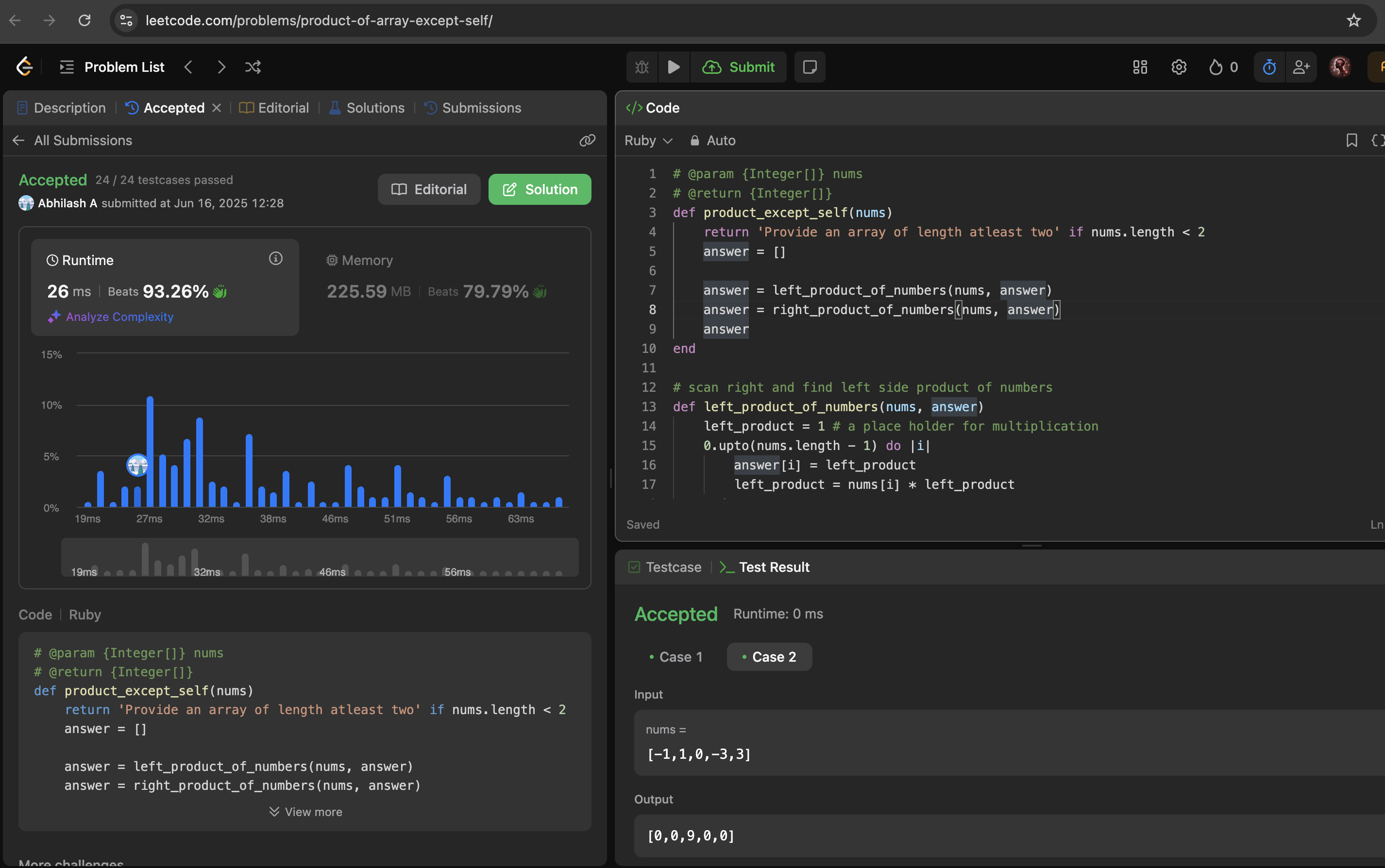
LeetCode Submission:

# @param {Integer[]} nums
# @return {Integer[]}
def product_except_self(nums)
    return 'Provide an array of length atleast two' if nums.length < 2
    answer = []

    answer = left_product_of_numbers(nums, answer)
    answer = right_product_of_numbers(nums, answer)
    answer
end

# scan right and find left side product of numbers 
def left_product_of_numbers(nums, answer)
    left_product = 1 # a place holder for multiplication
    0.upto(nums.length - 1) do |i|
        answer[i] = left_product
        left_product = nums[i] * left_product
    end
    answer
end

# scan left and find right side product of numbers 
def right_product_of_numbers(nums, answer)
    right_product = 1 # a place holder for multiplication
    (nums.length - 1).downto(0) do |i|
        answer[i] = answer[i] * right_product
        right_product = nums[i] * right_product
    end
    answer
end

The Problem: https://leetcode.com/problems/product-of-array-except-self/description/

The Solution: https://leetcode.com/problems/product-of-array-except-self/description/?submissionId=xxxxxx

https://leetcode.com/problems/product-of-array-except-self/submissions/xxxxxxxx/

Happy Algo Coding! 🚀

🏃‍♂️ Solving LeetCode Problems the TDD Way (Test-First Ruby): Contains Duplicate

Welcome to my new series where I combine the power of Ruby with the discipline of Test-Driven Development (TDD) to tackle popular algorithm problems from LeetCode! 🧑‍💻💎 Whether you’re a Ruby enthusiast looking to sharpen your problem-solving skills, or a developer curious about how TDD can transform the way you approach coding challenges, you’re in the right place.

🎲 Episode 3: Contains Duplicate

# Given an integer array nums, return true if any value appears # at least twice in the array, and return false if every element # is distinct.

Example 1:
Input: nums = [1,2,3,1]
Output: true

Explanation:
The element 1 occurs at the indices 0 and 3.

Example 2:
Input: nums = [1,2,3,4]
Output: false

Explanation:
All elements are distinct.

Example 3:
Input: nums = [1,1,1,3,3,4,3,2,4,2]
Output: true

Constraints:
1 <= nums.length <= 105
-109 <= nums[i] <= 109

🔧 Setting up the TDD environment

Create files and folder

mkdir array_duplicate
touch array_duplicate.rb
touch test_array_duplicate.rb
# frozen_string_literal: true
 
require 'minitest/autorun'
require_relative 'buy_sell'
#####################
##
#####################
# frozen_string_literal: true

#####################

❌ Red: Writing the failing test

# frozen_string_literal: true

require 'minitest/autorun'
require_relative 'array_duplicate'
######################################
#
#
#
######################################
class TestArrayDuplicate < Minitest::Test
  def setup
    ####
  end

  def test_array_with_length_one
    assert_equal false, Duplicate.new([]).present?
  end
end

✗ ruby array_duplicate/test_array_duplicate.rb
Run options: --seed 27633

# Running:
E
Finished in 0.000491s, 2036.6599 runs/s, 0.0000 assertions/s.
  1) Error:
TestArrayDuplicate#test_array_with_length_one:
NameError: uninitialized constant TestArrayDuplicate::Duplicate
    array_duplicate/test_array_duplicate.rb:16:in 'TestArrayDuplicate#test_array_with_length_one'

1 runs, 0 assertions, 0 failures, 1 errors, 0 skips

✅ Green: Making it pass

# Pass ✅
# frozen_string_literal: true

#############################
#
# Given an integer array nums, return true if any value appears at least twice in the array,
# and return false if every element is distinct.

# Example 1:
# .......
#############################
class Duplicate
  def initialize(nums)
    @numbers = nums
  end

  def present?
    'Provide a non-empty array' if @numbers.empty?
  end
end

…………………………………………………. …………………………………………………………..

Writing the Second Test Case:

# frozen_string_literal: true

require 'minitest/autorun'
require_relative 'array_duplicate'
######################################
# Given an integer array nums, return true if any value appears at least twice in the array,
# and return false if every element is distinct.
#
# Example 1:
# Input: nums = [1,2,3,1]
# Output: true
#
# Example 2:
# Input: nums = [1,2,3,4]
# Output: false
#
######################################
class TestArrayDuplicate < Minitest::Test
  def setup
    ####
  end

  def test_empty_array
    assert_equal 'Provide a non-empty array', Duplicate.new([]).present?
  end

  def test_array_with_length_one
    assert_equal false, Duplicate.new([2]).present?
  end

  def test_array_with_length_two
    assert_equal false, Duplicate.new([1, 2]).present?
    assert_equal true, Duplicate.new([2, 2]).present?
  end
end

# Solution 1 ✅
# frozen_string_literal: true

#############################
#
# Given an integer array nums, return true if any value appears at least twice in the array,
# and return false if every element is distinct.

# Example 1:
# ........
#############################
class Duplicate
  def initialize(nums)
    @numbers = nums
  end

  def present?
    return 'Provide a non-empty array' if @numbers.empty?

    count_hash = {}
    @numbers.each do |number|
      count_hash[number] ? count_hash[number] += 1 : count_hash[number] = 1
    end

    count_hash.values.max > 1
  end
end

⏳ Finding the Time Complexity

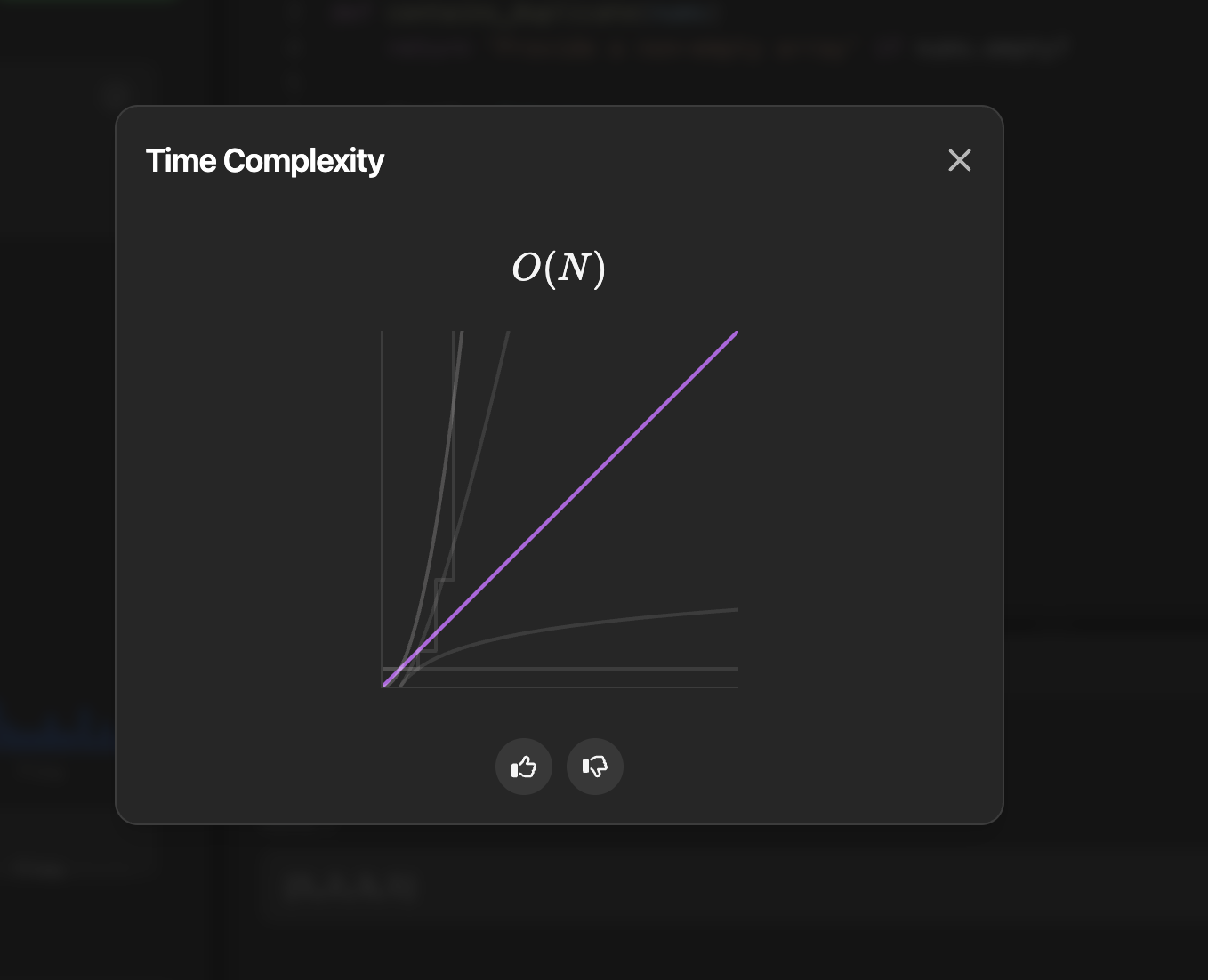
Time Complexity: O(n)
  • You iterate through the array once: @numbers.each do |number| → O(n)
  • Hash operations (lookup and assignment) are O(1) on average
  • count_hash.values.max → O(n) to get all values and find max
  • Total: O(n) + O(n) = O(n)
Space Complexity: O(n)
  • In worst case (all elements are unique), you store n key-value pairs in count_hash
  • Total: O(n)

♻️ Refactor: Optimizing the solution

# Solution 2 ✅
# frozen_string_literal: true

#############################
#
# Given an integer array nums, return true if any value appears at least twice in the array,
# and return false if every element is distinct.

# Example 1:
# .....
#############################
class Duplicate
  def initialize(nums)
    @numbers = nums
  end

  def present?
    return 'Provide a non-empty array' if @numbers.empty?

    count_hash = {}
    @numbers.each do |number|
      count_hash[number] ? count_hash[number] += 1 : count_hash[number] = 1

      return true if count_hash[number] > 1
    end

    false
  end
end

♻️ Refactor: Try to refactor the solution again

# Solution 3 ✅
# frozen_string_literal: true

#############################
#
# Given an integer array nums, return true if any value appears at least twice in the array,
# and return false if every element is distinct.

# Example 1:
# Input: nums = [1,2,3,1]
# .......
#############################
class Duplicate
  def initialize(nums)
    @numbers = nums
  end

  def present?
    return 'Provide a non-empty array' if @numbers.empty?

    found = {}
    @numbers.each do |number|
      return true if found[number]

      found[number] = true
    end

    false
  end
end

♻️ Refactor: Use Ruby Set – best approach

# Solution 4 ✅
# frozen_string_literal: true

#############################
#
# Given an integer array nums, return true if any value appears at least twice in the array,
# and return false if every element is distinct.

# Example 1:
# Input: nums = [1,2,3,1]
# ........
#############################
class Duplicate
  def initialize(nums)
    @numbers = nums
  end

  def present?
    return 'Provide a non-empty array' if @numbers.empty?

    found = Set.new
    @numbers.each do |number|
      return true if found.include?(number)

      found.add(number)
    end

    false
  end
end

Set vs Hash for Duplicate Detection

Set Approach:
seen = Set.new
@numbers.each do |number|
  return true if seen.include?(number)
  seen.add(number)
end
Hash Approach:
seen = {}
@numbers.each do |number|
  return true if seen[number]
  seen[number] = true
end

Why Set is Better for This Use Case:

1. Semantic Clarity
  • Set: Designed specifically for storing unique elements
  • Hash: Designed for key-value mappings
  • Since we only care about “have I seen this number?”, Set is semantically correct
2. Memory Efficiency
  • Set: Only stores the key (the number)
  • Hash: Stores both key AND value (number + true/false)
  • Set uses less memory per element
3. Intent is Clearer
# Set - clearly shows we're tracking unique elements
seen.add(number)
seen.include?(number)

# Hash - less clear why we're setting values to true
seen[number] = true
seen[number]  # relies on truthy/falsy behavior
4. Performance

Both have O(1) average lookup time, but:

  • Set operations are optimized for membership testing
  • Hash has slight overhead for value storage

When to Use Each:

Use Set when:
  • You only need to track “presence” or “membership”
  • You want to store unique elements
  • You don’t need associated values
  • This duplicate detection problem ✅
Use Hash when:
  • You need to store key-value pairs
  • You need to count occurrences
  • You need to associate data with keys
  • Example: {number => count} for frequency counting
Alternative Hash Approach (Still Valid):

If you prefer Hash, this is also perfectly fine:

seen = {}
@numbers.each do |number|
  return true if seen.key?(number)  # More explicit than seen[number]
  seen[number] = true
end

Bottom Line:

Both work correctly with the same time/space complexity, but Set is the better choice because:

  1. It’s semantically correct for the problem
  2. Uses less memory
  3. Makes the code’s intent clearer
  4. Is specifically designed for this use case

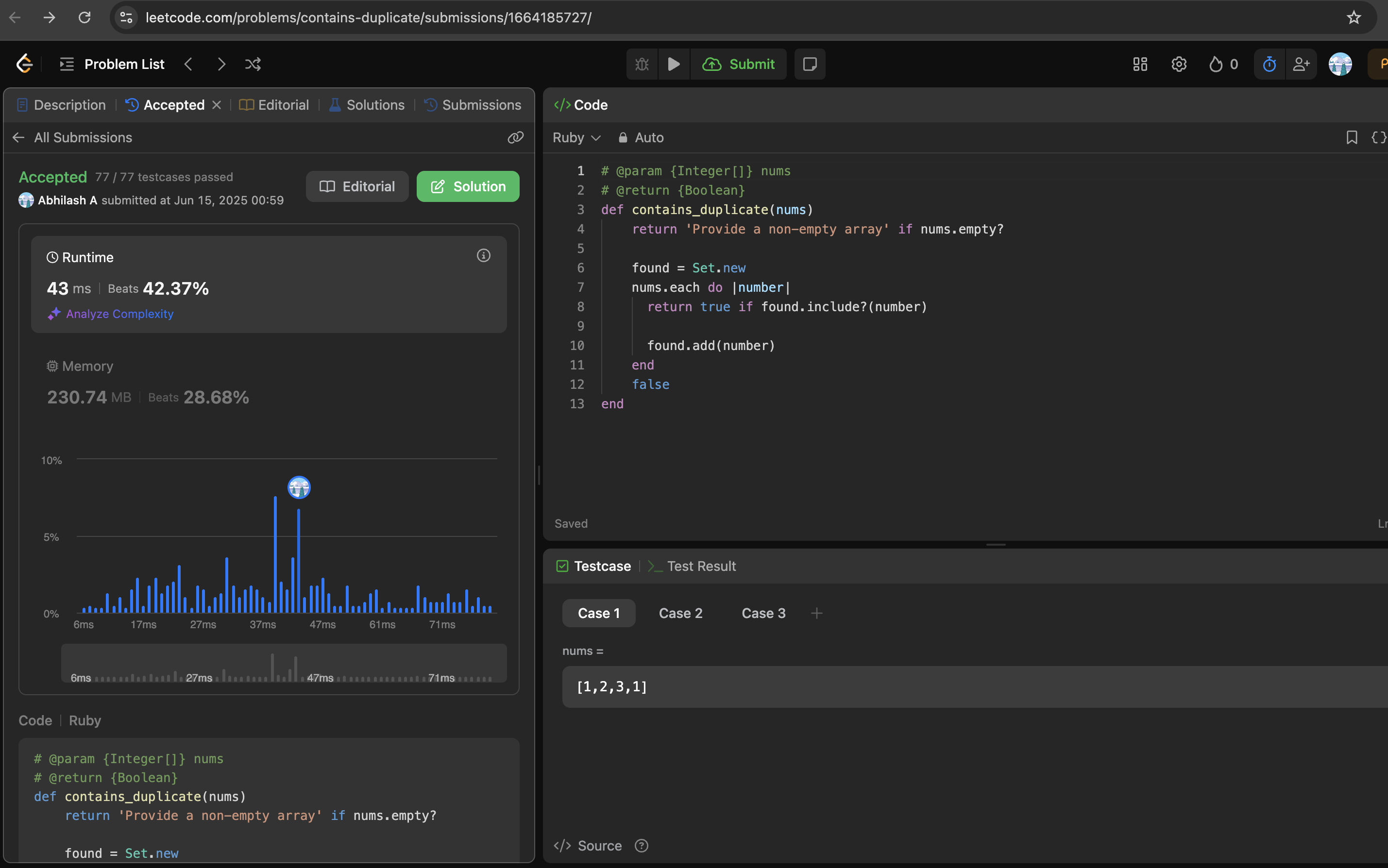
The Problem: https://leetcode.com/problems/contains-duplicate/description/

The Solution: https://leetcode.com/problems/contains-duplicate/post-solution/?submissionId=1664185727

https://leetcode.com/problems/contains-duplicate/submissions/1664185727/

Happy Algo Coding! 🚀