
Software development methodologies provide structured approaches to planning, managing, and executing software projects. Among these, the Waterfall model stands as one of the most traditional and well-known methodologies. In this comprehensive guide, I’ll explain software development methodologies in general and then focus specifically on the Waterfall model, including its phases, advantages, disadvantages, and practical examples.
Understanding Software Development Methodologies
Software development methodologies are frameworks used to structure, plan, and control the process of developing information systems. They define project steps, roles, responsibilities, activities, communication standards, and deliverables . The diversity in methodologies allows organizations to choose approaches that align with their specific needs and project requirements .
Methodologies can be broadly categorized into:
- Sequential/Plan-driven methodologies (like Waterfall)
- Agile methodologies (like Scrum, Kanban)
- Hybrid approaches (combining elements of both)
The choice of methodology depends on factors like project size, complexity, requirement stability, team size, and organizational culture .
The Waterfall Model: A Sequential Approach
The Waterfall model is the most classic and sequential method of software development, developed in 1970 . It follows a linear workflow where the development process is divided into distinct phases that must be completed sequentially, much like a waterfall flowing downward through several stages .
Waterfall Model Phases
- Requirements Analysis: Gathering and documenting all system requirements
- System Design: Creating architectural and detailed designs
- Implementation: Writing the actual code
- Testing: Verifying the system against requirements
- Deployment: Releasing the product to users
- Maintenance: Fixing issues and making updates
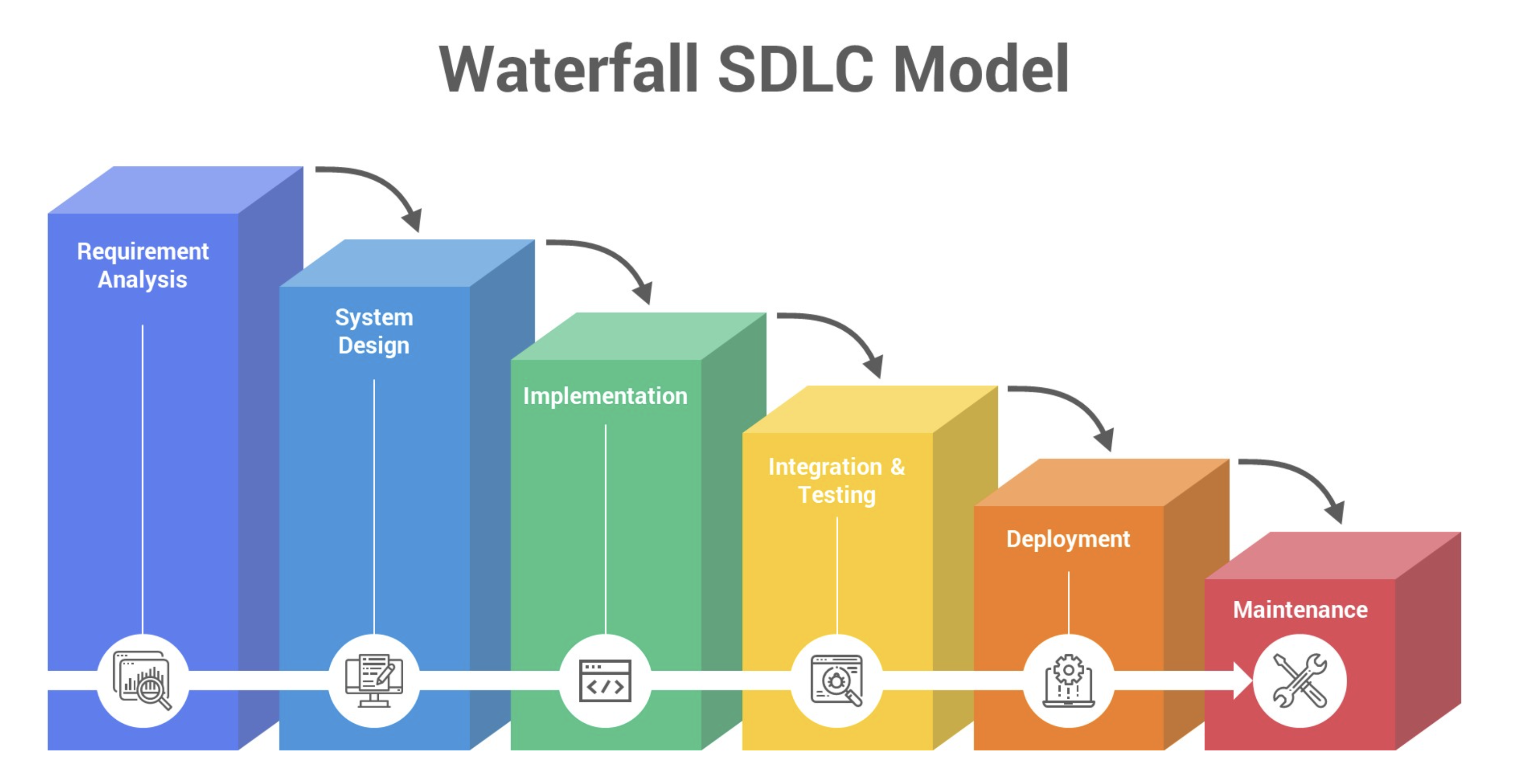
Diagram: Sequential phases of the Waterfall model
Key Characteristics of Waterfall
- Linear and sequential: Each phase must be completed before the next begins
- Document-heavy: Extensive documentation is produced at each stage
- Fixed requirements: Requirements are frozen after the initial phase
- Limited customer involvement: Mainly at the beginning (requirements) and end (testing)
Advantages of Waterfall
- Simple and easy to understand: Its linear nature makes it accessible, especially for beginners
- Clear milestones and deliverables: Each phase has defined outputs
- Good for stable requirements: Works well when requirements are well-understood upfront
- Easier to manage: Due to its structured nature
- Comprehensive documentation: Helps in maintenance and future updates
Disadvantages of Waterfall
- Inflexible to changes: Difficult to accommodate changing requirements
- Late testing: Testing occurs only after implementation is complete
- Delayed working software: No working product until late in the cycle
- High risk: Errors in requirements may not be discovered until late
- Limited customer feedback: Customers don’t see the product until it’s nearly complete
When to Use Waterfall
The Waterfall model is suitable for:
- Projects with well-defined, unchanging requirements
- Small to medium-sized projects
- Projects where technology is well-understood
- Situations where timeline and budget control is critical
- Projects with predictable outcomes
- Teams with inexperienced developers
Real-World Example: Building a Bridge
The Waterfall model works well for projects like bridge construction:
- Requirements: Determine load capacity, length, materials needed
- Design: Create blueprints and engineering plans
- Implementation: Actually construct the bridge
- Testing: Stress-test the completed bridge
- Deployment: Open the bridge to traffic
- Maintenance: Regular inspections and repairs
Just as you wouldn’t change bridge specifications midway through construction, Waterfall works best when requirements are fixed early on.
Variations of Waterfall
- V-Model: An extension that emphasizes testing in parallel with development
- Sashimi Model: Allows some overlap between phases
Comparison with Other Methodologies
Unlike Agile methodologies which embrace change, Waterfall assumes requirements can be fully defined upfront . While Agile is like jazz (improvisational), Waterfall is like classical music (precisely planned) .
Conclusion
The Waterfall model remains relevant for certain types of projects despite the popularity of Agile approaches. Its structured, document-driven approach works best when requirements are stable and well-understood. However, for projects with evolving requirements or needing frequent customer feedback, more flexible methodologies like Agile may be more appropriate.
Understanding the strengths and limitations of Waterfall helps teams select the right methodology for their specific project needs, balancing structure with flexibility as required.
Stay tuned! 🚀

 The Rails Drop