
𝐐) Why is Layering an Application Important in a Project?
Layering an application is a fundamental architectural principle where the codebase is divided into logical layers, each with a clear responsibility. This approach brings several benefits during the execution of a project:
1. Separation of Concerns (SoC)
- Each layer handles a specific responsibility:
- UI/Presentation Layer: Handles user interaction
- Business Logic Layer: Implements application rules
- Data Access Layer: Manages data storage and retrieval
✅ This makes the codebase easier to reason about and reduces interdependency.
2. Maintainability
- You can update or refactor one layer (e.g., switch databases or UI frameworks) without deeply affecting the others.
✅ Makes the system easier to modify and debug over time.
3. Testability
- Layers make unit testing and integration testing cleaner.
- You can test business logic without hitting the database or UI.
4. Scalability
- Different layers can scale independently.
- Example: You might scale out your API layer separately from your database layer.
✅ Allows for horizontal scaling and performance tuning.
- Example: You might scale out your API layer separately from your database layer.
5. Reusability
- Code in a layered architecture (like service or domain logic) can be reused across different contexts (e.g., web, mobile, CLI)
✅ Promotes DRY (Don’t Repeat Yourself) principles.
6. Security and Access Control
- Sensitive operations can be isolated in backend or service layers, reducing risk of direct access from external sources.
7. Team Collaboration
- Teams can work in parallel on different layers:
- Frontend team builds the UI layer
- Backend team develops business logic and APIs
✅ Leads to faster development cycles
Great! Here’s a diagram + real-world example of a layered architecture using a Ruby on Rails backend and a React frontend, typical for a full-stack application.
🎯 Example: Layered Architecture for an E-Commerce System
We’ll use a basic feature: placing an order.
🧱 Layered Architecture (Concept Diagram)
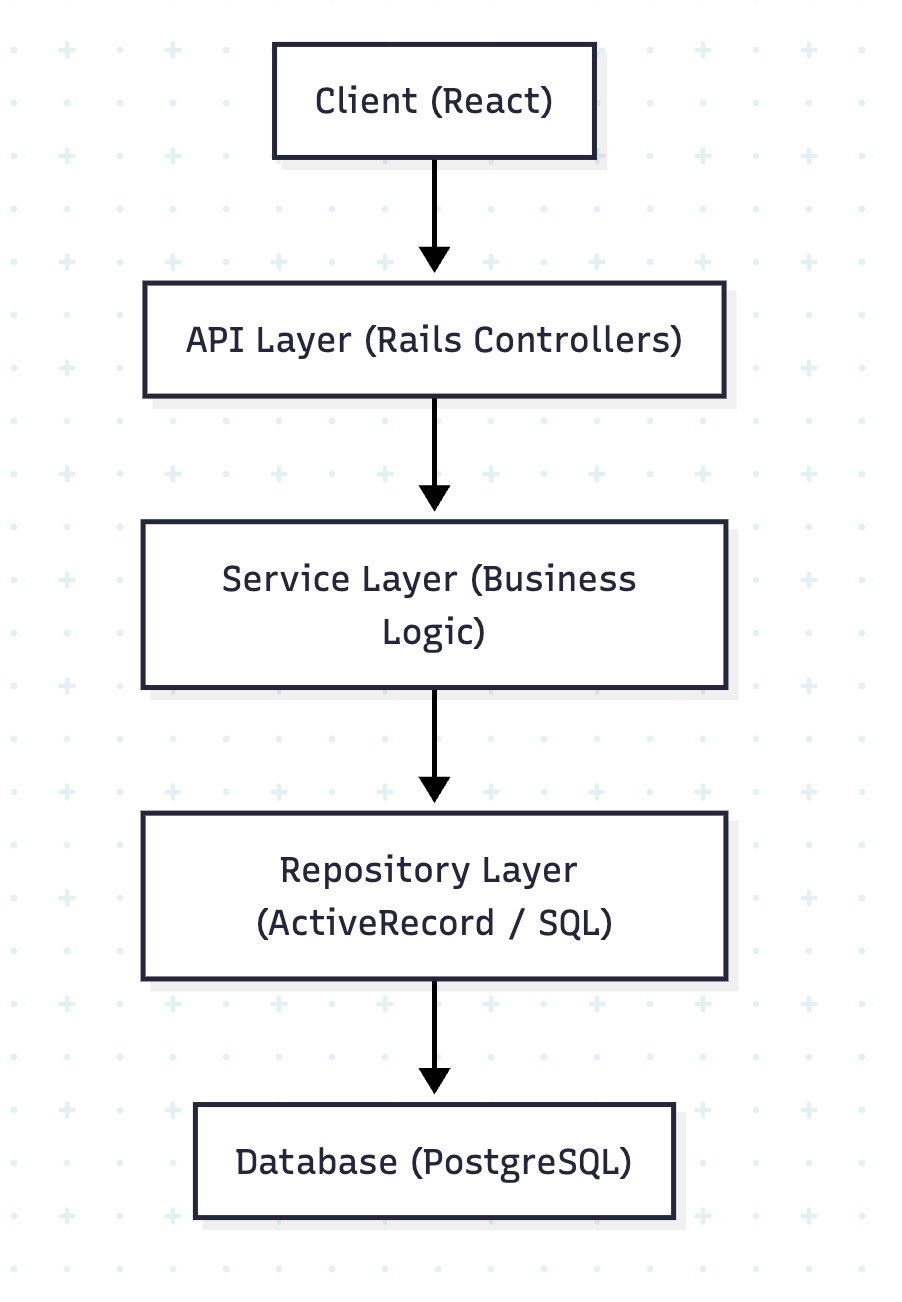
💡 Layer Descriptions
| Layer | Role | Tech/Tool |
|---|---|---|
| Client Layer | UI & User Interaction | React, Redux |
| API Layer | Receives requests, validates input, returns JSON | Rails Controllers |
| Service Layer | Core business logic (e.g., payment, inventory, discount rules) | Plain Ruby classes |
| Repository Layer | Data access, querying, persistence | ActiveRecord, SQL |
| Database Layer | Stores persistent data | PostgreSQL, Redis, etc. |
📦 Rails Example (Placing an Order)
1. React (Client Layer)
// POST /api/v1/orders
axios.post('/api/v1/orders', {
  product_id: 101,
  quantity: 2
});
2. Rails Controller (API Layer)
# app/controllers/orders_controller.rb
def create
  result = OrderService.new(params).place_order
  if result.success?
    render json: result.order, status: :created
  else
    render json: { error: result.error }, status: :unprocessable_entity
  end
end
3. Service Layer (Business Logic)
# app/services/order_service.rb
class OrderService
  def initialize(params)
    @params = params
  end

  def place_order
    product = Product.find(@params[:product_id])
    return OpenStruct.new(success?: false, error: 'Out of stock') if product.stock < @params[:quantity]

    order = Order.create!(product_id: product.id, quantity: @params[:quantity])
    product.decrement!(:stock, @params[:quantity])
    OpenStruct.new(success?: true, order: order)
  end
end
4. Repository Layer (Handled via ActiveRecord)
# ActiveRecord abstracts DB operations
Product.find(id)
Order.create!(...)
✅ Benefits in Action
- 🔍 Separation: Business logic is not tied to the controller.
- 🧪 Testable: You can test
OrderServicewithout hitting the API. - ♻️ Reusable: Service can be reused by background jobs or APIs.
- 🔧 Flexible: You can switch from React to React Native without changing the backend.
- Download pdf of this Architecture:
📌 Conclusion
Layering is important not just for writing clean code but also for building scalable, testable, and maintainable software systems. It provides clear boundaries, enhances agility, and allows teams to deliver high-quality features with confidence.

 The Rails Drop
One thought on “Software Architect Guide: Layering An Application”