
Welcome to my new series where I combine the power of Ruby with the discipline of Test-Driven Development (TDD) to tackle popular algorithm problems from LeetCode! 🧑💻💎 Whether you’re a Ruby enthusiast looking to sharpen your problem-solving skills, or a developer curious about how TDD can transform the way you approach coding challenges, you’re in the right place.
🎲 Episode 2: Best Time to Buy and Sell Stock
###############################################
#   Problem 2: Best Time to Buy and Sell Stock
###############################################

You are given an array prices where prices[i] is the price of a given stock on the ith day.

You want to maximize your profit by choosing a single day to buy one stock and choosing a different day in the future to sell that stock.

Return the maximum profit you can achieve from this transaction. If you cannot achieve any profit, return 0.


Example 1:

Input: prices = [7,1,5,3,6,4]
Output: 5
Explanation: Buy on day 2 (price = 1) and sell on day 5 (price = 6), profit = 6-1 = 5.
Note that buying on day 2 and selling on day 1 is not allowed because you must buy before you sell.
Example 2:

Input: prices = [7,6,4,3,1]
Output: 0
Explanation: In this case, no transactions are done and the max profit = 0.


Constraints:

1 <= prices.length <= 105
0 <= prices[i] <= 104
🔧 Setting up the TDD environment
Create files and folder
mkdir buy_sell_stock
touch buy_sell.rb
touch test_buy_sell.rb
# frozen_string_literal: true

require 'minitest/autorun'
require_relative 'buy_sell'
#####################
##
#####################
class TestBuySell < Minitest::Test
  def setup
  end

  # ex: []
  def test_array_is_an_empty_array
  end
end
########################
# @param {Integer[]} prices
# @return {Integer}
# Ex: max_profit([])
def max_profit
end
❌ Red: Writing the failing test
# frozen_string_literal: true

# ❌ first failing test case
require 'minitest/autorun'
#####################
##
#####################
class TestBuySell < Minitest::Test
  def setup
    ####
  end

  # ex: []
  def test_array_is_an_empty_array
    assert_equal 'Provide an array of two or more elements', []
  end
end
 ✗ ruby buy_sell_stock/test_buy_sell.rb
Run options: --seed 46112

# Running:
E
Finished in 0.000438s, 2283.1050 runs/s, 0.0000 assertions/s.

  1) Error:
TestBuySellStock#test_array_is_an_empty_array:
NameError: uninitialized constant TestBuySellStock::BuySellStock
    buy_sell_stock/test_buy_sell.rb:19:in 'TestBuySellStock#test_array_is_an_empty_array'

1 runs, 0 assertions, 0 failures, 1 errors, 0 skips
✅ Green: Making it pass
########################
# @param {Integer[]} prices
# @return {Integer}
# Ex: max_profit([])
def max_profit
    'Provide an array of two or more elements' if @prices.empty?
end
…………………………………………………. ⤵ …………………………………………………………..
Writing the Second Test Case:
# frozen_string_literal: true

# ❌ second failing test case
require 'minitest/autorun'
#####################
##
#####################
class TestBuySell < Minitest::Test
  def setup
    ####
  end

  # ex: []
  def test_array_is_an_empty_array
    assert_equal 'Provide an array of two or more elements', []
  end

  def test_array_with_length_one
    assert_equal 'Provide an array of two or more elements', [1]
  end
end
########################
# @param {Integer[]} prices
# @return {Integer}
# Ex: BuySellStock.new([2,8]).max_profit
def max_profit
    'Provide an array of two or more elements' if @prices.length < 2
end
…………………………………………………. ⤵ …………………………………………………………..
Writing the Third, Fourth Test Case:
# frozen_string_literal: true

require 'minitest/autorun'
require_relative 'buy_sell'
#####################
##
#####################
class TestBuySellStock < Minitest::Test
  def setup
    ####
  end

  def create_array(length)
    Array.new(length) { rand(1..100) }
  end

  # ex: BuySellStock.new([]).max_profit
  def test_array_is_an_empty_array
    assert_equal 'Provide an array of two or more elements', BuySellStock.new([]).max_profit
  end

  def test_array_with_length_one
    assert_equal 'Provide an array of two or more elements', BuySellStock.new([1]).max_profit
  end

  def test_array_with_length_two
    assert_equal 2, BuySellStock.new([1, 3]).max_profit
    assert_equal 0, BuySellStock.new([5, 3]).max_profit
  end

  def test_array_with_length_three
    assert_equal 5, BuySellStock.new([1, 3, 6]).max_profit
    assert_equal 0, BuySellStock.new([5, 3, 2]).max_profit
  end
end
Solution 1 ✅
########################
# @param {Integer[]} prices
# @return {Integer}
# Ex: BuySellStock.new([2,8]).max_profit
########################
class BuySellStock
  def initialize(prices)
    @prices = prices
    @profit_store = {}
  end

  def max_profit
    return 'Provide an array of two or more elements' if @prices.length < 2

    # iterate today's price
    @prices.each_with_index do |todays_price, index|
      # check profit with future prices
      @prices[(index + 1)..].each do |future_price|
        profit = future_price - todays_price
        update_profit_store(index, profit) if profit.positive?
      end
    end

    @profit_store.values.max || 0
  end

  def update_profit_store(index, profit)
    @profit_store[index] = 0 unless @profit_store[index]

    @profit_store[index] = profit if profit > @profit_store[index]
  end
end
⏳ Finding the Time Complexity
Let me analyze the time complexity of your algorithm in buy_sell.rb.
Looking at our code, there are two nested loops:
- The outer loop iterates through each price in the array using
each_with_index - The inner loop iterates through all future prices using
@prices[(index + 1)..]
For an array of length n:
- The outer loop runs n times
- For each iteration of the outer loop, the inner loop runs (n-1), (n-2), (n-3), …, 1 times
This creates a pattern of:
- First iteration: n-1 comparisons
- Second iteration: n-2 comparisons
- Third iteration: n-3 comparisons
- And so on…
This is equivalent to the sum of the first (n-1) natural numbers:
(n-1) + (n-2) + (n-3) + … + 1 = n(n-1)/2
Therefore, the time complexity is O(n²) or quadratic time complexity.
The space complexity is O(n) because:
- We store the
pricesarray: O(n) - We store the
profit_storehash which in worst case could store n-1 entries: O(n)
💡 Tip: To optimize this, we could use a single pass approach that keeps track of the minimum price seen so far and calculates the maximum profit in one iteration, which would give you O(n) time complexity.
♻️ Refactor: Optimizing the solution
Let’s optimize the algorithm step by step. Modify our code to achieve O(n) time complexity.
The key insight is that we only need to:
- Keep track of the minimum price we’ve seen so far
- For each price, calculate the potential profit if we sell at current price
- Update the maximum profit if current profit is higher
Here’s how we’ll modify your code:
Let me explain the optimization step by step:
- First, we remove the
@profit_storehash since we don’t need it anymore:
def initialize(prices)
  @prices = prices
end
- In the
max_profitmethod, we’ll use two variables:
min_price: to keep track of the lowest price we’ve seen so farmax_profit: to keep track of the maximum profit we can make
- The optimized algorithm snippet looks like this (Check: Final Solution ✅ at the bottom):
def max_profit
  return 'Provide an array of two or more elements' if @prices.length < 2

  min_price = @prices[0]  # Start with first price as minimum
  max_profit = 0          # Start with 0 profit

  @prices.each do |price|
    # Update min_price if current price is lower
    min_price = [min_price, price].min

    # Calculate potential profit
    potential_profit = price - min_price

    # Update max_profit if current profit is higher
    max_profit = [max_profit, potential_profit].max
  end

  max_profit
end
Let’s walk through how this works with the example [7,1,5,3,6,4]:
the optimized algorithm I described above works perfectly for this problem! Let me explain why:
The Problem Requirements:
- Choose a single day to buy one stock
- Choose a different day in the future to sell that stock
- Maximize profit from this transaction
- Return 0 if no profit is possible
How the Optimized Algorithm Satisfies These Requirements:
- Single buy/sell transaction: ✅ The algorithm finds the best single buy-sell pair
- Buy before sell: ✅ As we iterate through the array,
min_pricealways represents a price from a previous day (or current day), ensuring we buy before we sell - Maximize profit: ✅ We keep track of the maximum profit seen so far
- Return 0 if no profit: ✅ We initialize
max_profit = 0and only update it if we find a positive profit
Key Insight:
The algorithm works because at any given day, the maximum profit we can achieve by selling on that day is: current_price - minimum_price_seen_so_far
Since we process prices chronologically, the minimum price we’ve seen so far is always from a previous day (or the same day), which satisfies the “buy before sell” constraint.
- Start with
min_price = 7andmax_profit = 0
Example with [7,1,5,3,6,4]:
Day 0: price=7, min_price=7, profit=0
Day 1: price=1, min_price=1, profit=0
Day 2: price=5, min_price=1, profit=4 (buy day 1, sell day 2)
Day 3: price=3, min_price=1, profit=2 (buy day 1, sell day 3)
Day 4: price=6, min_price=1, profit=5 (buy day 1, sell day 4) ← Maximum
Day 5: price=4, min_price=1, profit=3 (buy day 1, sell day 5)
The algorithm correctly identifies buying on day 1 (price=1) and selling on day 4 (price=6) for maximum profit of 5.
The time complexity is now O(n) because:
- We only make a single pass through the array
- Each operation inside the loop is O(1)
- No nested loops
The space complexity is O(1) because:
- We only use two variables regardless of input size
- We don’t store any additional data structures
Your Current Algorithm vs Optimized:
- Your current O(n²) algorithm: Works correctly but inefficient
- Optimized O(n) algorithm: Works correctly and much more efficient
Both solve the same problem correctly, but the optimized version is significantly faster for large inputs.
♻️ Refactor: Try to find a solution below o(n^2) time complexity
# Solution 2 ✅ - Final Solution submitted
# frozen_string_literal: true

##########################################
#
# You are given an array prices where prices[i] is the price of a given stock on the ith day.
# You want to maximize your profit by choosing a single day to buy one stock and choosing a different day in the future to sell that stock.
# Return the maximum profit you can achieve from this transaction. If you cannot achieve any profit, return 0.
# Example 1:
# Input: prices = [7,1,5,3,6,4]
# Output: 5
# Explanation: Buy on day 2 (price = 1) and sell on day 5 (price = 6), profit = 6-1 = 5.
# Note that buying on day 2 and selling on day 1 is not allowed because you must buy before you sell.

# Example 2:
# Input: prices = [7,6,4,3,1]
# Output: 0
# Explanation: In this case, no transactions are done and the max profit = 0.
#
#  Constraints:
# 1 <= prices.length <= 105
# 0 <= prices[i] <= 104
##########################################
# @param {Integer[]} prices
# @return {Integer}
# Ex: BuySellStock.new([2,8]).max_profit
class BuySellStock
  def initialize(prices)
    @prices = prices
    @profit_store = {}
  end

  def max_profit
    return 'Provide an array with 1 or more elements' if @prices.empty?

    max_profit = 0 # Start with 0 profit
    return max_profit if @prices.length == 1

    lowest_price = @prices.first # assume lowest price is the first price
    @prices.each do |current_price|
      current_profit = current_price - lowest_price
      max_profit = current_profit  if current_profit > max_profit
      lowest_price = current_price if current_price < lowest_price
    end

    max_profit
  end
end
##########
# Solution 3 ✅ - For Reference by AI
# frozen_string_literal: true

##########################################
#
# You are given an array prices where prices[i] is the price of a given stock on the ith day.
# You want to maximize your profit by choosing a single day to buy one stock and choosing a different day in the future to sell that stock.
# Return the maximum profit you can achieve from this transaction. If you cannot achieve any profit, return 0.
# Example 1:
# Input: prices = [7,1,5,3,6,4]
# Output: 5
# Explanation: Buy on day 2 (price = 1) and sell on day 5 (price = 6), profit = 6-1 = 5.
# Note that buying on day 2 and selling on day 1 is not allowed because you must buy before you sell.

# Example 2:
# Input: prices = [7,6,4,3,1]
# Output: 0
# Explanation: In this case, no transactions are done and the max profit = 0.
#
#  Constraints:
# 1 <= prices.length <= 105
# 0 <= prices[i] <= 104
##########################################
# @param {Integer[]} prices
# @return {Integer}
# Ex: BuySellStock.new([2,8]).max_profit
class BuySellStock
  def initialize(prices)
    @prices = prices
    @profit_store = {}
  end

  def max_profit
    return 'Provide an array with 1 or more elements' if @prices.empty?

    max_profit = 0          # Start with 0 profit
    return max_profit       if @prices.length == 1

    min_price = @prices[0]  # Start with first price as minimum

    @prices.each do |price|
      # Update min_price if current price is lower
      min_price = [min_price, price].min

      # Calculate potential profit
      potential_profit = price - min_price

      # Update max_profit if current profit is higher
      max_profit = [max_profit, potential_profit].max
    end

    max_profit
  end
end
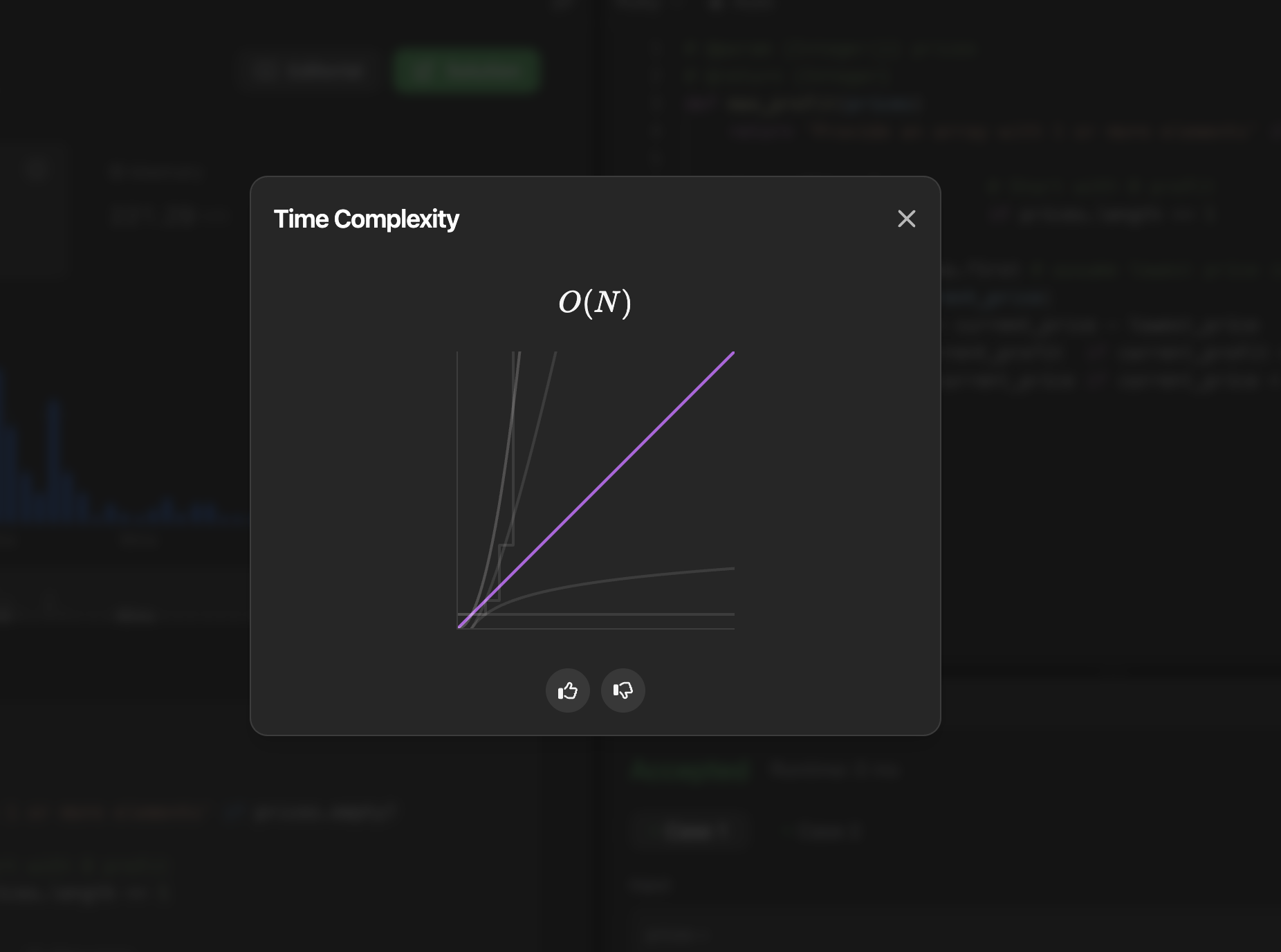
Time Complexity: O(n) ✅
About the time complexity being O(n). Here’s why:
- You have a single loop that iterates through the @prices array once: @prices.each do |current_price|
- Inside the loop, all operations are O(1):
- current_profit = current_price – lowest_price → O(1)
- max_profit = current_profit if current_profit > max_profit → O(1)
- lowest_price = current_price if current_price < lowest_price → O(1)
- No nested loops, no recursive calls
- Total: O(n)
Space Complexity: O(1) – Not O(n)
It’s actually O(1) constant space, not O(n). Here’s why:
Space used:
- max_profit variable → O(1)
- lowest_price variable → O(1)
- current_price (loop variable) → O(1)
- current_profit variable → O(1)
- The @prices array → This is input data, not additional space used by the algorithm
- @profit_store → You’re not using this anymore in the optimized version
Key Point: In space complexity analysis, we typically don’t count the input data itself. We only count the additional space the algorithm uses beyond the input. Since you’re only using a constant number of variables (4 variables) regardless of the input size, the space complexity is O(1).
Summary:
- Time Complexity: O(n) ✅
- Space Complexity: O(1) (not O(n))

…………………………………………………. ⤵ …………………………………………………………..
The Problem: https://leetcode.com/problems/best-time-to-buy-and-sell-stock/
The Solution: https://leetcode.com/problems/best-time-to-buy-and-sell-stock/submissions/1663843909/
Happy Algo Coding! 🚀

 The Rails Drop